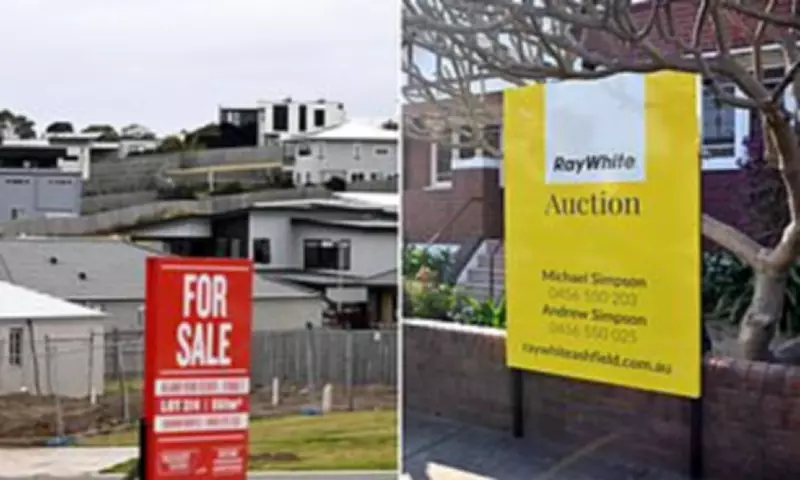
Australia's two largest housing markets have simultaneously recorded declines for the first time since the COVID-19 pandemic began, according to new data analysis. Research from Cotality reveals that property values in both Sydney and Melbourne have been decreasing since February, marking a significant shift in the nation's real estate landscape.
Market Divergence Across Capital Cities
The rolling daily index showed Sydney and Melbourne markets were down 0.04 percent as of Sunday, as reported by The Australian Financial Review. This downturn contrasts sharply with the continued growth observed across Australia's overall property market, where smaller capital cities are experiencing robust increases.
Expert Analysis of the Downturn
Cotality research director Tim Lawless stated unequivocally that the data indicates "Sydney and Melbourne are clearly in a downturn." He elaborated, "We've seen more than three months of housing values moving backwards, even though clearance rates haven't been at this lower level [for all of that time]."

Lawless provided historical context, noting, "If you go back historically, there's probably only around five times in the last 15 years where we've seen clearance rates holding this low and they all line up with housing market downturns."
Historical Parallels and Current Pressures
The most recent comparable downturns include:
- The beginning of the pandemic in 2020
- Credit tightening in 2018 and 2019
- Interest rate rises in 2011
Lawless attributed the current softening to multiple economic factors, stating that "the rise of interest rates since 2022 and the added stress of skyrocketing fuel prices was likely causing buyers to tighten their purse strings."
Regional Variations and Market Resilience
When balanced against the strong growth recorded in Brisbane, Perth, and Adelaide, the combined growth of all capital cities reached 0.3 percent. Growth outside of capital cities was even more pronounced at 0.9 percent, highlighting the geographical divergence within Australia's property sector.
Auction Market Indicators
This week recorded a preliminary clearance rate—the percentage of properties sold at auction—of just 58.9 percent. This marked the third consecutive week the figure remained below 60 percent, with 19 percent of auctions withdrawn from sale across all capital cities.
The withdrawal rate was particularly high in Sydney, where 26.7 percent of all sellers pulled their properties from auction. Despite this trend, some properties continued to perform exceptionally well, such as a large three-bedroom apartment in Botany that sold for $1.665 million, $65,000 above reserve.
Mixed Signals in Sydney's Market
BresicWhitney agent Brigitte Blackman described the Botany sale as a "fast auction" but noted the uneven nature of the current market, observing that some properties in the city are "not even getting any bids."
Ray White chief economist Nerida Conisbee offered a tempered perspective, confirming that while the Sydney and Melbourne markets had been slowing for several months, this was likely a temporary decline. She explained, "While conditions have softened slightly, they remain well-supported by underlying demand. As a result, they are unlikely to move into negative growth in the near term unless there is a more material deterioration in economic conditions."
Market Outlook and Seasonal Factors
Auction numbers are expected to decline further next week due to the Anzac Day public holiday, potentially providing a temporary pause in market activity. This seasonal adjustment may offer additional insights into the underlying strength of Australia's housing markets as they navigate current economic headwinds.
The simultaneous downturn in Sydney and Melbourne represents a notable development in Australia's post-pandemic economic recovery, highlighting how different regions are responding to interest rate pressures and broader economic conditions.