UK House Prices Climb £854 During Chancellor's Budget Month
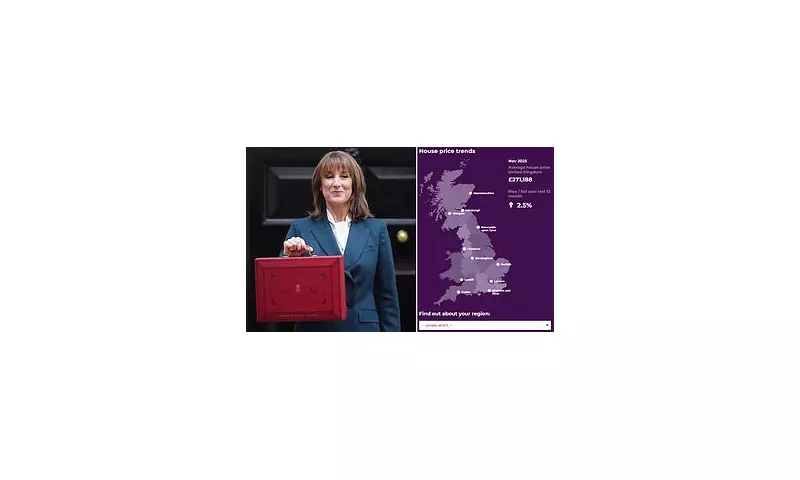
Average property values across the United Kingdom experienced a modest uplift of nearly £1,000 during the pivotal month of Chancellor Rachel Reeves's autumn Budget, according to fresh analysis released today. The Office for National Statistics (ONS) data reveals that the typical UK home increased in value by 0.3 per cent, rising from £270,334 in October to £271,188 for November 2025. This period coincided with the delivery of the government's key financial statement, highlighting a complex and regionally fragmented housing landscape.
Sharp Regional Divergence Defines Market Performance
While the national picture showed gentle growth, a detailed study by estate agent Purplebricks uncovers a stark tale of two markets. The analysis points to significant winners and losers, with geographical disparities becoming increasingly pronounced. The South East of England emerged as the hardest-hit region, with average property prices declining by 0.8 per cent over the month to settle at £381,369. This was followed by notable contractions in the East of England, where values fell 0.7 per cent to £338,286, and in Wales, which saw a 0.6 per cent drop to £208,935.
Northern Ireland and London Lead the Charge
In contrast, Northern Ireland delivered an exceptionally strong performance, recording a substantial monthly price surge of 4.3 per cent, pushing the average property value to £193,247. North East England also demonstrated robust growth, with a 1.8 per cent increase raising average prices to £166,568. London's market, often viewed as a bellwether, performed well despite pre-Budget uncertainties, with capital homes appreciating by 1.3 per cent to an average of £553,258.

Other regions posting positive monthly movements included:
- Yorkshire and the Humber: Up 1.2% to £209,236
- North West England: Up 0.9% to £216,741
- South West England: Up 0.8% to £306,045
- West Midlands: Up 0.3% to £248,653
- Scotland: Up 0.3% to £193,114
Overall, prices in England rose by 0.4 per cent to £293,131, underscoring the mixed performance within the nation's largest housing market.
Local Authority Hotspots and Cold Spots
The analysis delves deeper into local authority data, revealing dramatic micro-trends. The City of London was the standout monthly winner, with average property costs skyrocketing by £33,563 to reach £662,392. Kingston upon Thames in South West London followed, enjoying a rise of £19,541 to £582,206, while Mole Valley in Surrey saw prices increase by £14,981 to £558,220.
Conversely, several areas experienced significant depreciations. Four London boroughs were among the biggest losers, with the City of Westminster suffering the sharpest decline—a drop of £26,718 reduced the average property value to £866,170. Haringey, Camden, and Richmond upon Thames also recorded substantial monthly losses, alongside Windsor and Maidenhead in Berkshire and Stroud in Gloucestershire.
Annual Growth and Broader Economic Context
The ONS reported that annual UK house price inflation accelerated to 2.5 per cent in November, up from 1.9 per cent the previous month. Within England, the North East led annual growth with an impressive 6.8 per cent increase. This housing data arrives alongside other key economic indicators. The ONS also revealed that average monthly private rents rose by 4 per cent year-on-year to £1,368 in December, a slight deceleration from the previous month. Furthermore, wider Consumer Price Index (CPI) inflation edged up to 3.4 per cent in December, influenced by factors including tobacco duty and air fares.
Industry Outlook and Policy Implications
Commenting on the findings, Tom Evans, Sales Director at Purplebricks, struck an optimistic note for the year ahead. 'After a base rate cut to 3.75 per cent before Christmas and with more than two years to go before the so-called mansion tax kicks in, we're confident 2026 will be a positive year for growth,' he stated. Evans also highlighted potential benefits for first-time buyers, citing forthcoming Financial Conduct Authority plans to simplify mortgage rules.

The Chancellor's November Budget, her second, introduced a series of tax measures worth approximately £26 billion. Key policies included a freeze on income tax thresholds, a cap on salary sacrifice schemes, and the introduction of a 'high-value council tax surcharge'—often termed a 'mansion tax'—on English properties valued over £2 million. These fiscal decisions form the backdrop against which this nuanced monthly housing market activity has unfolded, setting the stage for the property sector's trajectory into 2026.