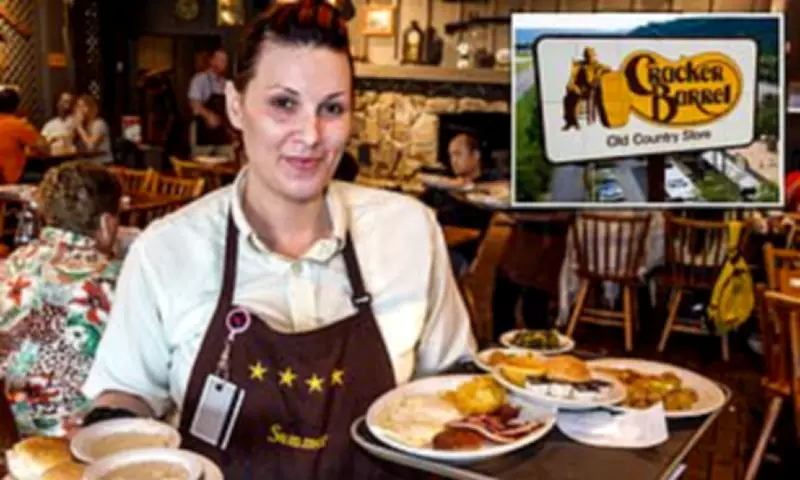
In a significant tightening of corporate travel rules, Cracker Barrel Old Country Store has mandated that employees must eat at its own restaurants for the majority of meals while on business trips. The struggling chain has also prohibited the expensing of alcohol without prior senior executive approval, as it continues to implement sweeping cost reductions following a botched rebranding effort that triggered customer backlash and substantial financial losses.
New Travel Directive Eliminates Dining Freedom
An internal company message, obtained by the Wall Street Journal, details the new policy which states that 'employees are expected to dine at a Cracker Barrel store for all or the majority of meals while traveling, whenever practical based on location and schedule.' This directive effectively removes one of the few remaining perks of corporate travel, forcing staff to consume the chain's signature meatloaf, country fried steak, and biscuits even when visiting cities abundant with alternative dining options.
The guidance explicitly bans reimbursement for alcoholic beverages, requiring employees to pay personally for any drinks unless special approval is granted by a member of the executive team. 'Exceptions for special occasions must be pre-approved by an E-Team member,' the internal document specifies, highlighting the stringent nature of the new regulations.

Broader Corporate Cost-Cutting Context
These strict measures emerge against a backdrop of layoffs, declining sales, and a painful consumer reaction to the company's recent rebranding initiative. The ill-fated attempt to modernize Cracker Barrel's image, which included removing the iconic Uncle Herschel mascot and introducing a minimalist logo, resulted in an estimated $94 million loss in market value within a single day and forced executives to publicly reverse course.
Internally, the new travel rules are perceived as part of a comprehensive effort to conserve every possible dollar after years of diminishing foot traffic and slowing revenue growth. Employees report that even their expense accounts are being 'modernized' in this austere direction, reflecting a corporate environment where financial scrutiny has intensified dramatically.
Wider Trend of Travel Policy Tightening
Cracker Barrel's approach aligns with a broader trend across corporate America, where companies are increasingly constraining travel policies as budgets contract. Employees nationwide are being instructed to seek budget hotels, prepare supermarket meals in their rooms, and avoid premium services entirely to reduce expenditure.
Justin Salerno, an engineer from the Milwaukee area, commented on this shift, noting that his new employer now requires adherence to federal reimbursement rates. 'I'm a bit loosey goosey about it,' Salerno told the Journal, acknowledging that comfort sometimes necessitates exceeding limits and providing justification afterwards.
Finance executive Jeff Oscarson highlighted extreme examples of expense-account creativity he has encountered, including attempts to claim $500 bottles of wine, pairs of jeans, and even a chair. 'Why would you do something to poke the bear by expensing a chair?' Oscarson remarked, recalling one particularly audacious submission.
Rebrand Fallout and Menu Controversies
The travel policy changes follow a series of operational missteps that have damaged the chain's reputation. Last August's rebrand was immediately condemned by MAGA influencers who labeled it 'woke,' with even Donald Trump publicly urging a return to the classic look. CEO Julie Felss Masino later admitted the backlash made her feel 'fired by America,' and the company ultimately scrapped major elements of the modernization plan.
Subsequent menu alterations exacerbated customer dissatisfaction, with regular patrons complaining about batch-made cookies replacing freshly rolled dough and sides like green beans being prepared in ovens rather than on stovetops. Some longtime diners began bringing their own maple syrup in protest, while online forums filled with accusations that the chain was abandoning its roots for corporate efficiency.

Cracker Barrel, which operates over 650 locations across the United States, has long marketed itself as a nostalgic refuge from modern corporate life, featuring rocking chairs on porches, peg games on tables, and walls adorned with Americana. The recent policies, however, suggest a stark internal focus on financial survival, even as the company publicly recommits to its traditional identity.