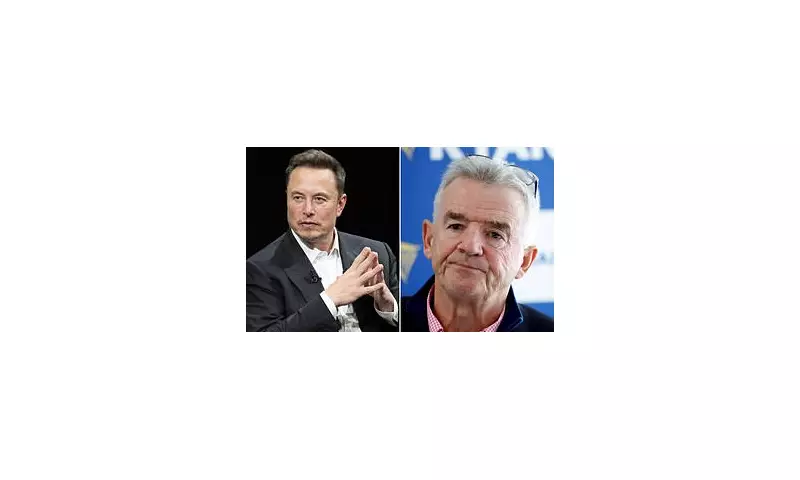
The aviation industry has been rocked by a spectacular public feud between two of the world's most outspoken business leaders. Michael O'Leary, the notoriously forthright chief executive of Ryanair, has delivered a blistering counter-attack against Elon Musk after the X-owning billionaire threatened a hostile takeover of the budget airline.
Musk's Provocative Poll and Firing Demand
The extraordinary confrontation escalated dramatically when Musk, responding to an official Ryanair social media post, declared that O'Leary "needs to be fired." The Tesla and SpaceX founder then escalated matters further by creating a poll asking his 232.5 million followers whether he should "Buy Ryan Air and restore Ryan as their rightful ruler." This provocative survey has already attracted nearly 900,000 responses, with 76.6 percent voting in favour of Musk pursuing the acquisition.
The Origins of the Conflict
The roots of this corporate clash trace back to January 14, when O'Leary publicly dismissed the idea of installing in-flight Wi-Fi across Ryanair's extensive fleet. The Irish airline boss expressed significant concerns about the practical implications, particularly regarding increased fuel consumption. "Fitting an antenna to the aircraft fuselage would add both weight and drag," O'Leary explained to Reuters, describing what he termed a "two per cent fuel penalty."

O'Leary elaborated on his reasoning during an interview with Newstalk, an Irish radio station, where he delivered his most direct criticism of Musk. "I would pay no attention whatsoever to Elon Musk," he stated bluntly. "He's an idiot. Very wealthy, but he's still an idiot. What Elon Musk knows about flights and drag would be zero."
Ryanair's Cost Concerns and Passenger Behaviour
The Ryanair chief executive provided detailed financial calculations to support his position. "We have to put an aerial antenna on top of the aircraft," he explained. "It would cost us about $200-250 million dollars a year, in other words, an extra dollar for every passenger we fly." O'Leary emphasised that Ryanair's business model and passenger expectations make such an investment impractical. "The reality for us is we can't afford those costs," he asserted. "Passengers won't pay for internet usage. If it's free, they'll use it, but they won't pay €1 each to use the internet. So we're not putting it on board."
Ryanair's Mocking Social Media Response
Ryanair's famously cheeky social media team entered the fray with characteristic irreverence. After Musk's initial criticism, the official Ryanair account posted: "Perhaps Musk needs a break?? Ryanair is launching a Great Idiots seat sale especially for Elon and any other idiots on 'X'." The airline's digital team further capitalised on a widespread X outage that left American users unable to access the platform, posting: "Perhaps you need Wi-Fi, @elonmusk?"
Market Valuations and Industry Context
The financial dimensions of this potential takeover scenario reveal significant disparities. Ryanair, listed on the Euronext index in Dublin, currently boasts a market capitalisation of approximately £26.5 billion. This valuation stands £8 billion below the £34.5 billion Musk paid for what was then called Twitter in 2022. The low-cost carrier expects to transport 207 million passengers during the current financial year, operating thousands of short- and medium-haul services across Europe, North Africa, and the Middle East.
Contrasting Approaches to In-Flight Connectivity
While Ryanair maintains its position against installing Wi-Fi, other major carriers are moving in the opposite direction. Emirates recently announced plans to upgrade its entire fleet with ultra-fast Starlink Wi-Fi, positioning itself as the world's largest international airline to offer the service network-wide. Since last November, passengers on select Emirates aircraft have enjoyed free, high-speed internet access at 40,000 feet, enabling streaming, video calls, gaming, and social media browsing with simple one-click access.
Starlink, developed by Musk's SpaceX, delivers high-speed internet through an extensive network of low-Earth orbit satellites. The first of Emirates' 232 Boeing 777 aircraft equipped with Starlink internet has already entered commercial service, with installations progressing at a rate of 14 aircraft per month across the carrier's fleet.

Historical Precedent and Musk's Acquisition Patterns
Industry observers note that while Musk's posts are widely interpreted as provocative rather than serious acquisition bids, his takeover of X began with a similarly unexpected offer after he accumulated a significant stake. This pattern adds an intriguing dimension to his Ryanair comments, though most analysts consider an actual takeover bid unlikely given the substantial financial commitment required.
The public spat represents more than just corporate bickering; it highlights fundamental differences in business philosophy between traditional aviation economics and tech-driven innovation. As O'Leary bluntly summarised his view of Musk's platform: "X is a cesspit." This remarkable corporate drama continues to unfold, capturing the attention of business observers and the travelling public alike.