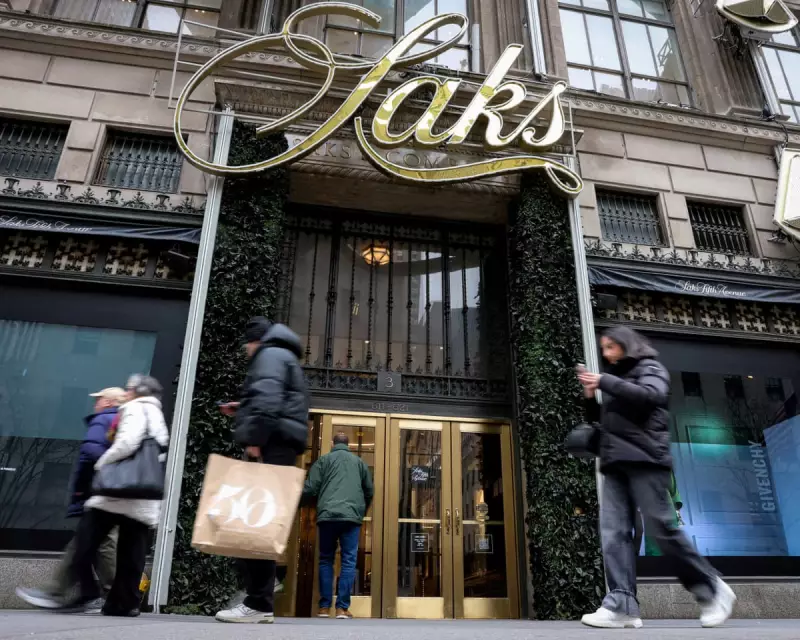
The glittering holiday light show at Saks Fifth Avenue's flagship New York store, a festive staple since 2004, went dark in 2024. This quiet omission foreshadowed a far more significant dimming of fortunes for the luxury retail behemoth. On Wednesday, Saks Global, the parent company formed just over a year ago to oversee Saks Fifth Avenue, Neiman Marcus, and Bergdorf Goodman, filed for Chapter 11 bankruptcy protection.
A Debt-Fuelled Gamble That Failed to Pay Off
The roots of the crisis lie in a bold, and many analysts now say reckless, acquisition. In 2023, Saks orchestrated a $2.7bn deal to purchase its historic rival, Neiman Marcus. To fund this move, the company took on a staggering $2.2bn in debt. At the time, Saks acknowledged a "challenging year for luxury" but expressed optimism about the future of the newly merged entity.
This optimism proved short-lived. The crushing debt load severely constrained the company's operations in an already difficult market for brick-and-mortar retailers. Neil Saunders, Managing Director at GlobalData Retail, noted, "As soon as you put debt into the equation in this kind of environment, it just crunches your ability to operate." This was particularly damaging for a department store model reliant on maintaining impeccable relationships with luxury vendors to stock its shelves.

Vendor Relations and Inventory Challenges
The financial strain quickly became apparent. Saks Global began struggling to pay its suppliers. Its bankruptcy petition lists major luxury houses, including Chanel and Kering (owner of Gucci), as creditors owed tens of millions of dollars. Analysts at S&P Global highlighted that Saks had faced "significant inventory challenges" for three years, a problem exacerbated after the Neiman Marcus deal.
By the second quarter of last year, dwindling stock translated into a 13% drop in revenue. The situation grew dire at the turn of the year with the abrupt departure of longtime CEO Marc Metrick and the emergence that the company had missed a critical multi-million-dollar interest payment on its loans at the end of 2025.
A Clash of Visions: Real Estate vs. Retail
Industry experts point to a fundamental conflict at the heart of Saks Global's strategy. For its executive leadership, notably Executive Chair Richard Baker, the company's value may have lain more in its prime real estate assets than in its retail brands. Baker, who is also CEO of Hudson's Bay Company and real estate firm NRDC Equity Partners, stepped down following the bankruptcy filing.
"Richard Baker is all about real estate," said Shelley Kohan, a former Saks executive and now a professor at the Fashion Institute of Technology. "He's not about retail. He's never been a retailer." She emphasised that a successful high-end department store requires a merchant leader with deep vendor connections, for whom product is paramount.
This stands in stark contrast to the approach of leaders like Macy's CEO Tony Spring, who is considered a "merchant" and has grown Bloomingdale's through a curated, smaller-footprint strategy—a path also taken by Nordstrom.
What Comes Next for the Luxury Giant?
The Chapter 11 filing is not an endpoint but a pivotal restructuring moment. Geoffroy van Raemdonck, the former Neiman Marcus CEO, has taken Baker's place and will lead the company through the process. Saks Global stated that van Raemdonck will appoint seasoned industry veterans from Neiman Marcus to join him.
The bankruptcy marks the third department store brand formerly under the Hudson's Bay umbrella to seek protection, following the liquidation of Lord & Taylor in 2020 and the Canadian Hudson's Bay stores last year.
Despite the profound challenges, there is belief in the potential for a revival. "The consumers are still out there," asserts Kohan, a firm believer in physical retail. She sees an opportunity for Saks to refocus its decisions through the lens of the customer experience. The path forward requires navigating its substantial debts while rediscovering the merchandising magic that once made it a retail icon.