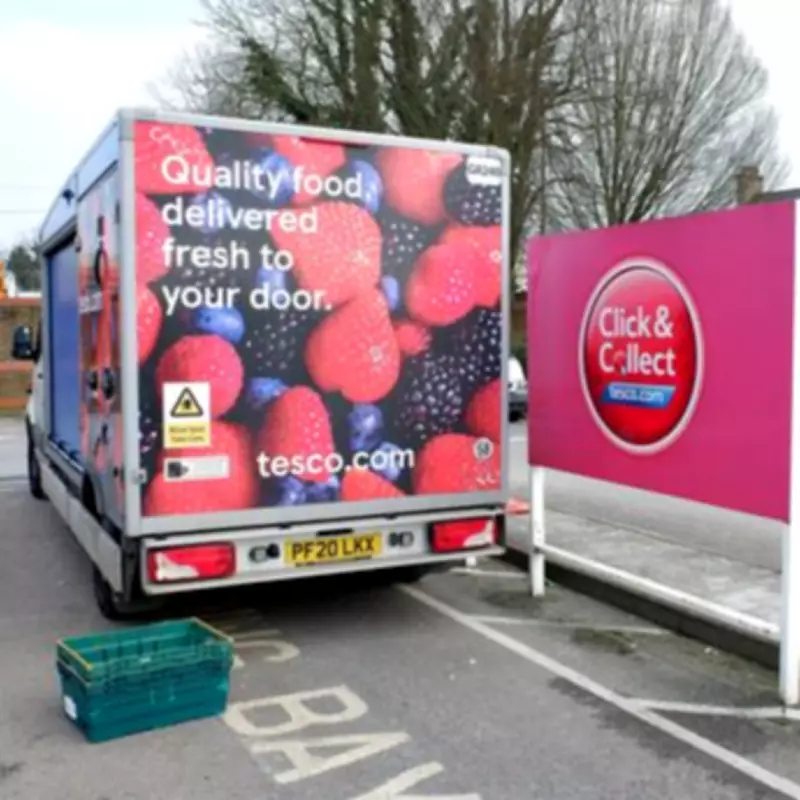
A viral social media revelation has left Tesco customers across the nation utterly perplexed, challenging long-held assumptions about the supermarket's home delivery protocol. The discovery centres on a simple action that can significantly streamline the process of receiving groceries.
The Delivery Dilemma That Sparked Mass Confusion
In an era where time-pressed households increasingly rely on supermarket home deliveries to avoid the weekly shop, one woman's approach to handling her Tesco order has ignited a firestorm of discussion. The service, which allows customers to select a one-hour delivery window and pay online in advance, has become a staple of modern British life, with the added convenience of order adjustments available until 11:45pm the night before delivery.
The Viral Moment That Changed Everything
Em, a 28-year-old beauty salon co-owner, uploaded a TikTok clip showing herself calmly carrying the distinctive blue Tesco delivery crate directly into her kitchen to unpack. Her caption, "the sheer panic of unpacking your Tesco delivery whilst the driver waits at the door," resonated with thousands, but it was her method that truly captured attention.

The video, which has amassed over half a million views, prompted an avalanche of comments from viewers who had never considered this approach. Many expressed genuine astonishment, questioning whether bringing the crates indoors was even permitted by Tesco's delivery policy.
Shopper Reactions Reveal Widespread Uncertainty
The comment section became a forum for shared bewilderment, with numerous shoppers revealing their own delivery routines:
- "I didn't know you could bring the crates in, I've been unloading it at my front door," confessed one viewer.
- Another admitted: "Is it just me that tips it on the floor?"
- A third commented: "Literally never occurred to me to bring crates inside, and now I understand why deliveries take forever with other people."
These reactions highlight how ingrained certain behaviours become, even when simpler alternatives exist. The assumption that crates must remain at the doorstep appears to have been widespread among Tesco's delivery customers.
Delivery Drivers Weigh In With Reassurance
Tesco delivery drivers quickly joined the conversation, offering clarification and reassurance to anxious customers. Their comments revealed a more relaxed reality than many shoppers had imagined:
- "Tesco delivery driver here, there's no need to rush, most of the time we're early. The majority of the time we're only late due to things out of our control," explained one driver.
- Another added: "Chances are we're early anyways no need to panic as it only makes us feel bad too. We get as much time per delivery as that individual delivery takes, so take the time you need... we do draw the line at putting it away whilst we wait."
- The same driver continued: "Personally I'm also always happy to help if it makes you feel better but we never mind waiting."
This insider perspective suggests that the perceived pressure to unpack quickly at the door may be largely self-imposed, with drivers generally accommodating reasonable unpacking times.
The Broader Implications for Delivery Culture
This viral moment has exposed a fascinating gap between customer assumptions and delivery reality. While Tesco's official policy regarding crate handling remains unspecified in the public discussion, the drivers' responses indicate significant flexibility in practice.
The episode serves as a reminder that sometimes the simplest solutions—like bringing crates indoors to unpack comfortably—can elude us simply because we've never seen them demonstrated. For thousands of Tesco customers, this viral TikTok has potentially transformed their future delivery experiences, turning a moment of panic into one of calm efficiency.
As home delivery services continue to evolve and expand, such social media revelations play an increasingly important role in shaping customer behaviour and expectations, proving that sometimes the most valuable shopping hacks come not from official guidelines, but from fellow customers sharing their experiences online.