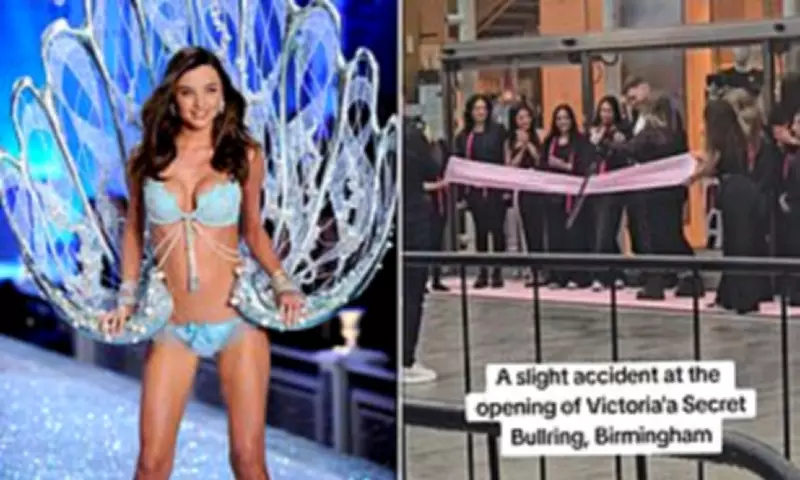
The grand reopening of Victoria's Secret in Birmingham's Bullring shopping centre over the weekend became an unexpected source of public ridicule, with onlookers describing feelings of 'second-hand embarrassment'. The event, intended to celebrate the lingerie brand's return to the West Midlands city, quickly unravelled into a series of awkward moments that were widely mocked on social media.
A Cringe-Worthy Commencement
The store had previously shut its Birmingham location in March 2024 after nine years of operation, a closure likely connected to broader business difficulties. The retailer's UK division had entered administration four years earlier, signalling significant operational challenges. Last week's reopening was meant to mark a fresh start, but instead provided ample material for online critics.
Ribbon-Cutting Farce and Pink Pyjama Parade
The ceremony began with a dance troupe performing in Victoria's Secret's trademark pink pyjamas, followed by what should have been a straightforward ribbon-cutting. However, the manager struggled conspicuously with a pair of oversized scissors, failing to cut the ribbon cleanly. This combined spectacle of awkward dancing and technical difficulty left many viewers both amused and embarrassed by the production.

Footage of the event shared by DJ Mystikle Blue on TikTok quickly attracted mocking commentary. One viewer quipped, 'Standard Birmingham behaviour,' while another bluntly stated, 'No need for dancing.' A third humorously compared the scissors struggle to personal experience: 'Me trying to use right handed scissors.'
From Global Phenomenon to Public Punchline
This latest public relations mishap represents just the most recent embarrassment for a brand that once possessed the power to launch modelling careers overnight. Victoria's Secret rose to global prominence through its famously sultry fashion shows, featuring 'Angels' like Cara Delevingne and Miranda Kerr strutting in elaborate wings and minimal lingerie. These events became cultural phenomena, appealing simultaneously to heterosexual male fantasies and women's aspirations toward high-fashion glamour.
The Failed Rebrand and Sales Struggle
However, changing cultural attitudes eventually turned against the brand's overtly sexualised marketing. Campaigners criticised its narrow beauty standards, forcing Victoria's Secret to temporarily retire its iconic shows. The company attempted a rebrand toward greater inclusivity, replacing supermodels with more diverse ambassadors. According to Business of Fashion reporter Cathleen Chen, while this shift received 'favourable reviews online, it never translated into sales.'
With inclusivity efforts failing to reverse declining sales, executives reportedly decided to return to the brand's original 'sexiness.' Chief executive Martin Waters acknowledged company performance issues, stating, 'The reality is we all know the performance of the company and so there must be something that's not going to plan.' Victoria's Secret and Pink brand president Greg Unis attempted to reconcile these approaches, telling investors, 'Sexiness can be inclusive' and 'can celebrate the diverse experiences of our customers.'
A Troubled History and Uncertain Future
Founded in 1977 by Roy Raymond, who named the brand after Queen Victoria to suggest refinement while adding 'Secret' to hint at hidden lingerie, Victoria's Secret expanded rapidly across America. The 1995 debut of its televised fashion show, featuring supermodels like Naomi Campbell and Tyra Banks, propelled the brand to unprecedented popularity.
However, cultural shifts during the late 2010s, particularly the #MeToo movement, made the brand's extravagant shows appear outdated. Controversy deepened when marketing chief Ed Razek stated the brand wouldn't cast plus-sized or transgender models because the show represented a 'fantasy.' The parent company, L Brands, ultimately cancelled the show in November 2019 as part of efforts to 'evolve the messaging' of the company.

Current Recovery Efforts
Despite these challenges, managing director for the UK, Ellis Quinn, is pursuing an expansion strategy with multiple new openings on British high streets. In the United States, there are tentative signs of recovery, with Fashion Network reporting total sales of $6.553 billion for fiscal year 2025, representing a 5 percent increase. The brand's return to its original ethos appears to be yielding some positive results, though the Birmingham opening suggests the road to full rehabilitation remains fraught with potential for public missteps.