If you think the life of a journalist is glamorous, take a look at Ann Hermes' photograph of Tom Haley from a winter day in Rutland, Vermont. He scribbles in a notebook, leaning back in an office chair while dressed in ill-fitting khakis and a baseball cap. His left foot rests on the one portion of a desk not covered with clutter — piles of notebooks, a newspaper, printed reports and a lanyard hanging from a stray photograph. What could be a calendar hangs askew on the wall behind him. The drab blue carpet has seen better days.
Hermes is fascinated by things that evoke a time gone by or are about to pass into history. She has photographed the last Morse code station operating in North America and department store photo booths. Lately, she has spent a lot of time in newsrooms like Haley's Rutland Herald. The Brooklyn-based photographer has brought her camera into some 50 newsrooms across the United States, many in smaller towns and cities, to document places and lives endangered by the industry's collapse over the past few decades. Already one of the newspapers she has photographed, in Alameda, California, has shut down. And she is nowhere near done.
Photographer didn't expect it to turn into a passion project
Even as someone who spent time in newsrooms herself professionally — Hermes worked for several years at the Christian Science Monitor — she did not anticipate it turning into such a passion project. 'I love these spaces,' she says. 'I love spending time with these people. The more time I spent in newsrooms and hearing about their difficulties of life, it took on a different agenda. I could not have spent so much of my free time on this if I did not enjoy it.'

Her photos dispel the notion that journalism is a prestigious job populated by elitists — certainly not at the local level. Here are working people in shabby surroundings, places that would make an office designer shudder. Post-it notes hang from a computer monitor. Pens, notebooks, boxes of paper are thrown into a bookshelf next to a half-empty bottle of whiskey. A carpet stain is left untended. A bottle of antacid pills sits on top of a microwave. An empty metal organizer sits behind a sign saying, 'stories to be written,' the product of a long-forgotten efficiency drive.
The New Yorker's Zach Helfand captures it: 'News people tend to pay their surroundings little mind. There is too much to do and always a deadline looming. What you see hanging around these rooms is not designed but improvised, and more revealing.'
Not just newsrooms in danger
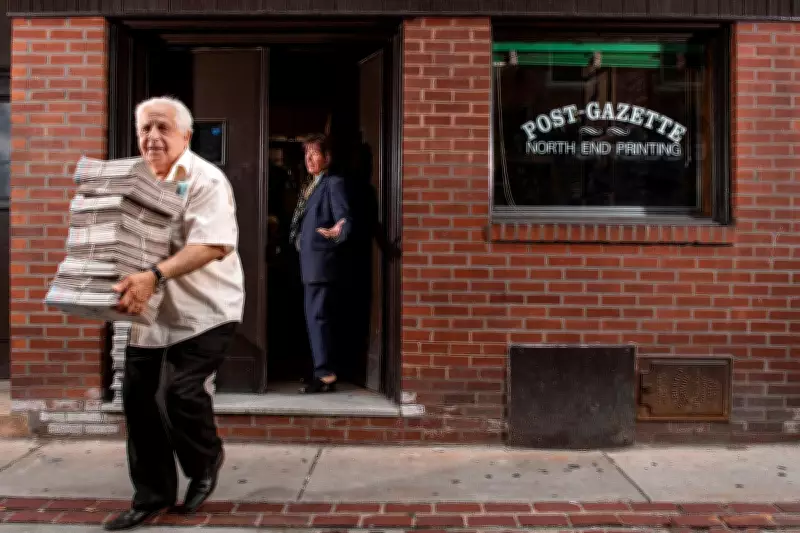
It is not just newsrooms in danger of becoming obsolete. How often do you see newspapers anymore, particularly with news outlets shutting their printing presses and going digital? Yet they are everywhere in Hermes' photographs. Stuffed into cubbies, yellowing with age. A jumble of them in the back of a van. Stacked in piles — some toppled over, others on the verge. Some need to be stepped around. Still more are in newspaper 'morgues,' the term becoming more appropriate by the day. Cut-out articles are stuffed into cardboard files, the destination for research before the day most information could be found with a few computer strokes. The history of a community is in these morgues, however. And when they are gone, so are many of the memories contained within.
A belief in a civic duty — with maybe some fun
'This is really a love letter to local journalism,' Hermes says. 'It is not a gotcha piece.' She is attracted to the 'true believers' who stick with the line of work, putting up with the anger and ridicule of civic leaders who do not like their judgments questioned, and the business realities that have driven many of their friends into different lines of work. 'The rewards are diminishing in doing this job,' she says. 'You have to really believe in the fundamental civic service that you are providing. Otherwise, why else would you do it? It is a really difficult job.'
Her work is available to see on her website, and she hopes one day to collect her newsroom photos in a book. She feels she has gone beyond capturing images and into an advocacy role; she wants to do exhibitions in some of the communities that she has visited to remind people about the importance of local journalism. Hermes' goal is to photograph 100 newsrooms: 'I feel like I learn something new in every newsroom I visit.'