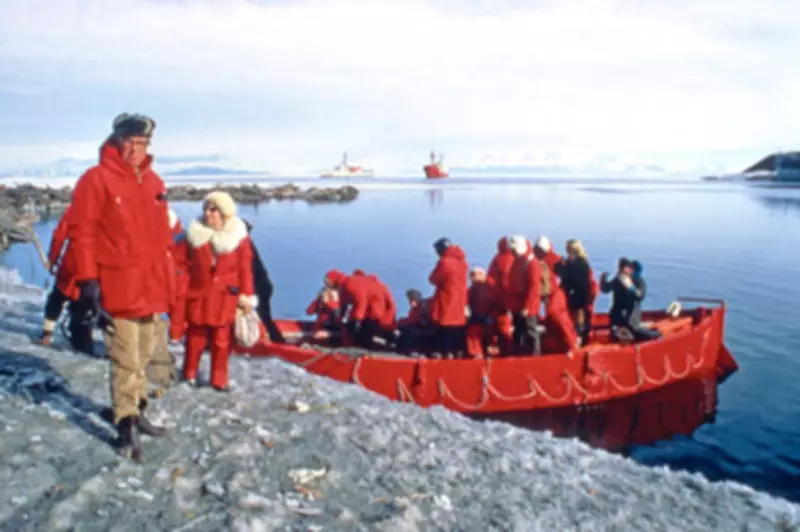
This month marks the sixtieth anniversary of a landmark moment in polar exploration history – the arrival of the first non-scientific tourists on the shores of Antarctica. On January 23, 1966, American pioneer Lars-Eric Lindblad led fifty-seven civilian travellers ashore at Smith Island and the Melchior Islands on the Antarctic Peninsula, effectively opening the world's most remote and inhospitable continent to tourism.
The Vision Behind the First Expedition
The original mission, as conceived by Lindblad, was not merely about adventure tourism. It was fundamentally an educational endeavour aimed at inspiring planetary stewardship. By exposing people to one of Earth's most awe-inspiring and fragile environments, Lindblad believed visitors would develop a profound connection and a desire to protect it. His son, Sven Olof-Lindblad, founder of Lindblad Expeditions, recalls the postcard his father sent from that historic trip, emphasising that this belief in creating ambassadors for the planet remains their driving force six decades later.
From Pioneering Trip to Booming Industry
What began with fewer than sixty guests has transformed into a significant industry. Last year alone, approximately 80,000 people visited Antarctica, the vast majority arriving on specialised expedition cruise ships offering varying levels of comfort. This phenomenon, described by some as the "destinationification" of Antarctica, has established seasonal itineraries and developed specific landing sites across the continent.

This growth has necessitated strict regulation. Recognising their responsibility, Lindblad Expeditions joined six other operators in 1991 to establish the International Association of Antarctic Tour Operators (IAATO). This body sets crucial industry standards, including the rule that only one hundred people can be on the ice at any given time and prohibiting ships with capacities over five hundred from making landings.
The Conservation Argument: Tourism as a Force for Good
Many within the polar community argue passionately that responsible tourism has been a net positive. Polar veteran and photographer Paul Goldstein asserts that opening the continent was "certainly positive," creating vital ambassadors who understand the delicate ecological balance and the severe threat of climate change. He believes tourism has assisted in fostering global awareness and support for the continent's governance.
This sentiment is echoed by Tudor Morgan, Antarctic Ambassador for HX Expeditions, who began his career with the British Antarctic Survey. He argues that tourism helps bridge the gap between complex scientific understanding and public awareness. When done responsibly, he contends, it can be a powerful force for good, with many operators now integrating citizen science programmes into voyages. Guests might assist researchers by collecting penguin bones for paleoecological studies or participating in onboard educational programmes run in partnership with institutions like the University of Tasmania.
The Scientific Counterpoint: Environmental Costs and Scepticism
However, not all observers are convinced of tourism's benefits. Climate scientists express deep concern about the environmental footprint, even from so-called low-impact visits. Assistant Professor Melisa Diaz of Ohio State University's School of Earth Sciences, writing from Antarctica, is sceptical that most tourists develop the deep, stewardship-driven connection hoped for by the industry's founders.
She points out that the logistical gymnastics required to reach Antarctica – involving planes, helicopters, and ships – creates an "enormous environmental footprint" that is inherently high-impact. She highlights the fragility of unique ecosystems, like the McMurdo Dry Valleys, which face new threats from microplastics, foreign contaminants like goose-down feathers, and climate change impacts exacerbated by human presence.

Dr Marco Tedesco, a research professor at the Columbia Climate School, agrees. While acknowledging that tourism has helped build global consciousness about Antarctica's plight, he warns that "the scale of current tourism has enormous ecological and environmental impacts, pushing a fragile system closer to its limits." He fears Antarctica risks becoming merely another exclusive bucket-list destination for a global elite, with incremental visits eroding the very wonder people seek.
Balancing Act: The Future of Antarctic Visitation
The debate reveals no simple answer. The industry cannot be simply cancelled, but its future requires careful management. Dr Tedesco proposes a framework for genuine low-impact tourism: visitor numbers must grow slower than monitoring capabilities; activities affecting wildlife must be contained; and per-capita emissions must be drastically reduced or offset.
Paul Goldstein redirects attention to what he sees as a greater immediate threat: the industrial harvesting of krill by nations like Norway and China, which removes a foundational species from the Antarctic food web. This, he argues, poses a more direct and unsustainable danger to the entire ecosystem than regulated tourism.
As the industry reflects on sixty years of operation, the central question remains unresolved. Was Lars-Eric Lindblad's pioneering 1966 expedition a mistake that opened a Pandora's box of environmental pressure, or a visionary act that created a global army of advocates for Earth's last great wilderness? The answer likely lies in the industry's ability to enforce stringent regulations, minimise its footprint, and truly fulfil its original mission of creating informed planetary stewards, not just transient spectators.