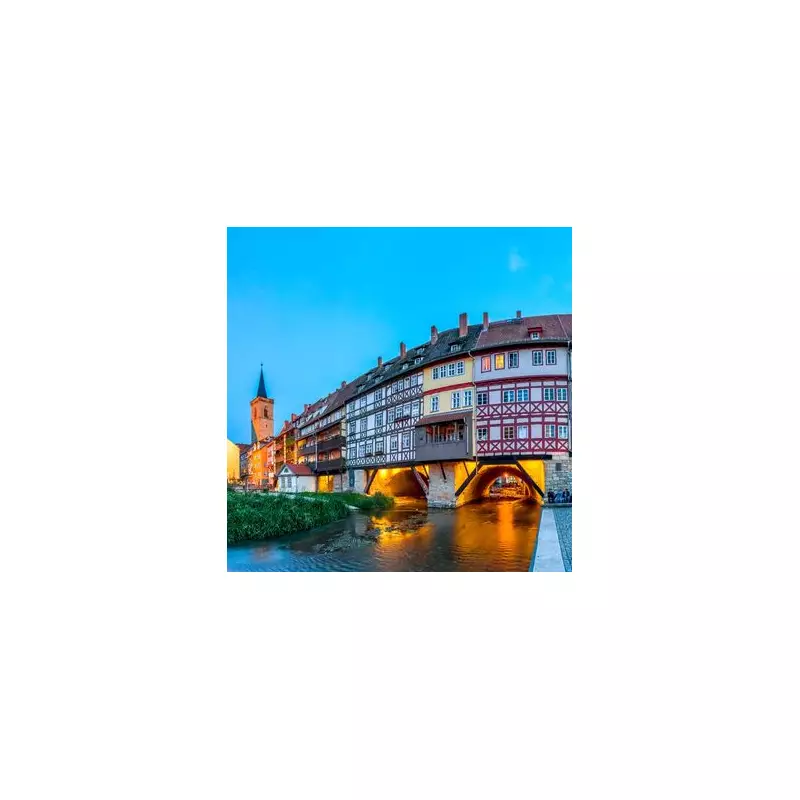
In the historic German city of Erfurt, a remarkable piece of living history spans the Gera River. The Krämerbrücke, or Merchant's Bridge, is not merely a crossing but a vibrant street and home to a community, holding the title of the longest inhabited medieval bridge in Europe.
A Bridge Built to Last: From Wood to Stone
The bridge's story began in the 12th century. Its earliest documented mention dates back to 1156, when it was known by the Latin name 'Pons rerum venalium'. Originally constructed from wood, the structure was rebuilt in durable stone in 1325. This reconstruction gave the bridge its defining feature: six sturdy sandstone arches that have supported life and commerce for nearly seven centuries.
Stretching an impressive 125 metres in length, the bridge was once lined with 62 narrow buildings. Over time, particularly after a series of devastating fires between the 16th and 18th centuries, these were consolidated. Today, 32 distinctive timber-framed buildings stand shoulder-to-shoulder along its length, providing homes for approximately 80 residents.

Architecture, Commerce, and Community
The Krämerbrücke's design is a tapestry of architectural history, showcasing influences from Gothic, Renaissance, and Baroque styles. Its foundations conceal a network of hidden cellar vaults, a testament to its complex construction. The bridge was originally flanked by two churches, one at each end. Only St Giles' Church at the eastern end remains today, its 33-metre spire offering a panoramic view of the unique structure below.
True to its name, the Merchant's Bridge was a crucial hub for trade during the Middle Ages. Local traders would peddle their goods from small wooden huts. The bridge ultimately earned its name from the merchants specialising in fine fabrics, spices, and jewellery. This commercial spirit thrives in a modern form today, with the bridge now boasting a charming mix of independent galleries, cosy cafés, and boutiques.
A Living Landmark in the Modern Era
The bridge has weathered centuries of change, including the damage of 20th-century conflicts and the demands of modern traffic, which led to the construction of the nearby Rathausbrücke. A dedicated series of restoration projects have preserved its character. Visitors can now explore shops selling traditional Thuringian blue printed fabrics, ceramics, handblown glassware, and mouth-watering local delicacies.
More than just a tourist attraction, the Krämerbrücke remains a fully functioning neighbourhood. It is a rare and captivating example of medieval urban planning where the line between a bridge and a street beautifully blurs, offering a unique glimpse into a way of life that has continued uninterrupted for over 800 years.