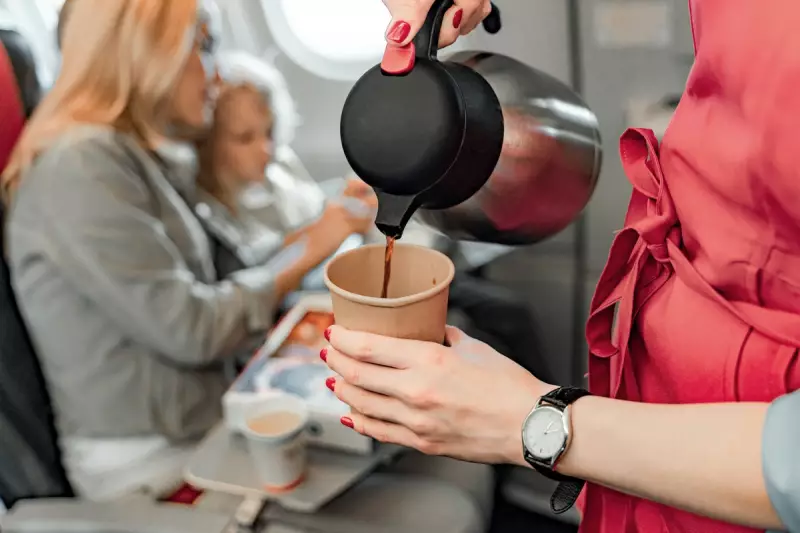
Passengers are being urged to reconsider drinking coffee or tea served on aircraft, following a comprehensive new study that raises significant concerns about the quality of water used onboard.
Major Study Uncovers Widespread Contamination
The research, conducted by the Center for Food as Medicine and Longevity, analysed a staggering 35,674 water tests carried out by airlines themselves between 1 October 2022 and 30 September 2025. These results were officially reported to the US Environmental Protection Agency (EPA).
Samples were taken from various points on aircraft, including galley taps and bathroom sinks, and tested for harmful bacteria. The findings revealed that 949 samples (2.66%) tested positive for coliforms, microbes which can signal the presence of disease-causing organisms. More alarmingly, 32 samples (0.09%) tested positive for E. coli, a bacterium indicating faecal contamination that can lead to stomach cramps, diarrhoea, and pneumonia.

Airline Scorecard: The Best and Worst Performers
The researchers created a detailed scorecard for 10 major and 11 regional US carriers, grading them on contamination levels, violations per aircraft, and how frequently they disinfected their water tanks.
Among major airlines, American Airlines received the lowest score of 1.75 out of five, earning a grade D. JetBlue, which also ranked poorly in a previous 2019 study, scored 1.8, also a D. Spirit Airlines followed with a D grade (2.05).
In contrast, Delta Air Lines and Frontier Airlines topped the table with A grades, scoring a perfect 5.0 and 4.8 respectively. Alaska and Allegiant Air both received B grades.
The regional airline ranking painted a grimmer picture. GoJet Airlines led with a B grade (3.85), but six carriers—SkyWest, Envoy Air, PSA Airlines, Air Wisconsin, Republic Airways, and CommuteAir—all received Ds. Mesa Airlines scored worst of all, with a grade F and a score of just 1.35.
Dr Charles Platkin, director of the research centre, stated: “Nearly all regional airlines need to improve their onboard water safety, with the exception of GoJet Airlines.”
Why Onboard Water Systems Are Vulnerable
Airlines are required to disinfect and flush their aircraft water tanks four times per year. However, the study notes that water systems can stagnate between flights and experience temperature shifts during ascent and descent. Contamination can also originate from airport water hoses and storage tanks, making complete safety a challenge.
The situation may be even worse than the data suggests. Researchers found a large number of incomplete EPA violation records where investigation end dates were missing, meaning these breaches were not included in the final statistics.
Expert Advice for Passengers
With these findings in mind, Dr Platkin offers clear guidance for travellers. “Never drink any water onboard that isn’t in a sealed bottle and do not drink coffee or tea onboard,” he advises. He further recommends against washing hands in the aircraft bathroom, suggesting the use of an alcohol-based hand sanitiser containing at least 60% alcohol instead.
In response to the study, American Airlines defended its practices, stating its program is fully compliant with EPA rules and that a recent audit showed no significant findings. The airline said it is reviewing the study's methodology. The Independent has contacted JetBlue for comment.
For passengers, the message is clear: when it comes to hydration in the skies, sticking to securely sealed bottled water is the safest bet.