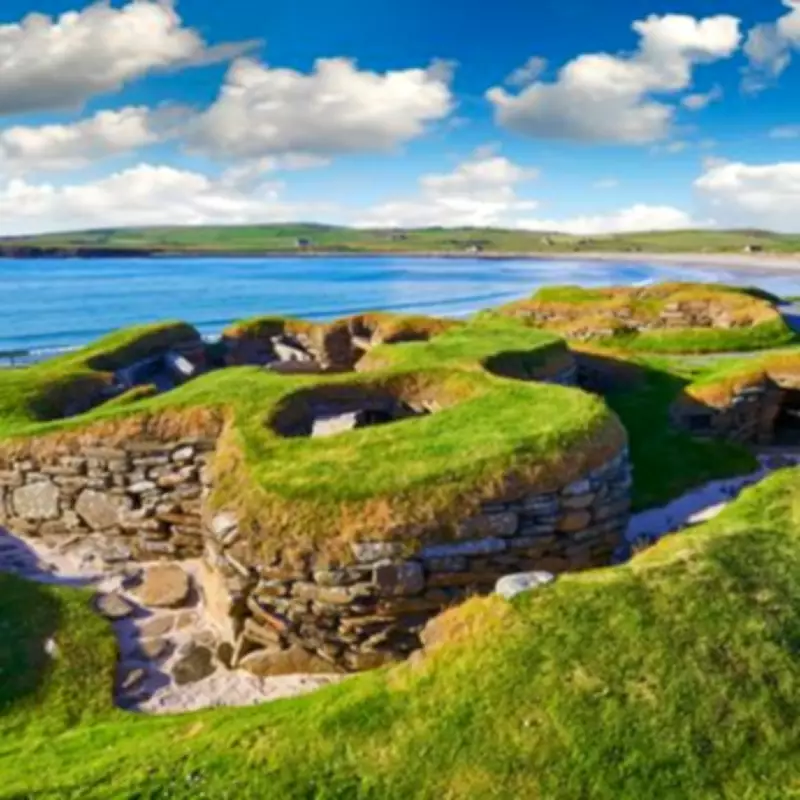
Tourists from across the globe are flocking to one of the United Kingdom's most ancient and enigmatic archaeological sites, only to make a rather embarrassing blunder. At Skara Brae, a remarkably preserved Neolithic settlement on the Orkney archipelago in Scotland, visitors have been enthusiastically tossing coins into a hole in the ground, convinced it is a traditional wishing well. However, local experts and guides have revealed the sobering truth: the hole is, in fact, an ancient toilet drain, dating back thousands of years.
The 'Scottish Pompeii': A Glimpse into Prehistoric Life
Skara Brae, often dubbed the "Scottish Pompeii" for its exceptional state of preservation, offers a rare window into a farming community that thrived between 3100 and 2500 BC. This stone-built village, nestled near the sea, allowed its inhabitants to fish, cultivate crops, and rear animals with relative ease. The site lay hidden until a fierce storm in 1850 uncovered its secrets, revealing stone dressers, box beds, tools, gaming dice, pottery, and jewellery that paint a vivid picture of Neolithic daily life.
Today, Skara Brae forms a crucial part of the "Heart of Neolithic Orkney," a UNESCO World Heritage Site that also includes the chambered tomb of Maes Howe and the ceremonial stone circles of the Stones of Stenness and the Ring of Brodgar. It remains a premier tourist attraction, drawing crowds fascinated by its antiquity—older than both Stonehenge and the Egyptian pyramids.

A Costly Misconception: Pennies Down the Drain
For years, a peculiar tradition has taken root among visitors. Many, driven by superstition, have thrown pennies into a subterranean hole at the site, believing it to be a wishing well. This practice has persisted despite the hole's true function as part of an ancient sewer system, complete with well-constructed drains and cisterns that highlight the advanced plumbing of the Neolithic residents.
Kinlay Francis, a local tour guide from Orkney Uncovered, has taken to social media to set the record straight. In a Facebook post that garnered over 2,000 reactions and nearly 150 comments, Francis stated, "For years, people have been throwing money down a subterranean hole in the Skara Brae ground, thinking they are throwing money down a well to make a wish. I have great delight in telling my clients and anybody who throws their money down there that they are, in fact, throwing money down a toilet."
The revelation sparked a mix of amusement and disbelief online. One commenter quipped, "Oh! So! Priceless!", while another joked, "Really a p*****g well not a wishing well then." A third added, "It's not a wishing well...it's a s******g well." Yet, some visitors remain undeterred, with one noting, "Still...maybe brings good luck," and another philosophising, "Where there is muck, there is brass!"
Enduring Appeal Amidst the Confusion
Despite the humorous mix-up, Skara Brae continues to captivate tourists, earning glowing reviews on platforms like TripAdvisor. One traveller praised, "Skara Brae Prehistoric Village is a must-see if you are in the Orkney Islands. Such an interesting place. You will be blown away by how well-preserved this 5000-year-old site is." Another shared, "This was my second time to Skara Brae and it was just as wonderful as the first. The setting of this village is spectacular... It is fantastic to view the site and then visit the reconstructed house to see how these people lived. Not so different from us."
A third reviewer highlighted the site's historical significance, calling it "a must-see bucket list experience older than the Giza pyramids" and noting, "They even had plumbing. Once you are at the site, you can tour the homes from the walkway, which shows the genius of the ancient culture."
The confusion over the toilet-turned-wishing-well has done little to dampen enthusiasm for this archaeological treasure. As visitors marvel at the ingenuity of a civilisation that mastered drainage systems millennia ago, they are reminded that sometimes, history's most mundane features can become the source of modern-day amusement and wonder.