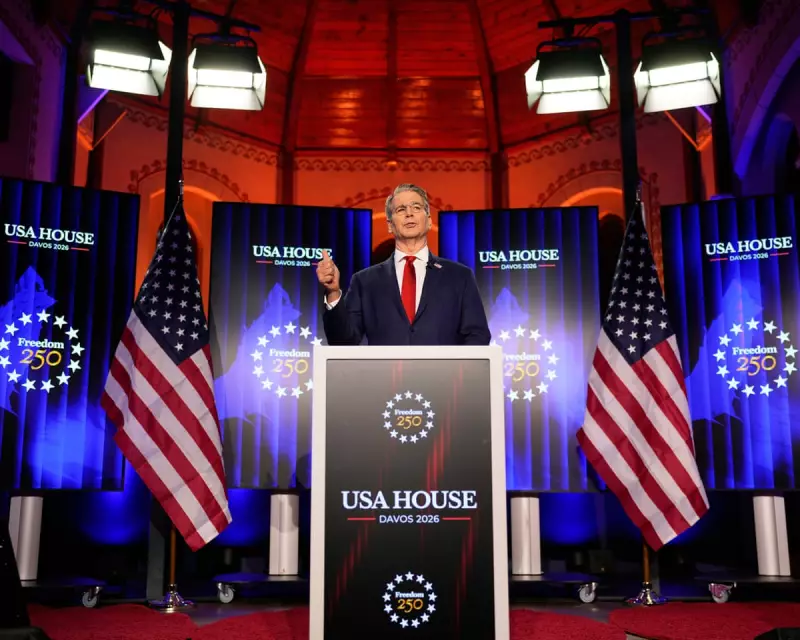
US Treasury Secretary Scott Bessent has publicly called on European countries to refrain from imposing retaliatory trade tariffs, following President Donald Trump's threat of new levies related to the Greenland dispute. Speaking at the World Economic Forum in Davos, Bessent dismissed the market panic as "hysteria" and urged a pause in escalation.
Davos Plea for Calm Amid Market Turmoil
Addressing a press conference at the annual gathering of global leaders, Bessent explicitly advised nations and corporations to "sit back, take a deep breath, and let things play out." He argued that the worst possible move would be for countries to escalate tensions against the United States. His comments came as global stock markets fell sharply in response to the heightened political uncertainty.
Bessent drew a direct comparison to the market reaction on 2 April of last year, which he labelled a "panic." On that date, President Trump's "liberation day" tariff announcement initially caused turmoil, before markets later recovered to record highs, partly driven by the artificial intelligence boom.

Dismissing the 'Nuclear Option' of Debt Sales
A key point of contention has been speculation that European nations could retaliate by selling off their vast holdings of US government debt. Bessent forcefully rejected this idea as a "completely false narrative" that defied logic. He expressed confidence that European governments would continue to hold US Treasuries, which are considered a cornerstone "risk-free" asset in global markets.
This rebuttal appeared aimed at a recent analysis from Deutsche Bank strategist George Saravelos. The report had noted that Europe owns approximately $8 trillion in US bonds and equities—almost double the holdings of the rest of the world combined—and questioned Europe's continued willingness to fund US deficits amid a geoeconomic rift. The US national debt currently exceeds $38 trillion, with a deficit of $1.78 trillion recorded in 2025.
Escalating Threats and Global Economic Warnings
The immediate trigger for the market sell-off was Trump's threat to impose a 25% tariff on a range of European goods, linked to his administration's pursuit of the autonomous Danish territory of Greenland. Overnight, tensions worsened as Trump also threatened 200% tariffs on French wines and champagne, following reports that President Emmanuel Macron was reluctant to join a proposed "board of peace" for Gaza.
The financial impact was swift and severe. On Tuesday, Japan's Nikkei index fell by 1.1%, while major European markets, including the UK's FTSE 100, dropped by around 1%. The US dollar also weakened by 0.8% against a basket of major currencies. Gold and silver prices surged to record highs as investors sought safe-haven assets.
Meanwhile, the head of the International Monetary Fund, Kristalina Georgieva, used her Davos platform to warn against a renewed tit-for-tat trade war. She stated that muted tariff impacts and the avoidance of escalation had been factors in the IMF's recent upgraded economic projections, adding that maintaining this calm would be beneficial for the global economy.
In response to the crisis, EU top diplomats held emergency talks on Sunday, discussing the potential revival of a suspended plan to levy tariffs on €93 billion worth of US goods. The US delegation at Davos, the largest in the forum's history, awaits an address by President Trump scheduled for Wednesday.