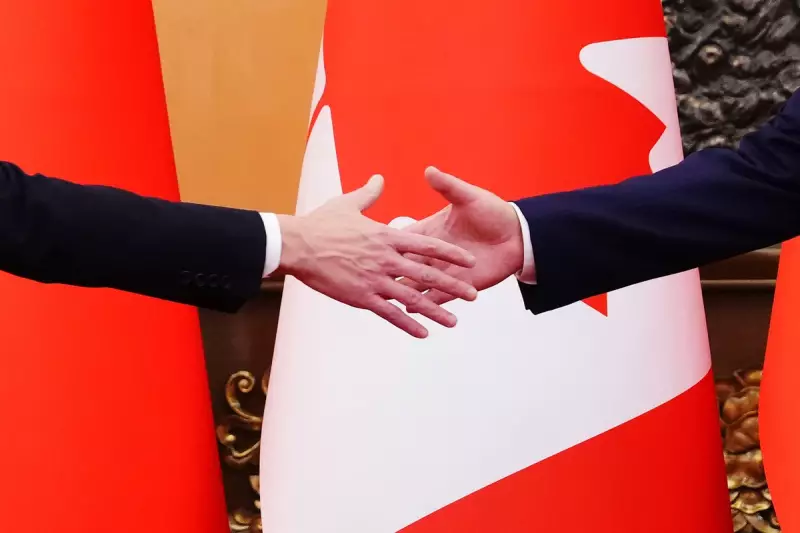
Canadian Prime Minister Mark Carney has concluded a significant visit to Beijing, declaring a success in mending fractured ties with China, all while the spectre of American policy under President Donald Trump loomed large over the negotiations.
A Diplomatic Thaw Forged in Uncertainty
The meetings between Carney and Chinese President Xi Jinping this week marked a concerted effort to heal a relationship stalled for nearly a decade. The discussions, held some 8,000 miles from Washington, were profoundly informed by the actions and rhetoric of the United States. Both nations are grappling with the same central challenge: predicting Washington's next move in an era of disruptive trade policies and provocative statements.
For Canada, this re-engagement with its second-largest trading partner aligns with a concept championed by Chinese media: "strategic autonomy." This principle suggests that a nation long intertwined with the US as an unwavering ally must now seek other pillars to support its international standing, especially given recent tensions with Washington.

Carney, who met with several leading Chinese firms, framed the pivot as essential. "We face many threats. You manage those threats through alliances," he stated, emphasising the goal of building an economy less reliant on the United States during "a time of global trade disruption."
Concrete Gains and a Delicate Balance
The visit yielded tangible, if preliminary, results. In a move with direct economic impact, Canada agreed to slash its 100% tariff on Chinese electric vehicles. In return, China will significantly reduce tariffs on key Canadian agricultural exports.
The specific terms see an initial annual cap of 49,000 Chinese EVs entering Canada at a reduced tariff rate of 6.1%, scaling up to roughly 70,000 over five years. On the Chinese side, the total tariff on Canadian canola seeds—a major export—will drop from 84% to approximately 15%.
Analysts viewed the outcomes as mutually beneficial and politically astute. "China is succeeding in driving a small wedge between Canada and the U.S.," observed Nelson Wiseman, professor emeritus at the University of Toronto. The deal acts as a workaround for Ottawa after a year of unprecedented treatment from Washington, where Trump has not moved to reduce tariffs harming the Canadian economy and has even mused about Canada becoming a US state.
The Long Shadow of Washington and Beijing's Calculus
The backdrop of US unpredictability was a constant subtext. China's official Xinhua News Agency highlighted the importance of stable Canada ties in "a time of heightened uncertainty," citing economic fragmentation and resurgent protectionism—challenges both nations face from Washington.
For Beijing, closer relations with Canada advance its broader aim of presenting a global counterbalance to American influence. With nearly two million citizens of Chinese descent in Canada and strong cultural links in cities like Vancouver, Beijing's approach is closely watched within Canadian borders.
The leaders' carefully chosen words reflected the delicacy of the rapprochement. While Carney insisted Ottawa-Washington relations were "much more multifaceted," he notably added that the progressing relationship with China was "more predictable." This prized commodity of predictability has become scarce in a world where Trump and other populists have upended post-war diplomatic norms.
As Robert Bothwell, a professor of Canadian history and international relations, summarised: "My guess is that the Chinese want the opposite in Canada to what Trump wants—a coherent country with a functioning economy... Trump wants the opposite—a fragmented satellite that is easier to bully and extort from." Ironically, Trump himself commended Carney for making a deal with Beijing, calling it a "good thing."
While the long-term impact remains unclear, one immediate shift is evident. As of Saturday 17 January 2026, when Carney departed Beijing, President Xi's government possesses a stronger friend in North America than it did just a week prior. In today's climate of global uncertainty, that may constitute a significant victory for Beijing.