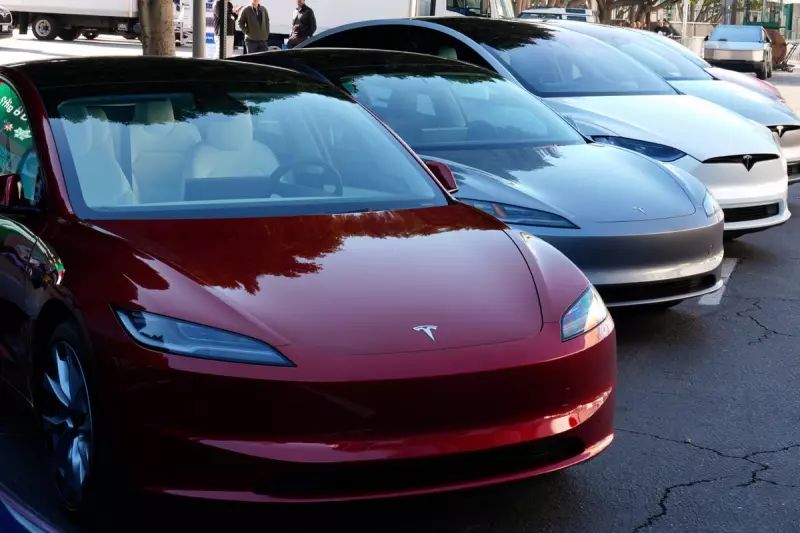
A landmark trade agreement by Canada has sent shockwaves through the global automotive industry, paving a smoother path for Chinese electric vehicle manufacturers to enter the North American market and intensifying fears for the future of American carmakers.
The Canadian Gateway and a Shifting Global Order
In a move with significant strategic implications, Canada recently agreed to cut tariffs on electric vehicles in exchange for concessions on its agricultural exports. This decision is poised to act as a powerful accelerant for the global expansion of China's rapidly advancing automotive sector, offering a critical entry point into the lucrative North American market.
This development comes at a pivotal moment. Tesla lost its crown as the world's bestselling electric vehicle maker in 2025, delivering 1.64 million vehicles compared to the 2.26 million sold by its Chinese rival, BYD. Experts argue that as Chinese brands, renowned for their high-tech, stylish, and affordable EVs, seek growth beyond a softening domestic market, this Canadian access could supercharge their drive to dominate globally.

"This is telling us that Chinese automakers continue to be really popular, and are doing better and better, and not just in markets that are marginal to U.S. automakers," observed Ilaria Mazzocco of the Center for Strategic and International Studies.
Why Chinese EVs Pose a Formidable Challenge
The threat stems from a potent combination of price, technology, and strategic focus. Chinese-made EVs can cost as little as $10,000 to $20,000, a stark contrast to the nearly $50,000 average for new vehicles in the US. "They've found a way to make small and mid-sized cars — cars that people want — at a reasonable price," said Sam Fiorani of AutoForecast Solutions. "These are the segments where GM and Ford and almost everybody else have abandoned."
Beyond cost, these vehicles are packed with desirable software and connectivity features, and Chinese manufacturers hold unique advantages in production efficiency and lightweighting, which extends driving range. Meanwhile, the global shift to electrification presents a perfect opportunity. While Europe saw a 33% surge in plug-in and EV sales in 2025 and China saw 17% growth, US sales crawled forward by just 1%.
Compounding the problem, US automakers have scaled back ambitious electrification plans under the Trump administration's policy shift, focusing instead on hybrids. "Trump administration policy slashing emissions rules at a time when Chinese companies are advancing quickly has experts worried for the future of American car manufacturers," the report notes.
Global Reactions and the Inevitable Advance
The West has reacted with protective measures. The EU hiked tariffs on Chinese EVs last year, and former President Joe Biden set a 100% tariff in 2024, which Canada matched until this week's reversal. Transportation Secretary Sean Duffy recently warned that China invests to "control this industry" and take away jobs, stating Canada "will live to regret the day they partner with China."
Despite the roadblocks, the advance is seen as inevitable. Chinese firms are already established in Europe, South America, and Mexico. To succeed in Canada, they must meet standards similar to the US, which may spur manufacturing investment there. Consulting firm AlixPartners predicts Chinese brands will seize 30% of the global market by 2030.
"It brings it home to what is needed to compete globally," said Mark Wakefield of AlixPartners, warning US carmakers must avoid becoming isolated like certain historical auto markets. Sam Fiorani concluded: "There are a lot of guardrails that have to be put up, but eventually they're going to make their way into all Western markets."