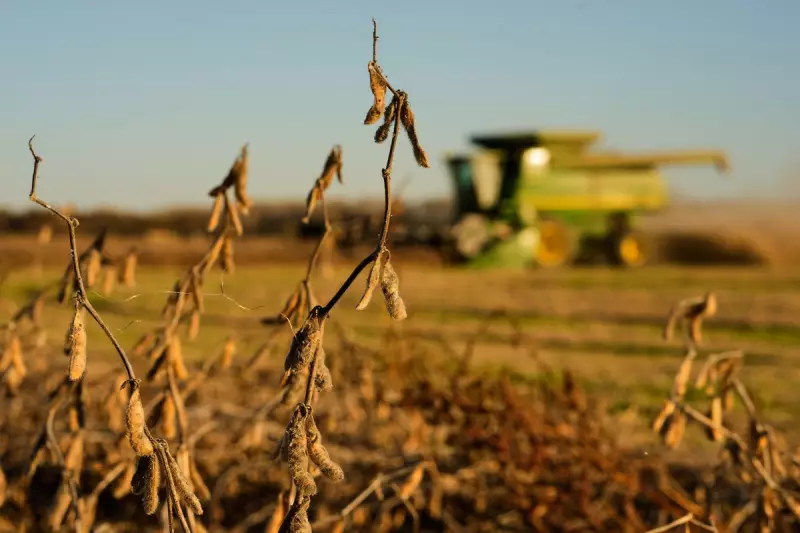
The Trump administration has confirmed that China has met its initial pledge to purchase 12 million metric tons of soybeans from the United States, marking a significant milestone in the trade agreement announced last October. However, the durability of this deal is now under intense scrutiny due to President Donald Trump's rapidly evolving trade policies and the ongoing financial pressures facing American agricultural producers.
Uncertainty Looms Over Trade Agreement
Despite this achievement, there are growing concerns that the broader trade pact may not withstand the unpredictable nature of Trump's international trade strategy. American farmers continue to grapple with soaring production costs, including expenses for fertiliser, seeds, and labour, which are making it increasingly difficult to turn a profit in the current economic climate.
Shifting Tariff Policies Raise Alarms
Earlier this month, President Trump declared his intention to impose 25% tariffs on any nation purchasing from Iran, a move that would directly impact China. Subsequently, over the weekend, he threatened to levy 10% tariffs on eight of America's closest European allies if they persist in opposing his efforts to acquire Greenland. This pattern of swiftly changing trade directives has introduced a layer of volatility that could potentially undermine the soybean agreement.

Chad Hart, an agricultural economist at Iowa State University, highlighted the precarious situation, stating, "Those new tariffs — what does that mean for this agreement? Does it throw it out? Is it still binding? That’s sort of the game here now." He warned that such policy shifts might jeopardise China's commitment to buy 25 million metric tons of American soybeans annually over the next three years.
Historical Context and Recent Developments
Beijing had suspended all purchases of US soybeans last summer amid the escalating trade war with Washington. The resumption of buying only occurred after Trump and Chinese leader Xi Jinping convened in South Korea and agreed to a temporary truce. Treasury Secretary Scott Bessent announced China's fulfilment of the initial purchasing goal during an interview with Fox News on Tuesday, conducted from the sidelines of a major economic forum in Davos, Switzerland.
Bessent, who met with his Chinese counterpart, Vice President He Lifeng, affirmed China's ongoing dedication to the agreement. "He told me that just this week they completed their soybean purchases, and we’re looking forward to next year’s 25 million tons," Bessent remarked. "They did everything they said they were going to do."
Data and Market Realities
Recent data from the US Department of Agriculture (USDA) indicates that China had acquired over 8 million tons of US soybeans by January 8th, with subsequent daily reports showing additional orders ranging from 132,000 to more than 300,000 tons. This comes after preliminary figures last autumn had cast doubts on China's adherence to the agreement due to a slow start in purchasing and delays in official reporting.
In recent years, China has significantly diversified its soybean sources, shifting much of its procurement to Brazil and Argentina in search of more economical deals. World Bank statistics reveal that Brazilian beans constituted over 70% of China's imports last year, while the US share dwindled to just 21%.
Financial Support and Farmer Concerns
To assist US farmers in weathering the trade war, the Trump administration plans to distribute approximately $12 billion in aid. Under this scheme, soybean farmers will receive $30.88 per acre, corn farmers $44.36 per acre, and sorghum farmers—another crop severely impacted by China's earlier buying halt—$48.11 per acre. These amounts are calculated based on a USDA formula that considers production costs.
Nevertheless, many farmers argue that this financial assistance does not fully address their underlying challenges. Cory Walters, an associate professor in the University of Nebraska-Lincoln's Department of Agricultural Economics, noted that uncertainty surrounding trade markets and crop pricing is causing anxiety even among the most optimistic growers.

"Everything is changing -- the land rental market, the fertiliser market, the seed market and it’s all pinching the farmer when they go to do their cash flows. The ability to make a decision is tougher now because of all the uncertainty in the market," Walters explained.
Price Volatility and Profitability Issues
Soybean prices experienced a brief surge, climbing above $11.50 per bushel following the announcement of the trade agreement. However, by Tuesday, prices had retreated to approximately $10.56 per bushel, hovering near levels seen a year ago. This pricing is insufficient to cover the majority of farmers' operational expenses, further compounding their financial strain.
The combination of Trump's mercurial trade policies, persistent high production costs, and market volatility creates a precarious environment for the future of US-China agricultural trade. While the initial soybean purchase goal has been met, the long-term stability of the agreement remains in question, leaving American farmers in a state of cautious uncertainty.