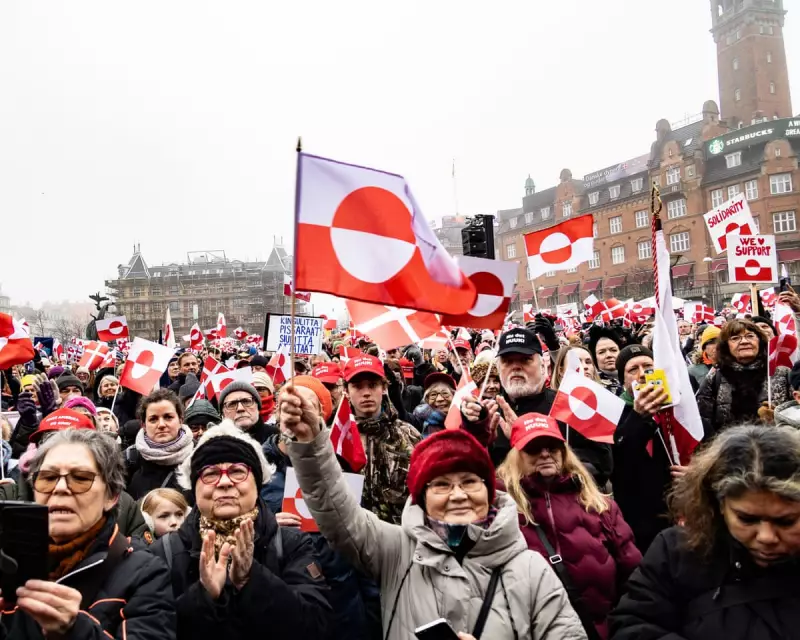
Senior European Union diplomats are scrambling to convene emergency crisis talks following a dramatic announcement from former US President Donald Trump, who has threatened to impose punitive tariffs on eight European nations. The move is a direct retaliation for their military support of Greenland, a vast autonomous territory of Denmark.
An Unprecedented Tariff Threat
The ambassadors from all 27 EU member states are set for an urgent meeting on Sunday. This follows Trump's declaration on his Truth Social platform on Saturday, where he accused Denmark, Norway, Sweden, France, Germany, the United Kingdom, the Netherlands, and Finland of playing "a very dangerous game" by deploying troops to Greenland.
Trump stated that these countries would face immediate 10% tariffs from 1 February, escalating sharply to 25% from 1 June. He explicitly linked the measures to his long-stated ambition to acquire Greenland, declaring the tariffs would remain "until such time as a Deal is reached for the Complete and Total purchase of Greenland".

European Leaders Rally in Defence and Defiance
The reaction from European capitals has been one of unified condemnation and resolve. French President Emmanuel Macron is poised to urge the EU to deploy its powerful, yet never-used, anti-coercion instrument should the US proceed with the tariffs. This legal tool allows the bloc to impose wide-ranging economic countermeasures against a country using coercion to force a policy change.
Macron was unequivocal, stating: "No intimidation or threat will influence us – neither in Ukraine, nor in Greenland, nor anywhere else in the world." EU leaders Ursula von der Leyen and António Costa, caught off-guard while signing a trade deal in South America, warned that such tariffs would "undermine transatlantic relations and risk a dangerous downward spiral".
Even traditional Trump allies within Europe voiced strong opposition. Italy's Prime Minister Giorgia Meloni labelled the proposed tariffs a "mistake", while the Dutch Foreign Minister David van Weel described the threats as "blackmail". Finland's President Alexander Stubb emphasised European unity behind Denmark and Greenland.
Broader Implications for NATO and Trade
The crisis has sent shockwaves through the transatlantic alliance, casting what one former NATO official called an "existential" shadow over the organisation. Robert Pszczel, a senior fellow at the Centre for Eastern Studies, stated that Trump's actions constituted direct violations of the North Atlantic Treaty's principles of peaceful dispute resolution.
The burgeoning EU-US trade deal, signed last August and expected for ratification by February, now hangs in the balance. Manfred Weber, leader of the European Parliament's largest group, declared that "approval is not possible at this stage", a sentiment echoed by Socialist and Green MEPs.
Spain's Prime Minister Pedro Sánchez offered a stark geopolitical warning, suggesting a US move on Greenland would "make Vladimir Putin the happiest man on Earth" by legitimising Russia's actions in Ukraine and potentially sounding the "death knell for NATO".
Denmark, for its part, expressed surprise at Trump's announcement, having held what it described as "constructive" talks in Washington just last week. The Danish government maintains that the increased military presence in Greenland is solely to enhance Arctic security.