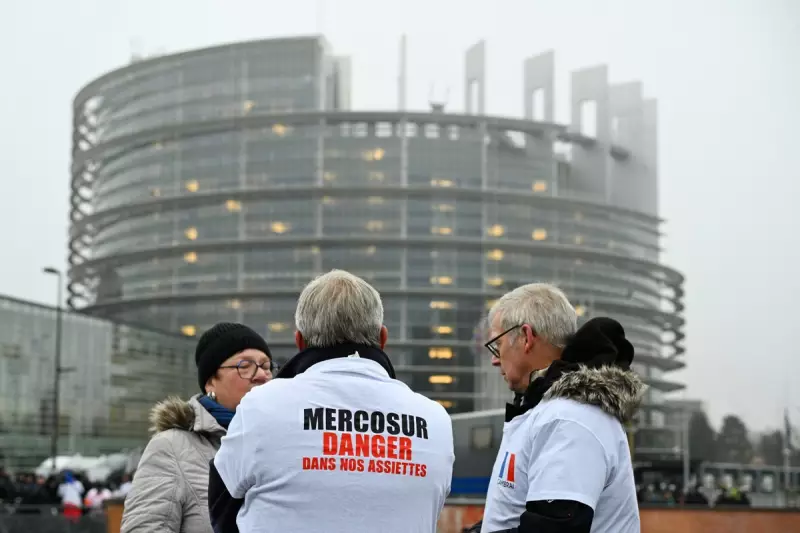
EU Parliament Halts Major Mercosur Trade Deal Over Legal Questions
European Union lawmakers have taken the significant step of blocking a major free trade agreement with the Mercosur bloc of South American nations, citing substantial concerns about the legality of the pact. The decision represents a major setback for a deal that has been under negotiation for a quarter of a century.
Narrow Vote Sends Agreement to Top Court
In a closely contested vote held in Strasbourg, France, members of the European Parliament narrowly approved a motion to refer the EU-Mercosur agreement to the European Court of Justice. The assembly seeks a ruling on whether the trade deal complies with the bloc's foundational treaties and legal frameworks.
The parliamentary vote concluded with 334 members in favour of the referral, 324 against, and 11 abstentions. This slender margin underscores the divisive nature of the agreement within European political circles.

Background of the Long-Awaited Trade Pact
This free trade agreement, twenty-five years in development, was formally signed into effect just days before the parliamentary vote. Celebrated by proponents as a landmark achievement, the pact aimed to strengthen commercial relationships amidst growing global protectionism and trade tensions.
The agreement enjoyed support from South America's major cattle-producing nations and various European industrial sectors. Its primary objectives included:
- Gradually eliminating over 90% of tariffs on a wide range of goods
- Creating one of the world's largest free trade zones
- Reducing shopping costs for more than 700 million consumers across both regions
Key trade flows that would have been affected include Argentine beef exports to Europe and German automobile exports to South American markets.
Political Resistance and Agricultural Concerns
France, as Europe's leading agricultural producer, has been particularly vocal in seeking stronger protections for its farming sector. French authorities have actively sought to delay implementation of the pact, reflecting broader European agricultural anxieties about competition from South American producers.
Immediate Reactions and Next Steps
The European Commission has expressed regret over the parliament's decision. Under current procedures, the assembly cannot proceed to ratify the agreement until the European Court of Justice delivers its legal assessment, a process that could extend for several months.
However, the EU's executive branch retains the authority to provisionally apply the trade deal during this judicial review period. EU leaders are scheduled to discuss the path forward at an emergency summit focused on transatlantic relations.
German Chancellor Friedrich Merz publicly criticised the parliamentary decision on social media, describing it as "regrettable" and arguing that it "misjudges the geopolitical situation." Merz affirmed Germany's conviction regarding the agreement's legality and called for provisional application without further delay.
South American Perspective and Mercosur Composition
Ratification appears virtually guaranteed within South America, where the agreement commands broad political and economic support. The Mercosur bloc comprises the region's two largest economies, Argentina and Brazil, alongside Paraguay and Uruguay.
Bolivia, the newest member of the political bloc, is not currently included in this specific trade agreement but could potentially join in future years. Venezuela remains suspended from Mercosur and is consequently excluded from the trade deal.
This parliamentary intervention introduces substantial uncertainty into the implementation timeline of what would represent one of the most significant trade agreements of the decade, affecting economic relationships between two major world regions.