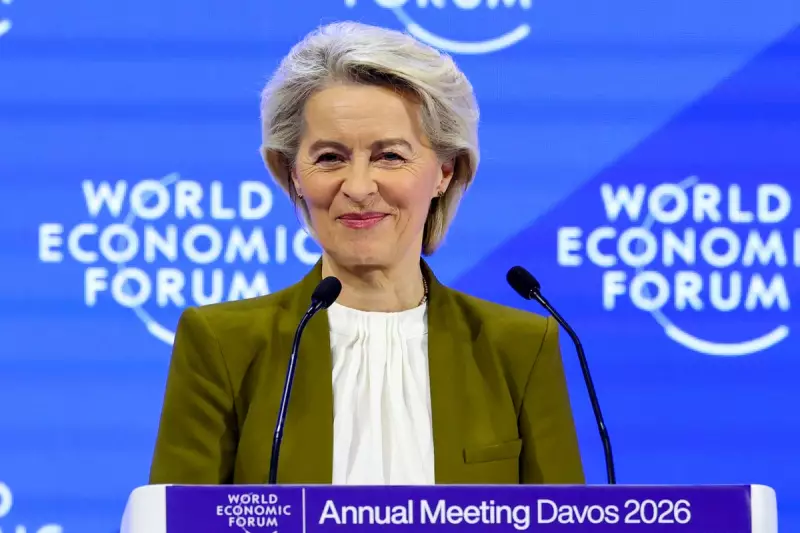
European Commission President Ursula von der Leyen has declared that the European Union is on the verge of signing a monumental trade agreement with India, describing it as the "mother of all deals." The announcement, made at the World Economic Forum in Davos, signals the completion of long-running negotiations that have spanned nearly two decades.
A Market for Two Billion People
Speaking on Tuesday, von der Leyen revealed that she will travel to India immediately after the Davos forum, where final details are expected to be ironed out. "There's still work to do. But we are on the cusp of a historic trade agreement," she stated, emphasising that the pact would create an integrated market serving approximately 2 billion consumers across Europe and India.
Optimism from European Leaders
This sentiment was echoed by Spain's Foreign Minister, Jose Manuel Albares, during his visit to Delhi on Wednesday. He expressed confidence that a deal could be concluded within the coming days, adding diplomatic weight to von der Leyen's announcement.

The journey to this point has been protracted. Negotiations for a free trade agreement between India and the EU commenced in 2007 but were shelved in 2013 due to unresolved issues. Talks resumed in 2022, only to stall again over contentious matters such as market access for European automobiles and alcoholic beverages.
Strategic Timing and High-Level Diplomacy
Von der Leyen is scheduled to arrive in India on 25 January for a three-day official visit. Alongside European Council President Antonio Luís Santos da Costa, she will attend India's Republic Day celebrations in Delhi on 26 January as a chief guest. The visit will culminate in an India-EU summit with Prime Minister Narendra Modi, where the conclusion of trade negotiations is anticipated to be formally announced.
Economic Significance and Scale
The EU currently stands as India's largest trading partner, surpassing both the United States and China. Bilateral trade reached over $130 billion in the 2023-24 period, marking an impressive increase of nearly 90 percent over the past decade. Approximately 6,000 European companies are already operational within India, a number expected to grow significantly post-agreement.
This trade deal is poised to dismantle numerous barriers, facilitating increased exports from European firms to India while simultaneously opening markets on both sides. If signed, it will represent India's most extensive free trade agreement to date in terms of economic scale and regulatory coverage, granting preferential access to all 27 EU member states through a unified framework.
Broader Geopolitical Context
The EU's push to finalise this agreement occurs against a backdrop of shifting global dynamics. The bloc is actively seeking to strengthen its relationships within the Indo-Pacific region. This move gains urgency as the Donald Trump administration threatens punitive levies against European nations for opposing his ambitions regarding Greenland. EU leaders have condemned these threats as economic coercion and are preparing potential retaliatory measures, including tariffs and the activation of the bloc's anti-coercion instrument.
Importance for India's Trade Strategy
For India, the negotiations with the EU have taken on heightened importance following recent trade tensions with the United States. The US has imposed a 25 percent reciprocal tariff on India, coupled with an additional 25 percent levy for its purchases of Russian oil. Concurrently, India and the US have struggled to finalise their own bilateral trade agreement, with both sides repeatedly describing themselves as "very near" a deal without reaching a conclusive endpoint.
The impending EU-India pact, therefore, represents not merely an economic milestone but a strategic realignment. It underscores a mutual desire to forge resilient supply chains and reduce dependency on volatile partnerships. As von der Leyen prepares for her pivotal visit, the stage is set for what could be one of the most significant trade alignments of the decade, reshaping economic flows between two of the world's major democratic blocs.