Senior Irish politicians have issued a stark warning that Donald Trump's threats to impose tariffs on European allies over Greenland could unravel a major EU-US trade agreement and provoke a damaging economic confrontation.
‘Deeply Regrettable’ Threats Risk Trade War
On Tuesday 20 January 2026, Irish Foreign Minister Helen McEntee and Taoiseach Micheál Martin responded forcefully to the US President's ultimatum. Mr Trump has stated he will hit eight European nations with 10% tariffs from 1 February unless they agree to his proposed purchase of Greenland, a semi-autonomous Danish territory. He has also refused to rule out using military force to seize the island.
Speaking ahead of a cabinet meeting, Ms McEntee described the situation as “deeply regrettable”, while the Taoiseach expressed hope that “common sense will prevail”. Their comments coincided with the departure of world leaders, including Mr Trump, for the World Economic Forum in Davos, Switzerland.

EU Prepared to Respond with €93bn Counter-Measures
Minister McEntee made it clear that European support for Denmark and Greenland is “absolute”. She warned that if the threatened tariffs are enacted, €93 billion worth of EU counter-measures would be back under active consideration. “The EU needs to respond strongly,” she told reporters.
“A threat of tariffs on eight member states is essentially a threat of tariffs on all member states,” McEntee stated. “It would be hugely regrettable for last year’s deal between the US and the EU to essentially be ripped up.” She emphasised that the tariff threats would not alter Europe's resolve regarding Greenland.
The Foreign Minister called for intensified dialogue with the US in the coming days but stressed the importance of having “a number of possible options to respond” if the threats materialise.
‘Crucial’ Days Ahead for Transatlantic Relations
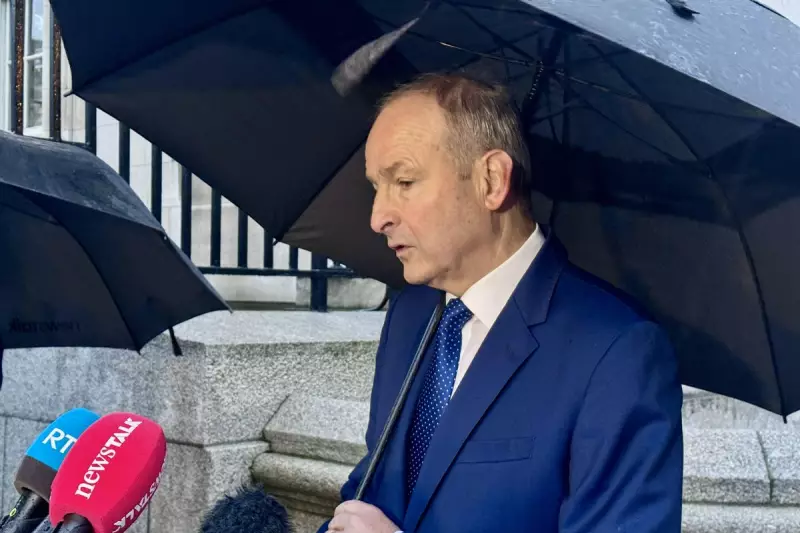
Taoiseach Micheál Martin, speaking outside Government Buildings in Dublin, cautioned that a trade war would be “very, very damaging indeed” for workers across Europe, the United States, and the wider global economy. He urged for calm, referencing the previous year's challenges and the need to avoid reacting to every statement.
Echoing the urgency, Ireland's deputy premier and finance minister, Simon Harris, declared the next few days “crucial” for EU-US relations. Attending a Eurogroup meeting in Brussels, Mr Harris said there was “not an hour to spare” in efforts to de-escalate the tension.
“This has the potential to cause a spiral of destabilising actions that could have dire consequences,” Harris warned. “Cool heads must prevail, and there is not a moment to lose... We are always stronger – the EU and the US – when we co-operate.”
The unified message from Dublin highlights significant concern that the dispute over Greenland could trigger a severe diplomatic and economic rift between the European Union and the United States.