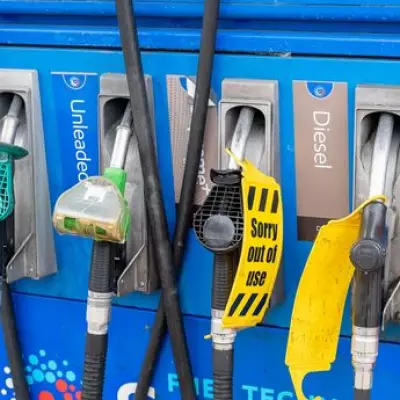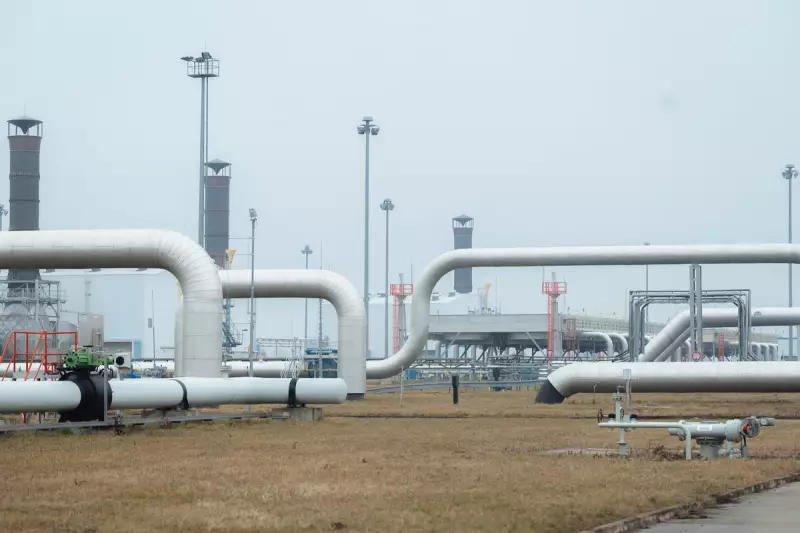
Slovakia is poised to initiate legal proceedings against the European Union following its decision to impose a comprehensive ban on Russian gas imports, Prime Minister Robert Fico confirmed on Tuesday. This announcement, reported by the news outlet Dennik N, comes just one day after EU member states granted their final approval to the landmark legislation.
Final Approval and Opposition
The EU's move, which received its conclusive endorsement from member nations on Monday, is designed to legally enforce a complete cessation of Russian gas imports by late 2027. This action solidifies the bloc's commitment to severing economic links with its former primary supplier, nearly four years after Russia launched its full-scale invasion of Ukraine.
Both Slovakia and Hungary cast dissenting votes against the measure. Hungary has already declared its intention to contest the law at the European Court of Justice, signalling a significant rift within the union over energy policy.

Overcoming Resistance
The ban was strategically crafted to be ratified by a reinforced majority of countries, a mechanism that enabled it to bypass opposition from Hungary and Slovakia. These two nations remain substantially dependent on Russian energy imports and have expressed a desire to preserve close diplomatic and economic relations with Moscow.
Under the specific terms of the agreement, the European Union will prohibit imports of Russian liquefied natural gas (LNG) by the conclusion of 2026. The ban on pipeline gas is scheduled to take effect by 30 September 2027.
The legislation incorporates a degree of flexibility, permitting this deadline to be extended to no later than 1 November 2027. This provision is applicable if a member state encounters difficulties in replenishing its gas storage facilities with non-Russian supplies ahead of the winter season.
Shifting Energy Landscape
Prior to 2022, Russia was responsible for supplying more than 40 per cent of the European Union's total gas consumption. According to the most recent EU data available, this share had diminished to approximately 13 per cent by 2025, illustrating a substantial shift in energy procurement strategies.
However, several EU countries continue to make substantial payments to Moscow for oil, pipeline gas, and liquefied natural gas. This ongoing financial flow appears to contradict their stated efforts to support Ukraine and restrict funding to Russia's wartime economy.
Substantial Financial Flows
Data from the non-profit Centre for Research on Energy and Clean Air revealed that last month alone, the five largest EU importers of Russian energy expended a collective €1.4 billion (equivalent to $1.66 billion). The majority of this expenditure was directed towards gas and LNG purchases.
Hungary emerged as the single biggest purchaser within this group, followed by France and Belgium. This underscores the complex economic dependencies that persist despite broader geopolitical tensions.
Legal Framework and Penalties
The European Union had previously imposed sanctions on Russian seaborne oil in 2022. Notably, it never formally proposed sanctions on gas imports, as such a measure would have required unanimous approval from all 27 member states—a threshold likely impossible to achieve given the existing divisions.
The newly enacted law explicitly prohibits companies from entering into new contracts for Russian gas. Furthermore, it mandates that firms with existing agreements must terminate these contracts to ensure full compliance with the ban.
Contractual Deadlines and Consequences
For existing contracts, imports under short-term deals that were signed before 17 June 2025 will face prohibition on 25 April 2026 for LNG, and on 17 June 2026 for pipeline gas. Long-term contracts are required to be phased out in alignment with the final deadlines established by the legislation.
Companies found to be in violation of these regulations could be subject to severe financial penalties. These fines may reach up to 3.5 per cent of a company's total global annual turnover, presenting a significant deterrent against non-compliance.

Future Regulatory Measures
Looking ahead, the European Commission has announced plans to introduce additional legislation in the coming months. This forthcoming proposal will aim to phase out imports of Russian pipeline oil and assist member states in reducing their reliance on Russian nuclear fuel, marking a continued effort to decouple from Russian energy sources entirely.