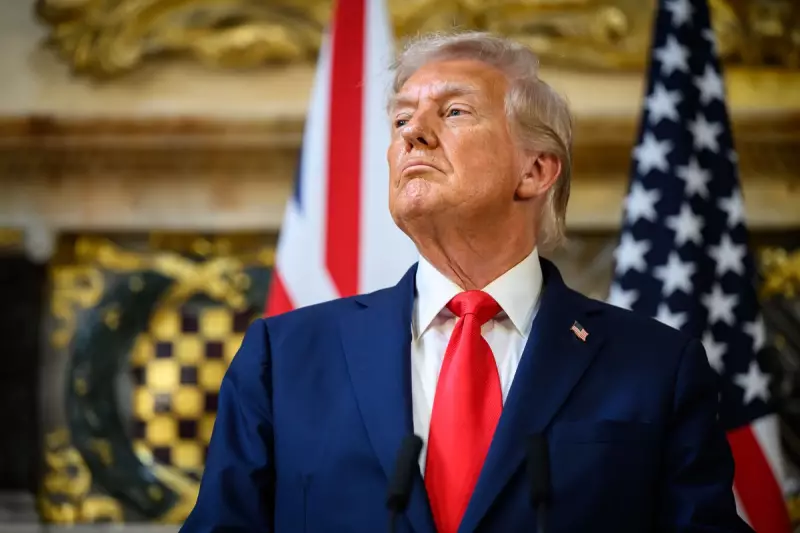
US President Donald Trump has ignited a major transatlantic trade row by announcing sweeping tariffs on the United Kingdom and several European allies, linking them directly to his administration's stalled ambition to purchase Greenland.
Tariff Threat Over Arctic Ambitions
In a post on his Truth Social platform on Saturday 17 January 2026, President Trump declared that the UK would face a 10% tariff "on any and all goods" sent to the United States starting from 1 February 2026. He stated this levy would be sharply increased to 25% from 1 June 2026. The punitive measures, he said, would remain in place "until such time as a Deal is reached for the Complete and Total purchase of Greenland."
Trump accused the UK, alongside Denmark, Norway, Sweden, France, Germany, the Netherlands, and Finland, of having "journeyed to Greenland, for purposes unknown," creating a "potentially perilous situation." He asserted that the move was necessary to protect "Global Peace and Security" and prevent rivals like China and Russia from gaining influence over the vast Arctic territory.

Cross-Party Fury in Westminster
The announcement prompted immediate and rare cross-party condemnation from UK political leaders, who warned of severe economic consequences.
Tory leader Kemi Badenoch labelled the plan a "terrible idea," stating President Trump was "completely wrong" to impose the tariffs. "These tariffs will be yet another burden for businesses across our country," she warned on social media, adding that the sovereignty of Greenland should be decided solely by its people.
Reform UK leader Nigel Farage, often a vocal supporter of Trump, broke ranks, stating, "We don't always agree with the US government and in this case we certainly don't. These tariffs will hurt us." Liberal Democrat leader Sir Ed Davey accused Trump of "punishing the UK and Nato allies just for doing the right thing" and called on the Prime Minister to stand firm against the "bully in the White House."
Military Moves and Mounting Tensions
The tariff threat follows heightened military activity in the region. Earlier in the week, Downing Street confirmed it had sent one UK military officer at Denmark's request to join a reconnaissance group ahead of a planned Arctic Endurance exercise, though it denied this constituted a formal "deployment."
Denmark's defence minister, Troels Lund Poulsen, had warned that "no-one can predict what will happen tomorrow" regarding the Arctic situation. Meanwhile, public opposition to any US takeover was demonstrated by rallies in Greenland's capital, Nuuk, and across Denmark on Saturday.
This episode marks a significant escalation in Trump's long-standing pursuit of Greenland, which his administration has previously threatened to annex by force. Since the start of 2026, Prime Minister Sir Keir Starmer has reportedly raised Arctic security in calls with Trump, Danish PM Mette Frederiksen, and NATO Secretary-General Mark Rutte.
The new tariffs compound existing trade pressures, coming less than a year after Trump's "Liberation Day" tariffs imposed an additional 10% charge on UK imports. The move now places the UK government in a precarious position, caught between supporting a NATO ally, Denmark, and facing severe economic penalties from its closest security partner, the United States.