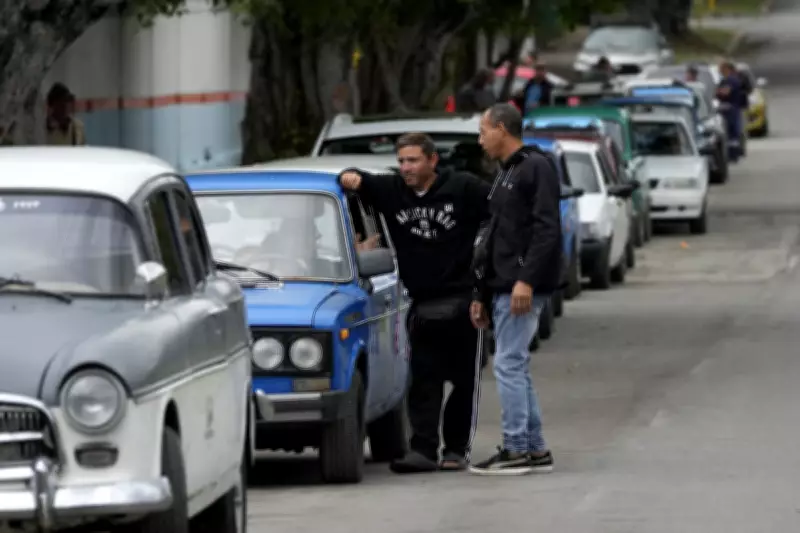
Anger and anguish have spread across Cuba as news emerges of a tariff threat from former US President Donald Trump targeting countries that provide oil to the Caribbean island. Massive power outages have left many Cubans unaware of the development, which threatens to exacerbate an already severe economic crisis.
Widespread Blackouts Obscure Critical News
Extensive electricity failures across Cuba meant numerous residents awoke on Friday completely unaware that Donald Trump had threatened to impose tariffs on any nation selling or supplying oil to their country. As word gradually spread through Havana and beyond, frustration and despair boiled over regarding a decision that promises to make life even more challenging for Cubans already grappling with intensified US sanctions.
"This Is a War": Voices From the Ground
Lázaro Alfonso, an 89-year-old retired graphic designer, described Trump as the "sheriff of the world" and compared the situation to living in the Wild West. Having survived the severe economic depression of the 1990s known as the "Special Period," Alfonso contends the current circumstances are worse, marked by severe blackouts, shortages of basic goods, and fuel scarcity.

"The only thing that's missing here in Cuba...is for bombs to start falling," he stated grimly.
Yanius Cabrera Macías, a 47-year-old street vendor selling bread and sweet snacks, expressed disbelief that Cuba could be considered a threat to the United States. "Cuba is a threat to Cubans, not to the United States. For us Cubans here, it is the government that is a threat to us," he said, adding that Trump's latest measure would impact ordinary people most severely. "In the end, it's the people who suffer...not the governments."
Economic Crisis Deepens
Cuba faces daily widespread outages attributed to fuel shortages and deteriorating infrastructure, worsening an economic crisis already exacerbated by declining tourism, increased US sanctions, and a failed internal financial reform aimed at unifying the currency. The prospect of new restrictions on oil shipments has heightened anxieties among the population.
Trump previously indicated he would halt oil shipments from Venezuela, Cuba's principal ally, following US actions against the South American nation. Meanwhile, speculation mounts that Mexico might reduce its shipments to Cuba.
International Responses and Uncertainties
Mexican President Claudia Sheinbaum stated on Friday that she would explore alternatives to continue assisting Cuba and prevent a humanitarian crisis following Trump's announcement. One potential option could involve the United States managing the shipment of Mexican oil to the island, though details of Trump's order require clarification first.
Mexico and Russia have become crucial fuel suppliers to Cuba after US sanctions on Venezuela disrupted crude oil deliveries. Jorge Piñon, an expert at the University of Texas Energy Institute who monitors shipments via satellite technology, highlighted the critical uncertainty: how many days' worth of fuel does Cuba actually possess?
Piñon warned that if no tanker appears within the next four to eight weeks, Cuba's future looks bleak. "This is now a critical situation because the only country we had doubts about was Mexico," he noted, emphasising that diesel serves as "the backbone of the Cuban economy."
He further explained that China lacks oil reserves and can only offer credit for Cuba to purchase oil from third parties. Russia, meanwhile, remains a "wild card" due to existing sanctions that might not deter Vladimir Putin, with much Russian oil seeking destinations amid those restrictions.
Daily Life in Darkness
Many Cubans continue to endure prolonged darkness. Luis Alberto Mesa Acosta, a 56-year-old welder, frequently cannot work due to ongoing outages, which evoke memories of the "Special Period." "I don't see the end of the tunnel anywhere," he lamented, urging Cubans to unite and support one another.
Daily power demand in Cuba averages approximately 3,000 megawatts, roughly half of what's available during peak hours. Dayanira Herrera, mother of a five-year-old boy, struggles to care for her child amid the blackouts, spending evenings on their stoop. Upon hearing Trump's announcement, she described the potential impact as "the end of the world" for Cuba.