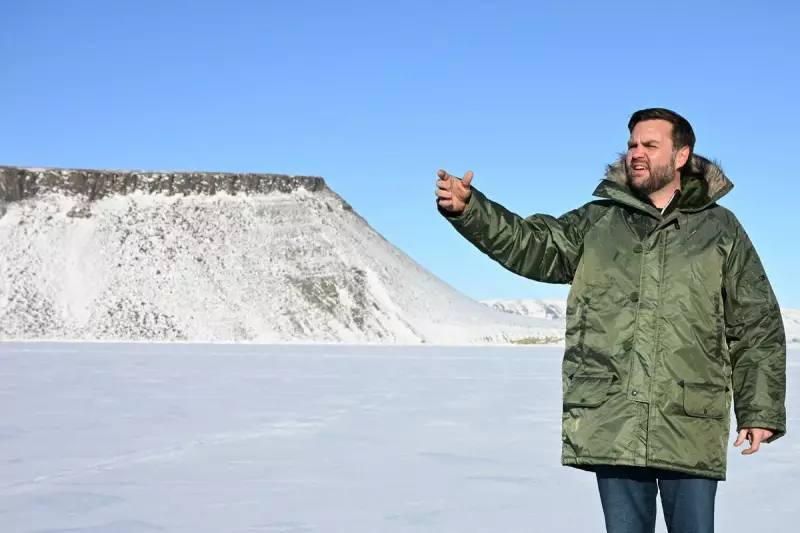
Former US President Donald Trump has issued a stark ultimatum to the United Kingdom, Denmark, and several other European nations, threatening to impose punitive tariffs unless they acquiesce to a US takeover of Greenland. The move, which has sent shockwaves through diplomatic circles, underscores the island's escalating strategic value in an era of heightened geopolitical tension and climate change.
The Tariff Threat and International Backlash
On Saturday 18 January 2026, Trump declared that 10 per cent tariffs would be levied on Denmark, Norway, Sweden, France, Germany, the UK, the Netherlands, and Finland from February 1. He warned these would rise to a staggering 25 per cent on June 1 and remain in place until a deal is secured for the United States to purchase Greenland. "World Peace is at stake! China and Russia want Greenland, and there is not a thing Denmark can do about it," Trump asserted, framing the demand as a national security imperative.
This aggressive stance has been firmly rejected by Denmark, a longstanding US ally and NATO member, as well as by Greenland's own self-governing administration. Trump's senior advisor, Stephen Miller, has controversially declared that Greenland should be part of the US and that "nobody will fight" over its future, a claim contradicted by the current diplomatic standoff.

Five Strategic Imperatives Driving US Interest
The confrontation is not merely rhetorical but is rooted in profound strategic calculations. A confluence of factors—from melting Arctic ice to the global race for critical minerals—has thrust Greenland into the centre of international power politics.
1. A Pivotal Arctic Location
Greenland's geography is its primary asset. Situated off northeastern Canada, with over two-thirds of its landmass inside the Arctic Circle, it has been vital to North American defence since the US occupied it during the Second World War. Today, climate change is thinning Arctic ice, opening new shipping routes like the Northwest Passage and intensifying competition with Russia and China for access and influence. The Trump administration accuses Denmark of failing to adequately bolster regional security.
2. Riches in Rare Earth Minerals
The island is a treasure trove of rare earth minerals, essential components for smartphones, computers, electric vehicle batteries, and advanced military hardware. As Western powers seek to break China's dominance over these critical supply chains, Greenland's resources have become a focal point. However, exploitation is hampered by a harsh climate and stringent environmental protections, which have deterred some investors.
3. Established US Military Footprint
The United States already maintains a significant military presence through the Pituffik Space Base in northwestern Greenland. Established under the 1951 Greenland Defence Agreement with Denmark, this base is crucial for US and NATO missile warning, defence, and space surveillance. Greenland also forms part of the strategic GIUK (Greenland, Iceland, UK) Gap, a naval chokepoint where NATO monitors Russian movements in the North Atlantic.
4. Denmark's Reinforced Defence Posture
In response to growing Arctic tensions, Denmark has moved to strengthen its sovereignty. In 2025, a 14.6 billion-kroner (£1.7bn) agreement was announced with Greenland and the Faroe Islands to enhance surveillance, including new Arctic naval vessels and drones. A further 27.4 billion-kroner investment was pledged in October 2025 for maritime patrol upgrades. Denmark's Joint Arctic Command, headquartered in Nuuk, and the elite Sirius Dog Sled Patrol are key components of this defensive architecture.

5. Mounting Security Threats in the Arctic
The region is attracting ambitious global players. In 2018, China declared itself a 'near-Arctic state' and proposed a 'Polar Silk Road', raising concerns about its long-term intentions. Former US Secretary of State Mike Pompeo warned against the Arctic becoming a new South China Sea. Simultaneously, Russian President Vladimir Putin has voiced alarm over NATO's Arctic activities, promising to strengthen Russia's military capabilities there—a concern magnified since the 2022 invasion of Ukraine.
Implications and the Path Forward
The threat of sweeping tariffs against close allies marks a dramatic escalation, testing the resilience of transatlantic partnerships. US Vice-President JD Vance's visit to Greenland last year highlighted the territory's importance to the current administration's thinking. With Greenland's population firmly opposed to the takeover and European capitals rallying behind Denmark, a protracted diplomatic and trade dispute seems inevitable. The outcome will not only determine Greenland's future but also set a precedent for how strategic resources in a rapidly changing Arctic are contested in the 21st century.