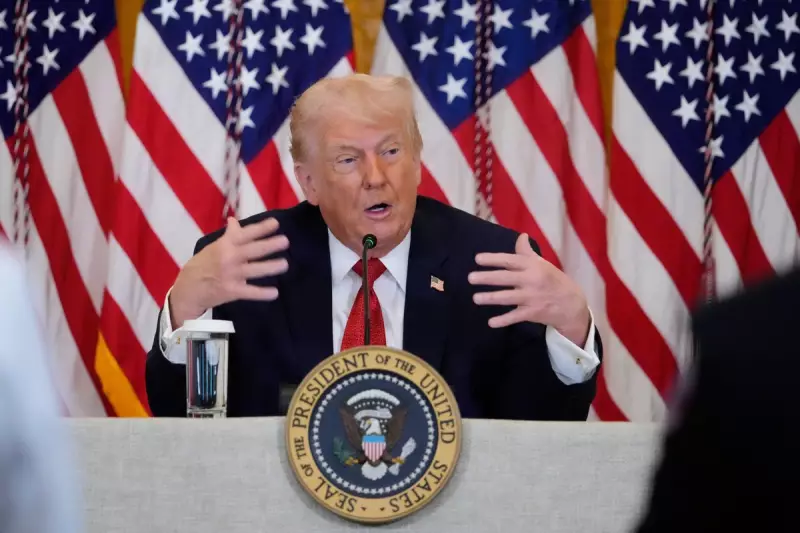
Former US President Donald Trump has issued a stark warning to the United Kingdom, threatening to impose significant new tariffs on British goods if the government maintains its opposition to American plans to acquire Greenland. The threat escalates a diplomatic row centred on the strategically vital Arctic island.
The Tariff Threat and Its Triggers
Mr Trump stated his desire to take over Greenland due to its strategic Arctic location and substantial mineral wealth. He has warned that the UK could face additional tariffs from next month if it does not support the US ambition. The UK is among several allies, including France, Germany, and the Netherlands, who have voiced opposition to the plan.
Prime Minister Sir Keir Starmer has responded by urging the United States to avoid military action or a trade war. He called for the issue to be resolved through "calm discussion between allies," expressing scepticism that Mr Trump's threats of military action in Greenland were genuine.

Understanding the Proposed Tariffs and Their Mechanics
Tariffs are a tax levied on products imported into a country, typically calculated as a percentage of the price paid to the foreign seller. In this scenario, a US company purchasing goods from a UK supplier would have to pay an extra amount to the US government.
Mr Trump has explicitly stated he would charge the UK a 10 per cent tariff "on any and all goods" sent to the US from 1 February 2026. This would then rise sharply to 25 per cent from 1 June, pending a deal for Washington to purchase Greenland from Denmark. It remains unclear how this would affect products like UK steel and cars, which currently benefit from tariff exemptions under last year's economic prosperity deal.
These import taxes are collected by the national customs authority. In the US, this is handled by Customs and Border Protection at ports of entry. Companies must correctly classify their goods using an internationally recognised 10-digit HTS code to determine the exact duty owed.
Potential Economic Fallout for the United Kingdom
Economists are assessing the potential damage to the UK, which has high exposure to the US market. Neil Shearing, chief economist at Capital Economics, suggested the wider effect would be "modest" but could "shave a few tenths of a percentage point off GDP in the affected economies."
He indicated that a 10 per cent tariff could reduce UK GDP by around 0.1 per cent, while a 25 per cent tariff could knock 0.2–0.3 per cent off economic output. Analysts at Goldman Sachs, Giovanni Pierdomenico and Sven Jari Stehn, projected a potentially higher impact, with the 25 per cent tariff affecting GDP by between 0.25 and 0.5 per cent.
The threat also carries an inflationary risk. Economists at Deutsche Bank warned that a "renewed threat of trade war, however, could disrupt the UK’s swift disinflation process," following a drop in inflation to 3.2 per cent in November 2025.
Key UK Industries in the Firing Line
Certain sectors would feel the brunt of the tariffs more acutely due to their export reliance on the American market.
The UK's biggest export to the US is machinery, including cars, engines, and turbines. The automotive sector, which secured valuable tariff exemptions last year, now faces renewed uncertainty.
Consumer goods sectors are also highly vulnerable. Scotland's iconic whisky industry, which exported nearly £1 billion worth of Scotch to the United States in 2024, would be particularly exposed to additional costs that could dampen demand.
The coming weeks will test the resilience of the UK-US trade relationship as the February deadline looms, with British policymakers hoping for a diplomatic solution to avert a costly economic confrontation.