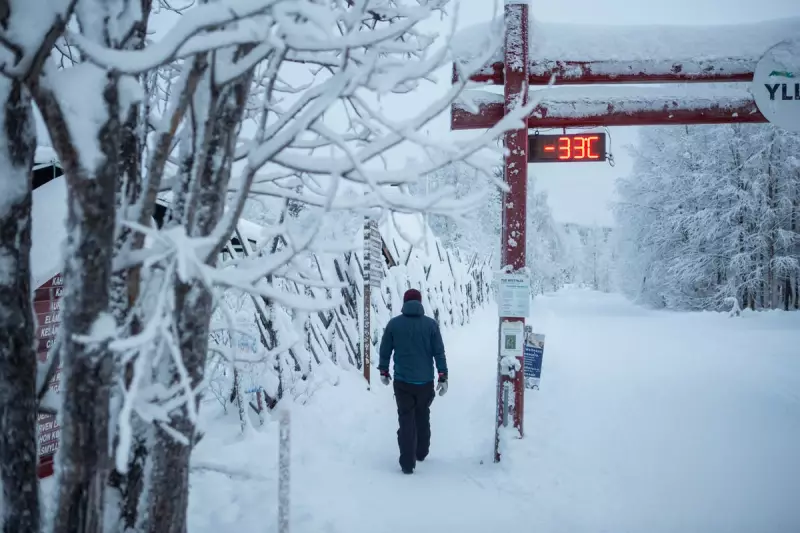
A severe Arctic freeze and heavy snowfall have plunged parts of Europe into travel chaos, leaving thousands of tourists stranded and disrupting transport networks across the continent.
Northern Finland Gripped by Extreme Cold
The situation is most acute in Finnish Lapland, where a deep freeze forced the cancellation of all flights at Kittilä Airport on Sunday, 11 January 2026. Temperatures at the airport plunged to a staggering minus 37 degrees Celsius (minus 34.6 Fahrenheit), making critical operations like aircraft de-icing impossible. Finland's national broadcaster, Yle, reported the issue.
The Finnish Meteorological Institute forecasts the bitter cold will persist, with temperatures in Kittilä expected to near minus 40 degrees Celsius (minus 40 Fahrenheit) on Monday. While Finns are accustomed to harsh winters, this cold snap is notably more severe than usual and is affecting a wide area of northern, central, and eastern Europe.

Widespread Transport Disruption Across the Continent
The travel woes extend far beyond Scandinavia. In Germany, national rail operator Deutsche Bahn halted all long-distance services in the north of the country on Friday due to heavy snow, stranding thousands. Delays and cancellations continued into Sunday. Authorities in North Rhine-Westphalia, Germany's most populous state, announced all schools would switch to online classes on Monday due to forecasts of dangerously icy roads.
In the Czech Republic, a major road linking Prague to Germany was blocked for hours by stranded lorries near the border, while public transport in the capital Prague ground to a halt in some areas. The Baltic states also faced severe conditions, with Estonia and Lithuania advising against all non-essential travel due to expected blizzards, and Latvia issuing a snow alert for its western regions.
Storm Goretti Brings Power Cuts and Coastal Standstill
Western Europe faced a different threat from powerful winds. Storm Goretti battered parts of north-west France and caused disruption in the UK. While no major damage was reported, the storm left approximately 320,000 French homes without power at noon on Friday, with most outages concentrated in the Normandy region. Meteo-France had issued urgent warnings, advising residents to stay indoors.
On Germany's North Sea coast, ferry services to several islands were largely suspended as strong easterly winds made them inaccessible by boat. The treacherous conditions have also turned deadly. German news agency dpa reported two separate fatal road accidents in Bavaria and the Upper Palatinate region, both believed to be caused by vehicles skidding on icy roads.
This confluence of extreme cold, heavy snow, and high winds has created one of the most significant winter travel disruptions in recent years, highlighting the vulnerability of European infrastructure to severe weather events.