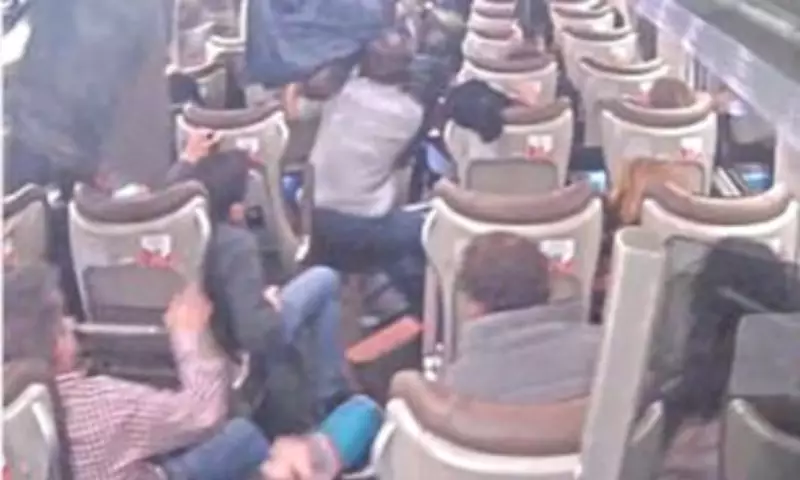
Harrowing images from inside a high-speed train have been released for the first time, capturing the final moments before a derailment that killed 46 people in Spain. The pictures, included in a Civil Guard report now submitted to a judge in Montoro, show the impact of tearing through the rear carriages just before the lights went out.
Details of the Crash
The dossier also documents the precise moment the Iryo service left the tracks near Adamuz, in Córdoba province, after a rail fractured - triggering a catastrophic chain of events that forced an oncoming Alvia train into an emergency stop. Passengers were thrown about by sudden lateral and vertical jolts as the carriages violently shook, with some seen clinging on to avoid being hurled to the floor.
Footage showed what investigators described as 'incandescent fragments' flashing past the windows - believed to be sparks from metal grinding against the track as the train came off the rails. Investigators have since concluded that the tragedy on January 18 was caused by a break in the rail, ruling out any faults with either of the trains involved.

Sequence of Events
The crash occurred on January 18 when the tail end of a train carrying some 300 passengers on the route from Malaga to the capital, Madrid, went off the rails. The incoming train, which was travelling from Madrid to Huelva and carrying nearly 200 passengers, slammed into the derailed vehicle. The second train took the brunt of the impact, after the collision knocked its first two carriages off the track and sent them plummeting down a 13ft slope.
Video and photos showed twisted train cars lying on their sides under floodlights on the evening of the incident. Passengers reported climbing out of smashed windows, with some using emergency hammers to break the windows, according to Salvador Jiménez, a journalist for Spanish broadcaster RTVE, who was on board one of the derailed trains. He told the network by phone Sunday that 'there was a moment when it felt like an earthquake and the train had indeed derailed.'
Investigation Findings
The Civil Guard determined that the crash occurred at 7.43pm, after adjusting recorded times, with the Iryo travelling at 130mph at the moment of derailment. 'The analyzed data does not show any anomalies in either of the two trains involved before the second 19.4.33, at which time car 6 of the Iryo train travels at the point of breakage of the outer wire of track 2,' the report explains. 'For this reason, it is concluded that the cause of the derailment and subsequent collision was the existence of a rail break at the height of PK 318.681.'
However, investigators cautioned that their findings are not yet final. He adds that his conclusions 'are provisional until the final report is written' and warns that 'new findings may appear during the investigation that modify the hypotheses taken into account.'
Technical Analysis
Spain's Railway Accident Investigation Commission (CIAF) has also examined audio from the Alvia driver's cab, CCTV footage from the Iryo train, and the so-called 'black boxes' from both services. The accident itself was initially logged at 19:43:21 at kilometre marker 319.412, when the train was travelling at 215 km/h. But technicians later discovered that the Alvia's onboard recording system was running two minutes and 22 seconds slow.
After correcting the discrepancy, the emergency braking was timed at 19:43:37 - leaving a margin of just two seconds in the sequence of events. Although all timings have been aligned as closely as possible, investigators warned there remains 'a margin of error of up to one second in the times shown' and 'up to about 70 meters' in the kilometre markers provided.