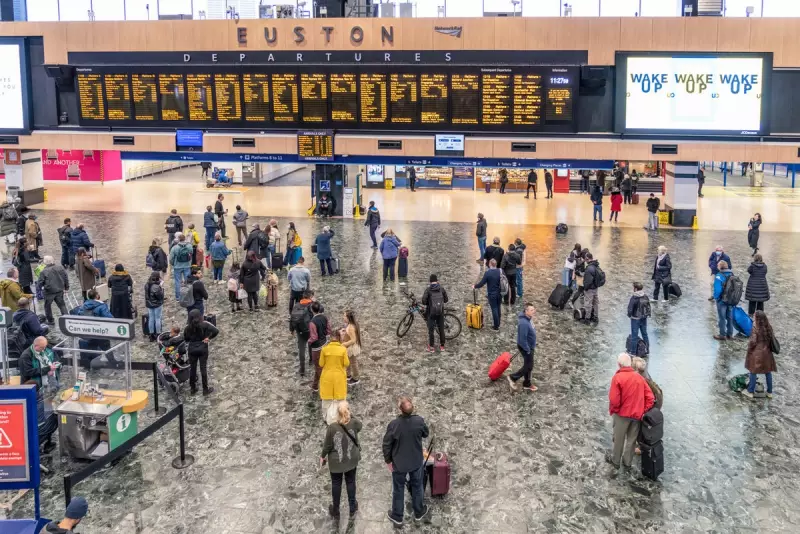
Winter travel chaos frequently leaves passengers stranded on platforms, but knowing your rights can turn frustration into a partial refund. While most UK rail operators offer compensation for delays as short as 15 minutes, significant disparities exist, with firms like Grand Central and Eurostar maintaining notably less generous policies.
Understanding Delay Repay: The Standard UK Scheme
The widely adopted Delay Repay scheme provides a no-fault compensation system, meaning payouts are made regardless of what caused the disruption. For most train companies, including giants like Avanti West Coast, Govia Thameslink, and Great Western Railway, the structure is clear-cut. Passengers are entitled to a 25% refund for delays of 15 to 29 minutes, 50% for 30 to 59 minutes, and a full single fare refund for hold-ups of an hour or more.
However, a handful of operators, such as LNER, Lumo, ScotRail, and the Caledonian Sleeper, only begin payments once a delay reaches the 30-minute threshold. The most stringent domestic policy belongs to Grand Central, which links London with Bradford and Sunderland. Its passengers receive nothing for delays under an hour, only 50% back for one-to-two-hour delays, and must endure over three hours of disruption to qualify for a full refund.

The Eurostar Exception and How to Claim
Cross-Channel services operate under a different, less favourable regime. Eurostar's delay compensation is markedly meagre compared to domestic firms. Travellers delayed between 60 and 119 minutes receive just 25% of the affected leg's cost as cash, or 30% as a voucher. A delay of two hours or more triggers a 50% cash refund. The company may cover accommodation and meals if passengers are stranded overnight at a station, but cash payouts are significantly lower.
Claiming a refund has been simplified by many operators through auto delay repay, where compensation is issued automatically if you've opted in. For manual claims, you'll need your ticket details, journey information, and proof of delay. The process typically takes around ten minutes, and all claims must be submitted within four weeks of the delayed journey. Payments are usually made via Bacs, card refund, or e-voucher within days.
Key Scenarios and Passenger Rights
What happens in specific situations? If your train is cancelled, you can usually use an Advance ticket on services immediately before or after the scheduled departure. A delay is only recorded if you take a later train, triggering compensation rights. For severe disruption, if your train is expected to be over 60 minutes late, National Rail conditions allow you to travel on a later date, subject to your ticket's restrictions.
Notably, compensation is generally limited to the ticket price, unlike aviation rules. Claims for consequential losses, like missing a theatre performance, are considered at the train company's sole discretion and are not guaranteed. Furthermore, scheduled engineering work that increases journey times does not qualify for compensation, as the published timetable for that day is the benchmark.
The system's fairness is occasionally questioned, as high-paying business and first-class travellers receive larger absolute refunds for the same delay. The future may bring change, with hopes that Great British Railways could unify and clarify the rules. For now, passengers are advised to understand their specific operator's policy, keep their ticket details, and claim promptly to secure the refunds they are owed.