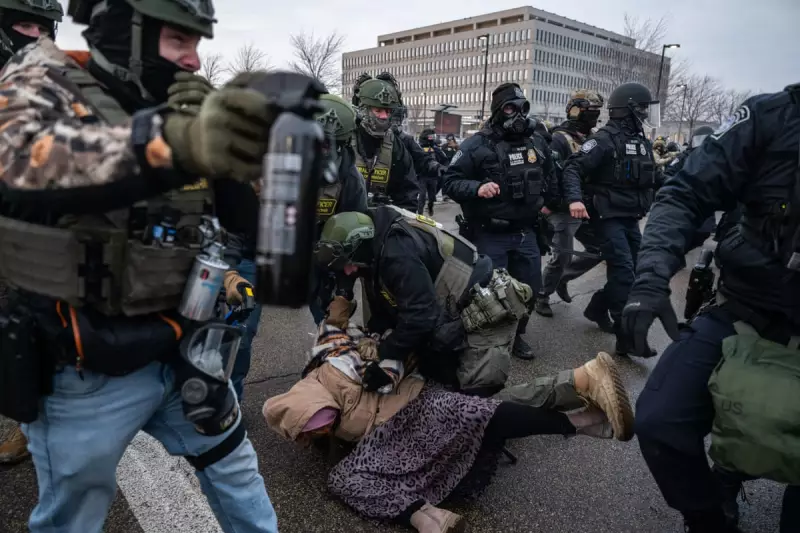
In a significant legal development, a United States appeals court has granted federal immigration authorities expanded powers to intervene in demonstrations, temporarily permitting officers to use pepper spray and make arrests among peaceful protesters in Minnesota.
Court Overturns Injunction on ICE Tactics
The eighth US circuit court of appeals issued an administrative stay on Wednesday, effectively lifting a preliminary injunction that had been imposed just days earlier by federal judge Katherine Menendez. This judicial reversal represents a notable victory for the Trump administration's justice department, which had urgently requested the intervention.
Judge Menendez's original ruling, delivered last Friday, had established substantial limitations on Immigration and Customs Enforcement (ICE) operations during protests. Her injunction specifically prohibited agents from retaliating against peaceful demonstrators, making arrests or detentions of individuals engaged in lawful protest activities, deploying pepper spray or comparable non-lethal munitions and crowd control equipment, and stopping or detaining drivers without reasonable suspicion.

First Amendment Concerns and Government Response
In her initial decision, Judge Menendez determined that the actions of federal immigration agents were creating what she described as a "chilling effect" on protesters' constitutionally protected First Amendment rights. She argued that the threat of federal intervention was suppressing legitimate political expression and assembly.
The Department of Homeland Security (DHS) swiftly defended ICE's operational methods following the injunction. Agency spokesperson Tricia McLaughlin stated emphatically: "DHS is taking appropriate and constitutional measures to uphold the rule of law and protect our officers and the public from dangerous rioters." This position underscores the administration's firm stance on maintaining public order through assertive law enforcement tactics.
Political Context and Vice-Presidential Visit
This contentious legal decision arrives as Vice-President JD Vance prepares to visit Minneapolis on Thursday. According to official White House communications, Vance intends to "hold a roundtable with local leaders and community members and will deliver remarks focused on restoring law and order in Minneapolis." His scheduled appearance highlights the national political significance of the ongoing situation in Minnesota.
Escalating Tensions and Fatal Incident
ICE operations within Minnesota have attracted increasing scrutiny and criticism in recent weeks, with public outrage intensifying following the fatal shooting of Renee Good, a 37-year-old mother of three, by a federal agent. This tragic incident has sparked substantial protests both statewide and across the country, amplifying calls for accountability and reform of federal law enforcement practices.
In response to mounting public pressure, DHS has consistently supported ICE's conduct, maintaining that agents have operated within legal boundaries and employed force strictly in self-defence situations when they perceived genuine threats to their safety.
State Leadership Opposition and Federal Subpoenas
Minnesota's state leadership has vehemently rejected the federal government's characterisation of events. Governor Tim Walz, alongside numerous local officials, has condemned the deployment of thousands of federal agents as an unconstitutional and destructive "federal invasion." They describe the operation as a retaliatory campaign that has spread fear throughout communities, undermined fundamental civil liberties, and violated the rights of Minnesota residents.
The justice department has responded to this opposition by issuing subpoenas to several prominent Minnesota Democrats, including Governor Walz and Minneapolis Mayor Jacob Frey. Federal authorities accuse these officials of conspiring to obstruct ICE operations, further escalating the political and legal confrontation between state and federal entities.
This complex situation continues to evolve, balancing concerns about public safety, lawful protest rights, and the appropriate limits of federal law enforcement authority in domestic settings.