Victims of IRA atrocities were left devastated on Friday after a landmark civil trial against former Sinn Féin president Gerry Adams collapsed at the eleventh hour. Three survivors of IRA bomb attacks in England dramatically withdrew their case after two weeks of evidence when it emerged they could be liable to pay Adams' legal fees of up to £500,000.
Defiant Press Conference in Belfast
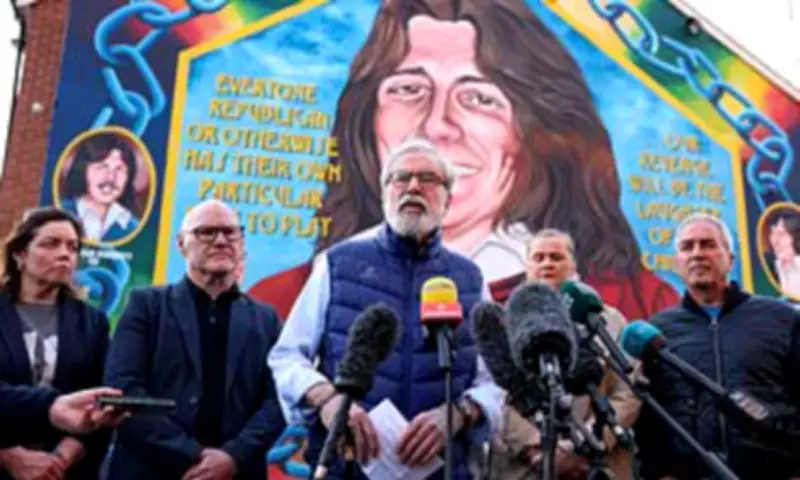
In a brazen move yesterday, Adams, 77, held a press conference in Belfast in front of a mural of IRA hunger striker Bobby Sands. He claimed the civil case, which aimed to prove he was 'directly responsible' for three bomb attacks between 1973 and 1996 owing to his senior role in the IRA, 'verged on a show trial'.
Evidence Presented in Court
The trial heard from 11 witnesses for the claimants, including former Army and police intelligence officers and a former member of the IRA, who all named Adams as being a leading figure in the Provisional IRA over the past 50 years. The court heard he was its 'de facto leader'.

Adams has always denied membership of the IRA, and his legal team said any evidence linking him to the bombings in question was 'bordering on non-existent'. Adams stated: 'I was never a member of the IRA or its Army Council. I have never held a 'command-and-control role' in the IRA and have never been a senior, let alone most senior figure, in the IRA.'
Legal Arguments and Settlement
Edward Craven KC questioned the time taken to bring the claims – more than 50 years in one case – which he said was 'genuinely unprecedented in magnitude'. He argued the case could be considered an abuse of process because the claimants were looking to 'undertake a protracted, wide-ranging public inquiry-style examination of [Adams'] alleged membership of... the IRA over a period of several decades.'
A cost protection order imposed earlier in the four years of legal action – which protected the claimants from paying Adams' legal costs, whatever the result – was at risk if Judge Jonathan Swift found the claim to be an abuse of process. Adams then offered to settle the case on a 'drop hands' basis, meaning both parties walk away and pay their own legal costs.
Claimants Forced to Discontinue
Yesterday, the last scheduled day of the trial before the judge was due to consider his verdict, Anne Studd KC, for the claimants, said that, following discussions, the claim had been 'discontinued' with 'no order as to costs'.
A statement on behalf of the IRA survivors from solicitors McCue, Jury and Partners, said: 'This outcome is not of the claimants' making. Due to an extraordinary series of events, and faced with even a small risk of life-changing financial consequences, the claimants had no realistic choice but to accept the defendant's offer. The claimants consider this deeply unfair.'
It added: 'For the first time, Mr Adams was brought before an English court and compelled to give evidence and face cross-examination on his alleged role. A substantial body of evidence concerning his alleged involvement in the IRA has now been placed on the public record. That material has been widely reported on and, even if the court may not now do so, it will be available for judgment by history.'
Victims' Reactions
Adams was being sued for £1 in damages by John Clark, a victim of the 1973 Old Bailey bombing in London; Jonathan Ganesh, a 1996 London Docklands bombing victim; and Barry Laycock, a victim of the 1996 Arndale bombing in Manchester. Mr Laycock, 86, said he was 'completely devastated'.
'The fair trial we sought – getting Mr Adams into the dock for the first time – was achieved,' he said. 'But somehow we have lost our protection. How is that fair?' Mr Ganesh said: 'This is no victory for Mr Adams. He blinked first, offering settlement while our cost protection was threatened. Out-matched financially, we had to withdraw.'

IRA victims also reacted with fury. Mark Tipper, whose brother, Trooper Simon Tipper, was killed in the Hyde Park bombing in 1982, said: 'I feel for everyone denied justice. Too many IRA terrorists got away with murder but our military have been persecuted through the courts. You have all these people who have given testimony to say he was an IRA leader, yet he continues to deny it. Adams is so far from being the peace-loving angel he says he is. This is another kick in the teeth for those who have served in Northern Ireland.'
Community and Financial Aspects
Kenny Donaldson MBE, of the South East Fermanagh Foundation, which supports victims of terrorism across Northern Ireland, said: 'Mr Adams is understandably spinning this case as vindication of his denials stretching across five decades and more, but the reality is this: the jury still very much remains out in terms of his alleged connectivity with terrorism over the course of The Troubles.'
The claimants raised £120,000 in crowdfunding to finance their case. Adams said he had been 'supported by friends' in paying his own legal costs, and would not seek any costs from the claimants. In Belfast, where somebody shouted 'w*****' at least twice, Adams said the case 'at times verged on a show trial', but he had 'nothing but sympathy' for the claimants.
'I was moved by the testimony of the two people, the two men, who came forward and told of their own personal difficulties and circumstances within the explosions and following the explosions,' he said. Mr Clark was too unwell to give evidence.