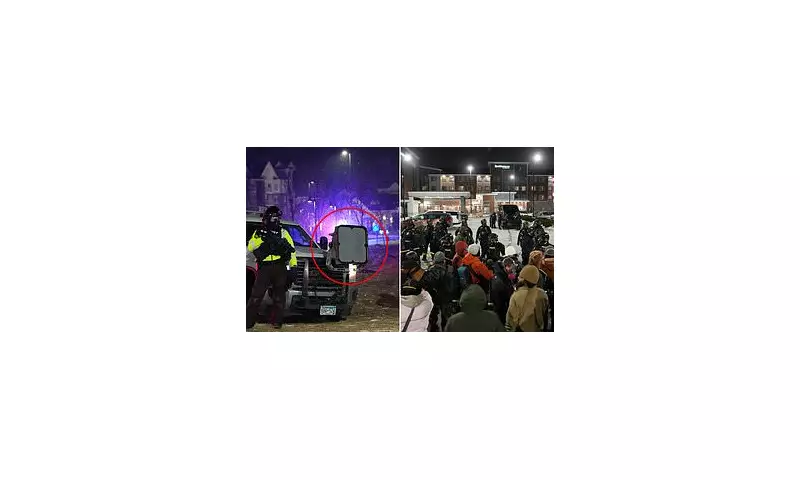
Minnesota State Patrol officers deployed a military-grade acoustic weapon during a tense confrontation with anti-ICE protesters in Maple Grove on Monday night, marking a significant escalation in crowd control tactics during immigration-related demonstrations.
Confrontation Outside Maple Grove Hotel
State patrol troopers faced off with demonstrators outside the SpringHill Suites hotel in Maple Grove, where protesters believed federal immigration enforcement agents were staying. The standoff occurred amid heightened tensions following a shooting incident on Saturday that left 37-year-old Alex Pretti dead after an altercation involving multiple federal officers.
The protest unfolded as federal law enforcement leadership in Minnesota remains in flux, with Border Patrol Commander Gregory Bovino and some agents expected to depart the state following intense public scrutiny of recent immigration authority actions. It remains unclear whether Bovino or other federal agents were actually staying at the Maple Grove hotel where demonstrators gathered.

"Voice of God" Technology Deployed
Officers threatened to activate a Long-Range Acoustic Device (LRAD), giving the crowd a countdown before deployment. The highly directional loudspeaker system, originally developed for military applications, can project deafening deterrent tones or amplified voice commands over considerable distances.
Marine Colonel Mark Cancian, a senior adviser for the Center for Strategic and International Studies who has experience with the technology, described its effect: "We used it in Iraq... if you're in the cone, it sounds like the voice of God is speaking to you." He added, "I think we saw that in the video there of the system, because it's so loud, I mean, it pushes you back."
Serious Health Risks Documented
Security experts warn that exposure to LRAD systems at close range can cause:
- Permanent hearing loss and ruptured eardrums
- Constant tinnitus (ringing in the ears)
- Severe migraines and nausea
- Balance problems and disorientation
- Panic responses and psychological trauma
Despite these risks, state patrol officials stated they carefully monitored the device's volume, issued proper dispersal notices, and ultimately used only voice commands rather than activating the system's more aggressive deterrent tones. This contradicted some social media reports circulating during the incident.
Non-Lethal Alternative with Controversial Applications
The LRAD system represents what military analysts describe as a non-lethal alternative to traditional crowd-control methods like pepper spray, tear gas, and rubber bullets. Colonel Cancian explained its strategic value: "In some situations where you might end up using force, kinetic force, or even lethal force, you know this can avoid that and avoid permanent damage to people."
The technology employs an array of high-frequency speakers to produce highly directional sound, concentrating audio into a narrow beam rather than dispersing it broadly. This allows spoken messages or warning tones to travel long distances while maintaining clarity over ambient noise. The portable system can be mounted on vehicles, tripods, or handheld platforms, with operators able to adjust range, angle, and intensity depending on the situation.
Connection to Recent Military Operations
The Minnesota incident comes amid revelations about similar technology being used in recent US military operations. Former President Donald Trump recently boasted about "secret sonic" weapons used during the capture of Venezuelan President Nicolás Maduro earlier this month, claiming "nobody else has it" and "we have weapons nobody else knows about."
Following Maduro's capture, reports surfaced that special forces used unknown sonic weapons to disable Cuban bodyguards assigned to protect the Venezuelan leader. An unnamed security guard described experiencing "a very intense sound wave" that caused Venezuelan forces to bleed from the nose, vomit blood, and collapse to the ground unable to move.

Aftermath and Official Response
The Maple Grove protest was declared unlawful after demonstrators allegedly caused property damage and engaged in violent behavior. Officers deployed the LRAD after the crowd failed to comply with a dispersal order. The night ended with 26 arrests for alleged "unlawful assembly and riotous conduct."
The Minnesota Department of Public Safety issued a statement clarifying their position: "While we respect First Amendment rights, we will not tolerate property damage or violence in our community." They emphasized that property damage and violent behavior are not protected under the First Amendment.
This incident highlights the increasing militarization of domestic law enforcement tools and raises significant questions about the appropriate use of military-grade technology against civilian protesters, particularly in emotionally charged immigration-related demonstrations.