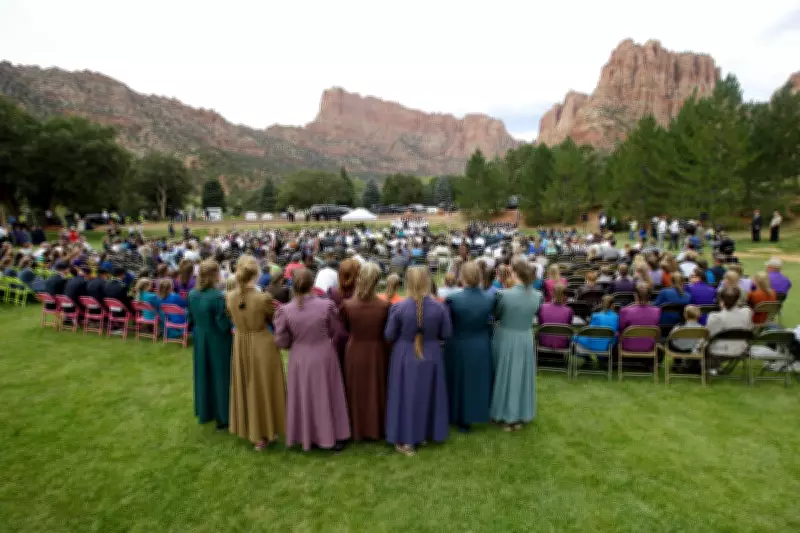
The remote towns of Colorado City, Arizona, and Hildale, Utah, once defined by prairie dresses, walled compounds, and deep distrust of outsiders, have undergone a profound and rapid transformation. For nearly a century, these communities functioned largely as a theocracy under the control of the Fundamentalist Church of Jesus Christ of Latter-Day Saints (FLDS). Today, they resemble any other picturesque town near Zion National Park, complete with weekend soccer games, local bars, and even a winery.
A Legacy of Control and a Dark Turn
Church members originally settled in the area during the 1930s to continue practicing polygamy after breaking away from the mainstream Mormon church. For decades, authorities largely turned a blind eye to their practices. However, the towns' trajectory took a sinister turn after Warren Jeffs assumed leadership following his father's death in 2002.
Under Jeffs' command, the FLDS tightened its grip. Families were systematically broken apart by church leaders who cast out men deemed unworthy, reassigning their wives and children to others. Children were pulled from public schools, basketball hoops were removed, and followers were dictated how to spend their time and what to eat. "It started to go into a very sinister, dark, cult direction," recalled Shem Fischer, a former member who left in 2000.

The Fall of a Prophet and Legal Reckoning
Jeffs' reign unravelled after he was charged in 2005 with arranging the marriage of a teenage girl to an older, already married follower. He became a fugitive, landing on the FBI's Ten Most Wanted list before his arrest in 2006. In 2011, he was convicted in Texas for sexually assaulting two girls, aged 12 and 15, and sentenced to life in prison.
Even after his imprisonment, the towns remained under the sect's shadow. Federal prosecutors accused local governments of acting as an arm of the church, denying basic services like building permits, water hookups, and police protection to non-followers. This led to a pivotal court-ordered overhaul in 2017.
Court-Ordered Transformation and 'Life After Jeffs'
The court placed the towns under supervision, excising the church from their governments and shared police department. A trust controlling the church's vast real estate was handed over to a community board, which began selling properties. For communities that had operated as a theocracy for 90 years, learning to run "a first-generation representative government" was a monumental task, as noted by court-appointed monitor Roger Carter.
Private property ownership was a novel concept for many, as the FLDS had previously dictated where followers could live. Civic leaders had to learn to prioritise residents' needs over religious doctrine. The transformation was so successful that court-ordered supervision was lifted in the summer of 2025, almost two years ahead of schedule.
"What you see is the outcome of a massive amount of internal turmoil and change within people to reset themselves," said Willie Jessop, a former FLDS spokesman. "We call it 'life after Jeffs' — and, frankly, it's a great life."
Embracing Normalcy and Rebuilding Community
With Jeffs imprisoned and the sect stripped of control, many FLDS members left or distanced themselves. Other places of worship opened, and practicing FLDS members now constitute only a small percentage of the population. The towns have attracted new residents drawn by the stunning landscape, clean air, and abundant sunshine.
Hildale Mayor Donia Jessop highlights the community's huge strides, including reconnecting families once divided by the church. The tragic 2015 flash flood that killed 13 people ironically became a catalyst for reconciliation, as former residents returned to help and mend broken relationships.
Longtime resident Isaac Wyler, who was expelled by the FLDS in 2004, experienced severe ostracism. Now, he notes a dramatic shift: his religious affiliation no longer affects police interactions, and former FLDS-run businesses have been replaced by a supermarket, bank, pharmacy, coffee shop, and bar. "Like a normal town," he observes.

Challenges Remain on the Road to Recovery
Despite the progress, challenges persist. The new openness has introduced common societal issues like drug use. Polygamy has not been entirely eradicated; a Colorado City sect member with over 20 spiritual "wives," including 10 underage girls, was sentenced to 50 years in prison in late 2024.
Briell Decker, who was once Jeffs' 65th "wife" in an arranged marriage at age 18, now works at a support centre for people leaving polygamy. Now 40 and remarried, she believes full recovery from the FLDS's abuses under Jeffs will take generations. "I do think they can, but it's going to take a while because so many people are in denial," Decker said. "Still, they want to blame somebody. They don't really want to take accountability."
The journey of Colorado City and Hildale from isolated theocracies to evolving, open communities stands as a testament to legal intervention and communal resilience, marking a dramatic new chapter in their long and complex history.