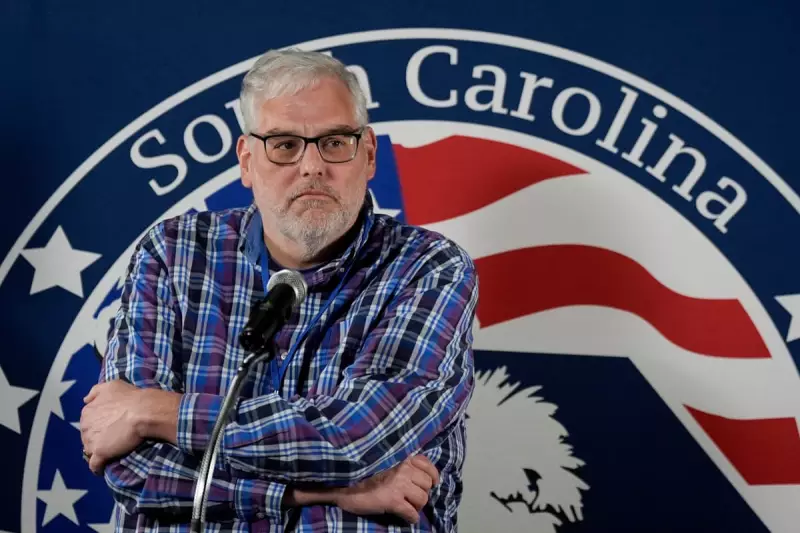
For over two decades, Associated Press reporter Jeffrey Collins has served as an official witness to state-sanctioned death in South Carolina. He has observed 14 executions, including 10 lethal injections, three firing squads, and one electrocution, providing a crucial, impartial record of a process shrouded in official secrecy.
The Solemn Duty of a Witness
Collins became the primary media witness for executions in South Carolina almost by default. As the last reporter remaining in the AP's state bureau after a 13-year hiatus in executions, his continuity allows him to compare procedures over time. His first was on 3 May 2002, the execution of Richard Charles Johnson. Since then, he has witnessed more than a quarter of the state's executions since 1976.
"You have no idea what it's going to be like," Collins said of his first experience. "It's a very somber experience, because you realize you're getting ready to go see someone die. The government only gets to kill people in rare circumstances... This is really the only time where the killing is scheduled."

Observing Three Methods of Execution
South Carolina revived capital punishment in September 2024 after a 13-year pause caused by pharmaceutical companies refusing to supply lethal injection drugs. State lawmakers passed a law shielding supplier identities, allowing officials to acquire the sedative pentobarbital. Under current law, inmates must choose between injection, electrocution, or firing squad.
Collins described the distinct processes. In lethal injections, which take around 25 minutes, he notes the inmate's breathing slows with "a couple of loud snorts or breaths" before ceasing. He observed one case where the inmate turned blue 10-15 minutes into the procedure.
Of the electrocution he witnessed in 2004, he recalled the close proximity—the chair just 10-15 feet away—and the sound: "a thunk when everything starts." He described the body's reaction: "The current goes through every muscle in their body, which tenses up."
The Instantaneous Violence of the Firing Squad
Collins has witnessed three executions by firing squad, a method chosen by three men in 2025. The inmate is strapped in, facing away from witnesses, with a red target bullseye placed over the heart. After a hood is placed, witnesses wait 40-70 seconds before a sudden bang.
"They're going to flinch, because there's no warning or countdown," Collins said. In the most recent, "the target was blown across the room out of sight."
One case, the execution of Mikal Mahdi, raised allegations of being botched. Collins observed Mahdi let out an instantaneous groan, followed by more noises of apparent discomfort and a final moan around 90 seconds later. "It was so different from the first one," he noted. Mahdi's lawyers later claimed autopsy results showed bullets largely missed his heart, a claim the corrections department denied.
The Weight of Bearing Witness
With no video recording allowed, journalists' written accounts become the only official record, often cited in court. Collins is acutely aware of this responsibility. "I see it cited in court. There's no video. There's nothing but my words," he said.
He maintains strict professionalism, focusing on observation rather than interpretation, but acknowledges the human element. He recalled the 2004 execution of Jerry McWee, where a tear rolled down the inmate's cheek as he locked eyes with his anti-death penalty advocate mother.
The psychological toll is real. After each execution, Collins deliberately engages in a life-affirming activity—attending a festival or taking a daughter to lunch. "I remind myself I'm witnessing this because it's important this information gets out... People need to know what it looks like," he stated.
Challenging the Secrecy
Collins expressed frustration with the process's opacity. He advocates for videotaping executions, even if under seal, to provide definitive answers when questions arise, as with Mahdi's case.
"The secrecy prevents the entire story from being told," he argued. Witnesses don't see needle insertion for lethal injections, shooter training for firing squads, or target placement. "We don't get to see everything."

As South Carolina continues its accelerated execution schedule—seven in 14 months—Collins remains the consistent observer. His detailed, factual accounts serve as a vital public record in a democracy that has decided, through its elected representatives, to maintain the ultimate punishment.