Dame Carole Jordan: A Luminary in Solar Astrophysics
Dame Carole Jordan, an internationally acclaimed astrophysicist who dedicated her career to unraveling the secrets of the sun's outer atmosphere, has died at the age of 84. Her groundbreaking work on ultraviolet spectroscopy and the structure of cool stars, including our sun, cemented her reputation as a pioneering figure in astronomy. In 1994, she made history by becoming the first female president of the Royal Astronomical Society, where she was a formidable advocate for women in scientific fields.
Decoding the Sun's Atmospheric Layers
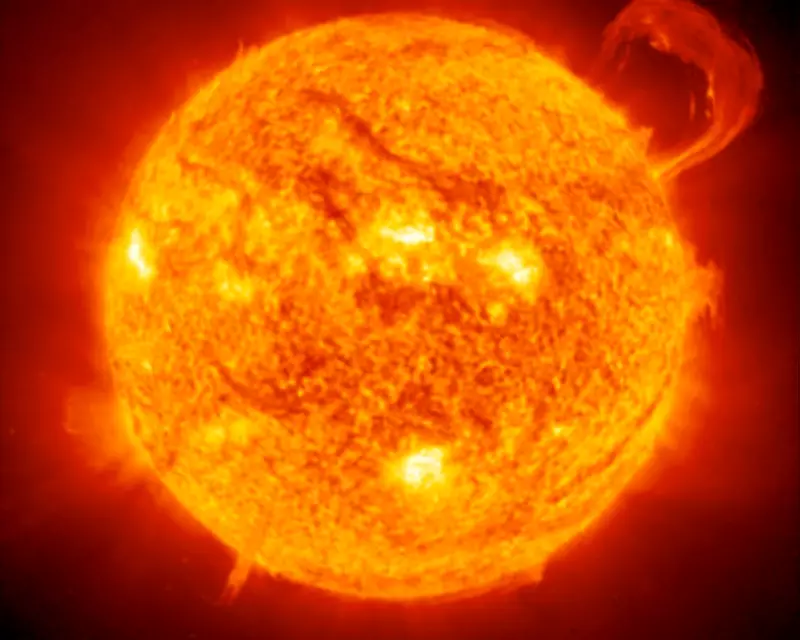
When we observe the sun, the visible yellow photosphere shines at about 5,500 degrees Celsius. However, Carole Jordan focused her expertise on the layers beyond this surface. The chromosphere, a thin region just above, and the corona, extending millions of kilometres and visible only during eclipses, were her primary areas of study. In the corona, temperatures soar to an astonishing 1 million degrees, causing light and spectral lines to emerge in extreme ultraviolet (EUV) or soft X-ray wavelengths.
In 1962, as Carole embarked on her PhD, a rocket experiment led by US astronomer Richard Tousey detected unidentified EUV emission lines from the sun. Carole set out to solve this puzzle, eventually becoming the world's leading authority on ultraviolet spectroscopy for the sun and other stars. Her 1965 PhD thesis, Analysis of the Solar Ultraviolet Spectrum, identified several of these lines as transitions in highly ionized iron, specifically Fe XIV, a finding that initially surprised the scientific community.

Groundbreaking Research and Career Milestones
Carole's work was confirmed during a visit to the Zeta ionized gas experiment at the UK Atomic Energy Laboratory in Culham, where she observed the same spectral lines in laboratory conditions. Her most-cited paper, The Ionization Equilibrium of Elements Between Carbon and Nickel, published in 1969, provided a definitive guide to EUV spectroscopy by detailing ionization states across common heavy elements.
The launch of the International Ultraviolet Explorer (IUE) satellite in 1978 allowed Carole to extend her analyses to other cool stars, establishing her as an expert on stellar chromospheres. Throughout the 1980s, she contributed to X-ray studies of solar flares and developed diagnostic techniques for estimating densities and temperatures in atmospheric structures.
Advocacy and Legacy in Science
Born in Pinner, north-west London, Carole was inspired by astronomers like Arthur Eddington and Fred Hoyle during her time at Harrow County Grammar School for Girls. She pursued astronomy at University College London, where her supervisor suggested she tackle the EUV spectral lines observed by Tousey. Over her career, she held positions at the University of Colorado, UCL, and Culham, before becoming a tutorial fellow at Somerville College, Oxford, where she served until her retirement.
Carole was a staunch supporter of the Royal Astronomical Society, serving as secretary from 1981 to 1990 and as president from 1994 to 1996. She challenged the society's slow admission of women, earning both respect and occasional controversy. Her accolades include the RAS gold medal in 2005, fellowship in the Royal Society in 1990, and being made a dame in 2006. Asteroid 8078 was named Carolejordan in her honour in 2000.
Beyond her scientific achievements, Carole was known for her warmth and wit, with a love for cats and a home filled with books. She married Richard Peckover in 1971, divorcing in 1983, and remained a dedicated mentor and friend in the scientific community. Her legacy as a trailblazer for women in astrophysics continues to inspire future generations.