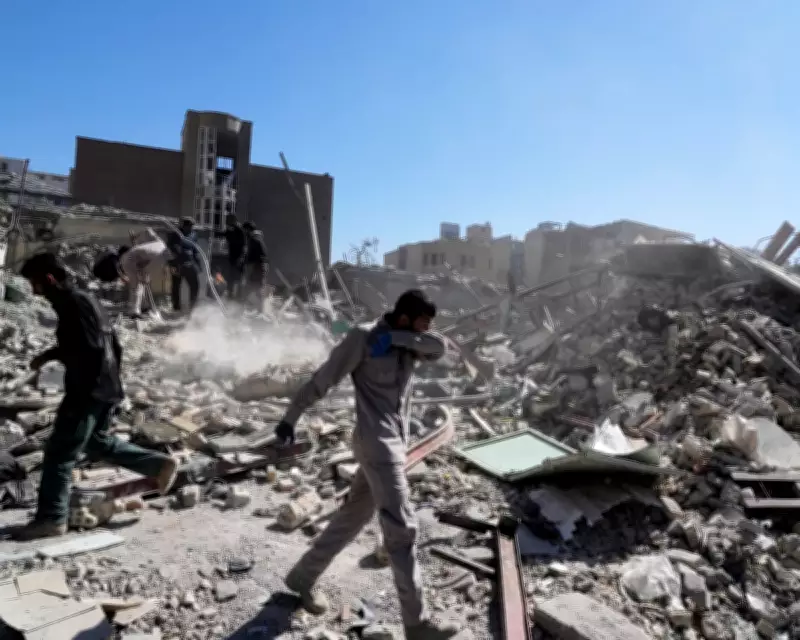
Iran Airstrike Aftermath: Civilian Toll Rises as Conflict Spirals Across Middle East
Iranians surveyed the wreckage of a police station in Tehran on Tuesday, struck by a recent airstrike, as the Middle East conflict intensifies with regional repercussions. Photographic evidence captured the scene amidst a near-total internet blackout, complicating efforts to verify civilian casualties.
Escalating Violence and Civilian Impact
Iranian drones targeted the US embassy in Riyadh, while Tehran launched retaliatory strikes toward the Gulf and Israel. Simultaneously, Israeli military operations commenced in southern Lebanon, marking the fourth day of a broadening regional war. The Human Rights Activists news agency, a US-based NGO, estimates that US-Israeli airstrikes have resulted in at least 742 civilian deaths, including 176 children, with hundreds more cases under review.
Other organizations report higher figures: the Iranian Red Crescent Society cites 787 fatalities, and Norway-based Hengaw claims at least 1,500 deaths, comprising 200 civilians and 1,300 Iranian military personnel. These numbers are anticipated to increase as the conflict persists.

Political and Legal Dimensions
Former US President Donald Trump remarked that the military campaign, initially projected to last four to five weeks, could extend significantly longer. In response, the US State Department has advised Americans to evacuate over a dozen Middle Eastern countries, including Saudi Arabia and the UAE, due to worsening conditions.
Legal experts consulted by The Guardian unanimously deemed the initial strikes unlawful under international law. Professor Susan Breau noted a lack of evidence for an imminent threat from Iran, highlighting that the US Constitution reserves war declaration powers for Congress, which was not consulted beforehand.
The US justification for the war has evolved: Trump initially cited imminent threats to Americans and aims to curb Iran's nuclear program, while Secretary of State Marco Rubio later attributed pre-emptive strikes to anticipated Iranian retaliation against US troops.
International Reactions and Economic Fallout
European nations have shown reluctance to engage. Spain refused US access to joint military bases, labeling the assault unjustified, and Trump criticized the UK for delays in approving American use of its airbases.
The closure of the Strait of Hormuz, a critical global shipping route controlled by Iran, has disrupted oil flows, with one-fifth of global seaborne oil affected. This has spurred oil price surges, fueling concerns about renewed cost-of-living pressures worldwide.
Additional Developments
In unrelated news, the US Department of Education faced backlash for displaying a banner featuring far-right commentator Charlie Kirk, while Florida Governor Ron DeSantis allocated substantial public funds to an immigration detention facility. The Supreme Court intervened in California's transgender student laws, and a measles outbreak in South Carolina has prompted anti-vaccine advocacy linked to Robert F Kennedy Jr.
Cultural highlights include the second season of The Artful Dodger on Disney+, and a feature on a high school student detained by ICE for ten months. Climate concerns were raised regarding AI's role in agriculture, and the tenth anniversary of Stardew Valley celebrated its anticapitalist themes.