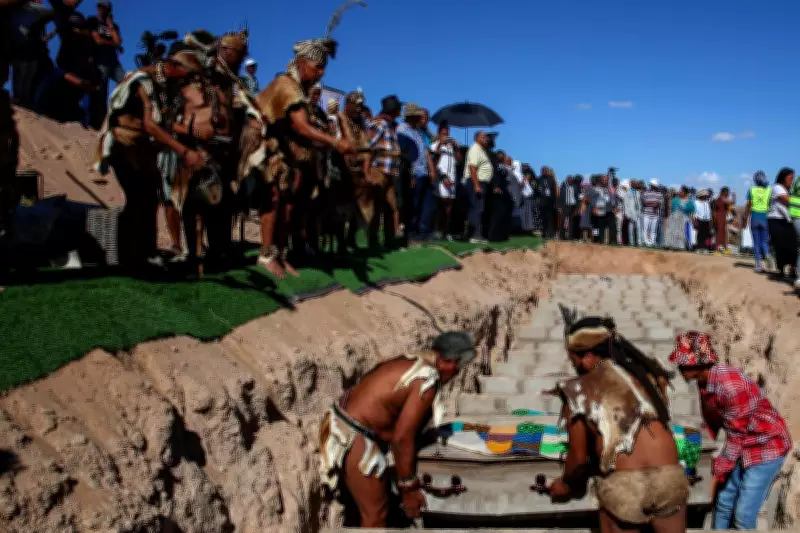
In a significant act of historical redress, South Africa has conducted the reburial of the remains of at least 63 individuals from the Khoi and San communities. These remains, which were excavated decades ago and sent to Europe for scientific research, have now been returned to their homeland, marking a poignant moment in the ongoing efforts to confront colonial injustices.
Repatriation from European Museums
The remains, originally dug up between 1868 and 1924, were donated to The Hunterian Museum at the University of Glasgow in Scotland. Others had been stored at the Iziko Museums in South Africa since the 1920s. The repatriation process involved negotiations between the South African government and the University of Glasgow, which commenced in 2022, culminating in Monday's solemn reburial ceremony.
Condemnation of Colonial Practices
South African President Cyril Ramaphosa, who attended the event alongside museum representatives and traditional leaders, strongly condemned the historical practices that led to the removal of these remains. He described the sale and study of Indigenous human remains in Europe as "rooted in racism and used to advance theories of European racial superiority." Ramaphosa emphasized that these individuals were treated as commodities and specimens under what he termed the "cold gaze of pseudoscience."

This reburial is part of a broader movement across Africa to repatriate stolen or removed remains and artifacts, aiming to restore dignity to affected communities. The Khoi and San, widely recognized as the earliest inhabitants of southern Africa, resisted colonialism, with many losing their lives to European settlers.
Calls for Further Action
President Ramaphosa urged European countries to do more in acknowledging the indignities suffered by Africans during the colonial era. He suggested that these nations should consider paying reparations to their former colonies as a step towards reconciliation and justice.
The ceremony underscores a growing global awareness of the need to address historical wrongs, particularly in the context of Indigenous rights and cultural heritage. As South Africa continues to heal from its colonial past, this reburial serves as a powerful symbol of resilience and the reclaiming of identity.