Myanmar's Coup Leader Moves Closer to Presidency Amid Global Outcry
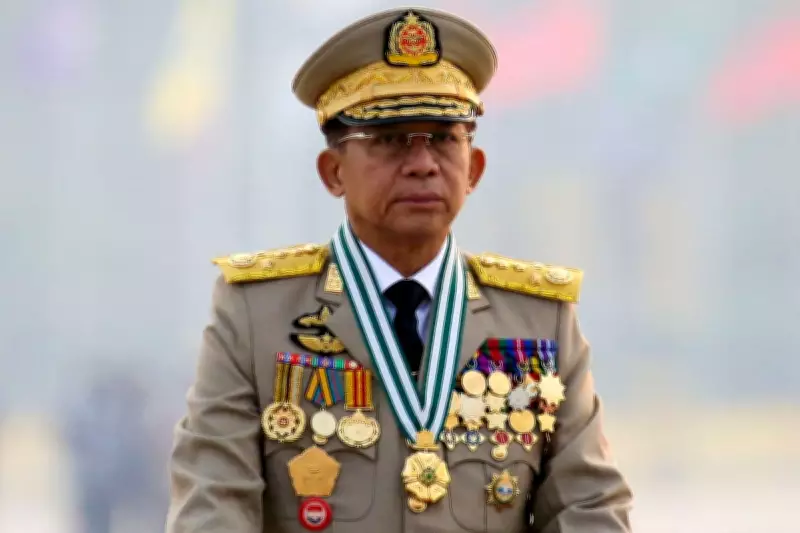
General Min Aung Hlaing, the military leader who orchestrated the coup that overthrew Aung San Suu Kyi's democratically elected government five years ago, has been nominated for the presidency by Myanmar's newly convened parliament. This development marks a significant step in the consolidation of military rule, as the parliament itself is a sham institution, entirely controlled by former soldiers who have merely exchanged army uniforms for civilian attire.
A Sham Election and a Legitimacy Crisis
The nomination follows what United Nations Special Rapporteur Tom Andrews described in his final report as a highly choreographed electoral theatre. The process was neither free nor fair, with opposition parties banned, pro-democracy politicians imprisoned, and large segments of the population disenfranchised. If confirmed, Min Aung Hlaing will become a sham president, nominated by a sham parliament born out of a rigged election, further eroding Myanmar's international reputation.
UN Report Highlights Atrocities and International Failures
Andrews' report, presented in Geneva, serves as a stark wake-up call to the global community. It details a humanitarian catastrophe of staggering proportions:

- Over 22,000 political prisoners remain detained, including Aung San Suu Kyi.
- Nearly four million people have been displaced, with over 7,000 civilians killed.
- Almost one-third of the population requires humanitarian assistance.
- Widespread torture, rape, and brutal killings, including beheadings and burnings, have been documented.
- Daily airstrikes target homes, schools, hospitals, and places of worship.
The report criticises the international community for waning support, inadequate sanctions, and devastating cuts to aid, which have left refugees and displaced communities in dire straits. Andrews urges governments to double down on measures to deny the junta money, weapons, and legitimacy, such as refusing to recognise the new leadership and strengthening coordinated sanctions.
Geopolitical Stakes and Accountability Efforts
Myanmar's crisis extends beyond humanitarian concerns into geostrategic realms. The country serves as China's only viable overland route to the Indian Ocean, making it a critical access point to the Malacca Strait and the Bay of Bengal. Allowing Myanmar to become a playground for external power projection or to descend further into organised crime and instability could have far-reaching consequences beyond its borders.
Despite the grim scenario, there are faint glimmers of hope in accountability efforts:
- The International Criminal Court has sought an arrest warrant for Min Aung Hlaing.
- Courts in Argentina and Timor-Leste are pursuing cases under universal jurisdiction.
- The Gambia's genocide case continues at the International Court of Justice.
These proceedings cast a long shadow over Min Aung Hlaing's potential presidency, highlighting the ongoing pursuit of justice for mass atrocity crimes.
A Call to Action for the International Community
The so-called political transition in Myanmar is nothing more than a rebranding of military rule, with generals repackaging rather than relinquishing power. To avert further descent into darkness, the international community must act decisively by cutting the junta's lifelines while supporting the movement for federal democracy and ensuring accountability. As Andrews' successor, Kelley Eckels Currie, takes over as UN Special Rapporteur, her experience and commitment to human rights will be crucial in sustaining advocacy efforts. The world must confront this reality to prevent Myanmar's reputation from being irreparably stained.