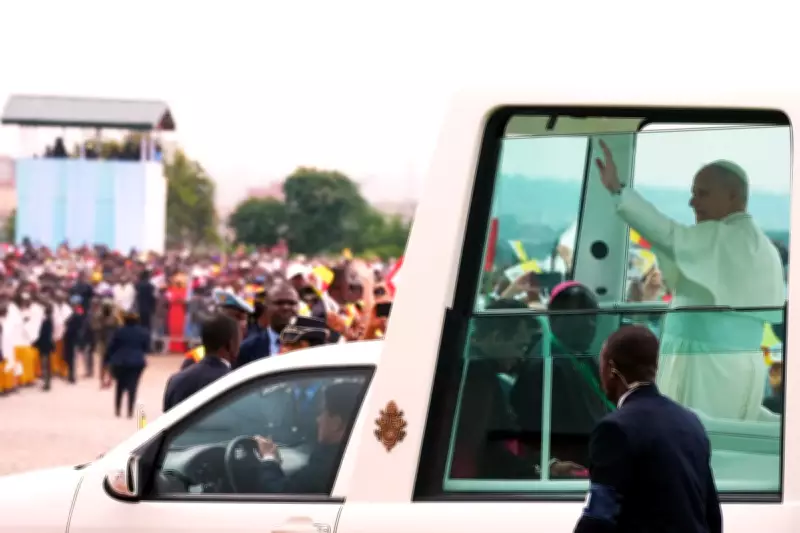
Pope Leo XIV concluded his significant visit to Cameroon on Saturday, celebrating a vibrant Mass at Yaounde Airport before preparing to travel to Angola for the third segment of his four-nation African journey. The pontiff's departure marks the end of a spiritually charged stop in Cameroon, where his messages of hope and anti-corruption resonated deeply with the local population.
Mass in Yaounde Draws Thousands Including World's Oldest Leader
The Mass in Cameroon's capital was attended by thousands of faithful, creating a jostling, joyful atmosphere that highlighted the profound impact of the visit. Among the congregation was President Paul Biya, aged 93, who holds the distinction of being the world's oldest serving leader. The event underscored the joy brought by the third pope ever to visit Cameroon, a former French colony where approximately one-third of the population identifies as Catholic.
Remarkably, some individuals who faced mobility challenges were transported to the Mass in wheelbarrows pushed by family members, demonstrating the deep devotion and communal effort surrounding the papal visit. Throughout his time in Cameroon, Pope Leo XIV focused on encouraging young people to maintain hope despite widespread disillusionment, while also issuing strong demands for elites to cease exploiting both the land and its people for personal profit.

Angola Awaits with Complex History of War and Resources
Following the Mass, Pope Leo XIV was scheduled to fly to Luanda, the capital of Angola, where he planned to meet with President Joao Lourenco and deliver his first address to Angolan government authorities. Angola, a southern African nation of approximately 38 million people, gained independence from Portugal in 1975 but continues to bear the scars of a devastating civil war that began immediately after independence and persisted intermittently for 27 years until finally concluding in 2002.
The conflict resulted in an estimated death toll exceeding half a million people and functioned for years as a Cold War proxy struggle, with the United States and apartheid-era South Africa supporting one faction while the Soviet Union and Cuba backed the opposing side. "I would like to hear a message of peace, a message of reconciliation," expressed Luanda resident Sergio Jose, reflecting local expectations. "I would also like to hear good political messages and I would also like to hear that the pope would also talk about the upcoming elections in Angola."
Resource Wealth Contrasts with Widespread Poverty
Despite Angola's status as Africa's fourth largest oil producer and one of the world's top twenty oil producers according to the International Energy Agency, alongside being the world's third biggest diamond producer with significant deposits of gold and critical minerals, poverty remains pervasive. The World Bank estimated in 2023 that more than 30% of Angola's population survived on less than $2.15 per day.
In Cameroon, Pope Leo XIV had vehemently criticized the "chains of corruption" hindering development and condemned the "handful of tyrants" ravaging the Earth through war and exploitation. Similar themes are anticipated in his Angolan addresses, particularly given the nation's history under former President Jose Eduardo dos Santos, who ruled for 38 years from 1979 to 2017.
Dos Santos faced accusations of diverting billions of dollars in public funds, primarily from oil revenues, to his family while millions of Angolans lived in poverty. The Lourenco administration, upon taking power, estimated that at least $24 billion had been stolen or misappropriated during the dos Santos era and has since vowed to combat corruption and recover allegedly stolen funds.
Slavery Legacy and Religious Significance in Angola
Angola's historical significance extends to the transatlantic slave trade, where as a Portuguese colony it served as the epicenter of this tragic commerce. More than 5 million of the approximately 12.5 million enslaved Africans transported across the ocean departed from Angolan ports, representing the highest number from any single country, though not all were Angolan nationals.

The highlight of Pope Leo XIV's Angolan visit is expected to occur on Sunday with his journey to Muxima, located south of Luanda. This site hosts a popular Catholic shrine in a nation where around 58% of the population is Catholic. The Church of Our Lady of Muxima was constructed by Portuguese colonizers in the late 16th century as part of a fortress complex and became a hub in the slave trade, serving as a stark reminder of the historical connection between Catholicism and the exploitation of Africa.
Pope Leo XIV, who is historically the first U.S.-born pope, has genealogical research revealing Black and white ancestors that included both enslaved individuals and slave owners. His planned Rosary prayer at Muxima acknowledges the site's transformation into a popular pilgrimage destination following reported apparitions of the Virgin Mary around 1833.
As Pope Leo XIV transitions from Cameroon to Angola, his messages of hope, anti-corruption, and reconciliation are poised to address both contemporary challenges and historical legacies across the African continent.