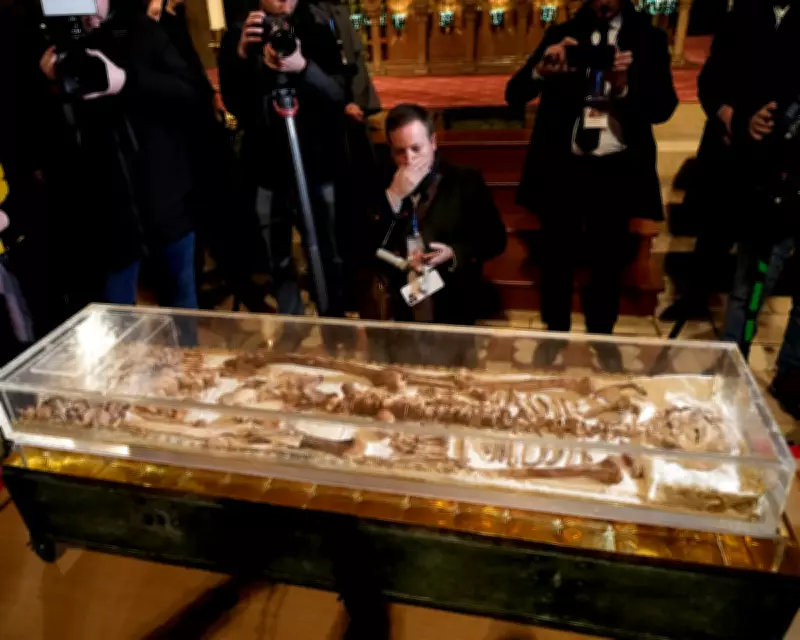
Saint Francis of Assisi's Skeleton on Public Display for First Time
In a historic event, the skeleton of Saint Francis of Assisi is being placed on full public display for the very first time, starting from Sunday. This unprecedented exhibition is anticipated to attract hundreds of thousands of visitors over the course of a month, as the remains of the 13th-century saint are showcased in the Basilica of Saint Francis of Assisi, located in the picturesque Italian hillside town.
Exhibition Details and Security Measures
The remains are encased in a nitrogen-filled plexiglass container, bearing the Latin inscription "Corpus Sancti Francisci", which translates to "the body of Saint Francis". To ensure their protection, the transparent case, which has been housed inside a metal coffer within the saint's stone tomb in the basilica's crypt since 1978, was carefully extracted on Saturday. It is now situated within an additional bullet-proof and anti-burglary glass enclosure. Surveillance cameras will operate around the clock to provide continuous security for the relics.
Historical Context and Significance
Saint Francis, who passed away on October 3, 1226, is renowned for founding the Franciscan order after renouncing his wealth and dedicating his life to serving the poor. His remains were transferred to the basilica constructed in his honor in 1230. However, it was not until 1818, following secretive excavations, that his tomb was rediscovered. Prior to this public display, the bones have only been exhibited once before, in 1978, to a very limited audience for a single day.

Giulio Cesareo, the director of communications for the Franciscan convent in Assisi and a Franciscan friar himself, expressed hope that the display would offer "a meaningful experience" for both believers and non-believers. He noted that the "damaged" and "consumed" condition of the bones reflects how Saint Francis "gave himself completely" to his life's mission. Cesareo also highlighted the Christian tradition of venerating relics, stating, "From the very beginning, since the time of the catacombs, Christians have venerated the bones of martyrs, the relics of martyrs, and they have never really experienced it as something macabre."
Visitor Expectations and Logistics
The exhibition, which will run until March 22, has already garnered nearly 400,000 reservations from individuals across the globe, with a significant majority coming from Italy, according to Marco Moroni, the guardian of the Franciscan convent. He added that visitors are also expected from Brazil, North America, and Africa. Typically, during this quieter period, the basilica welcomes about 1,000 visitors on weekdays and up to 4,000 on weekends. However, for the duration of the display, projections indicate a surge to 15,000 visitors on weekdays and as many as 19,000 on Saturdays and Sundays.
Preservation and Environmental Considerations
Experts assure that the extended public viewing should not compromise the preservation of the remains. Cesareo explained, "The display case is sealed, so there is no contact with the outside air. In reality, it remains in the same conditions as when it was in the tomb." Additionally, the lighting within the church will be kept subdued to prevent any adverse effects, with Cesareo emphasizing, "The basilica will not be lit up like a stadium. This is not a movie set."
Commemorative Events and Public Holiday
In honor of the 800th anniversary of Saint Francis's death, Italy is reinstating a public holiday on October 4. Saint Francis holds the title of Italy's patron saint, making this commemoration particularly significant for the nation. The exhibition serves as a central component of the anniversary celebrations, offering a unique opportunity for reflection and reverence.