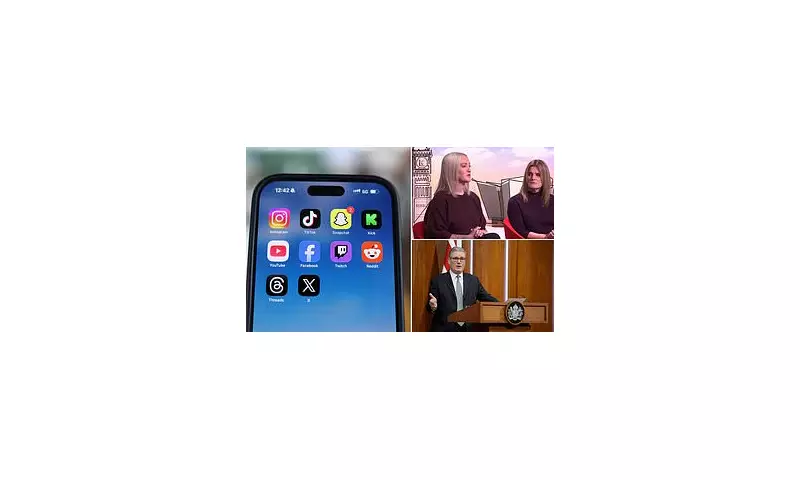
Prime Minister Keir Starmer is facing renewed and intense pressure from bereaved parents to implement an immediate ban on social media access for children under the age of 16. This call to action comes as ministers appear to be attempting to delay a significant crackdown on young people's mobile phone usage, despite stark warnings about the escalating mental health crisis among the youth.
Alarming Statistics Fuel Urgent Demands
Campaigners have highlighted that an astonishing 500 children are referred for mental health treatment every single day across the United Kingdom. This troubling figure underscores the scale of the issue as policymakers debate the timing of regulatory measures. Esther Ghey, whose daughter Brianna was tragically murdered by two teenagers, delivered a powerful plea for immediate action during a recent BBC interview.
'Whilst we're waiting, more and more children are being harmed,' Ms. Ghey stated emphatically. 'We know that every single day 500 children are being referred to mental health services, and we know that 97 per cent of 12-year-olds own smartphones, so we need to do something now.'

Parliamentary Moves and Potential Delays
Last week, members of the House of Lords amended proposed legislation to compel the Prime Minister to enact an immediate prohibition on under-16s using popular applications such as TikTok and Snapchat. However, Members of Parliament in the Commons are anticipated to reject this amendment following indications from government ministers that a ban could potentially be established by the summer.
This proposed timeline follows the initiation of a three-month consultation period that commenced earlier this month, suggesting a possible delay in implementing concrete restrictions. The legislative process has thus become a focal point of contention between those advocating for swift action and those favouring a more measured, consultative approach.
Personal Tragedies Highlight Systemic Failures
Esther Ghey has previously spoken about her daughter's struggles, describing Brianna as having a 'social media addiction' and being 'desperately wanted to be TikTok famous', which placed her 'in constant fear about who might be speaking to online'. Ms. Ghey appeared alongside Ellen Roome on a national television programme to amplify their concerns.
Mrs. Roome believes her 14-year-old son, Jools Sweeney, died while attempting an online challenge, a tragedy that has galvanised her campaigning efforts. Both women are urging ministers to ban smartphones from schools entirely, criticising current policies where phones are merely required to be 'out of sight' as insufficient. They argue that such measures fail to address the core issue of unregulated access.
'How much longer are we going to let children have unregulated access?' Mrs. Roome questioned. 'They’ve got access to everything, and I just really think it needs to go. Those children are being harmed.'
Evidence of Effectiveness and Political Crossfire
In a compelling letter to the Prime Minister, Esther Ghey cited evidence from Brianna's former school, where incidents linked to mobile phones and social media plummeted by a remarkable 94 per cent within a single year following the implementation of a total ban. This real-world data provides a strong argument for the efficacy of stringent restrictions.
The issue has also ignited political debate, with the Conservative opposition backing demands for a social media ban. Laura Trott, the Shadow Education Secretary, criticised the government's stance, stating: 'Last week, members of the House of Lords voted to support our amendment to get children off social media. It was deeply disappointing that Labour could not bring themselves to support this measure.'
She added, 'Bereaved parents and campaigners are right to call this out. They are crying out for politicians to act, not to kick the can down the road. We do not need more evidence, and we do not need to wait months or years when legislation is there for us to enact now.'

Public Opinion and Broader Support
Supporters of an Australian-style ban argue that parents currently find themselves in 'an impossible position', struggling to protect their children from the myriad of online harms they are exposed to daily. Recent polling data reveals substantial public backing for such measures, with two-thirds of Britons expressing support for a ban.
Furthermore, majorities in favour of implementing new age restrictions on social media usage were found across all of Britain's major political parties, indicating a rare consensus on the urgency of the issue among the electorate.
Government Response and Internal Pressures
The Government has confirmed it will examine proposals to restrict access to websites and applications for individuals under 16 years of age. This review comes as the Prime Minister seeks to navigate potential backbench rebellions and mounting internal pressure.
A significant group of 61 Labour MPs recently wrote to Sir Keir Starmer demanding 'urgent action' to raise the minimum age requirement for social media platforms. This internal party pressure underscores the growing political imperative to address what is increasingly viewed as a public health and safety emergency affecting the nation's children.