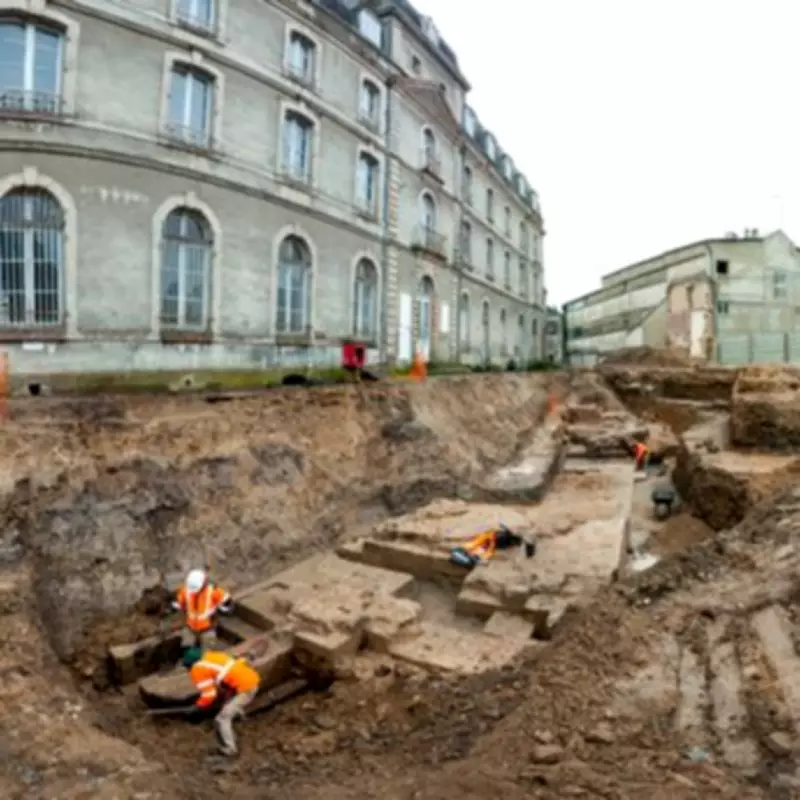
Incredible Medieval Castle Unearthed Beneath Popular French Hotel
Archaeologists have made a breathtaking discovery in Vannes, France, unearthing a remarkably well-preserved 640-year-old medieval castle directly beneath the courtyard of the popular Hotel Lagorce. The structure has been identified as the Château de l'Hermine, originally constructed by Duke John IV the Conqueror during the 1380s.
Exceptional Preservation Stuns Researchers
Excavations conducted throughout spring and autumn of 2023 revealed the castle in an astonishing state of preservation. The National Institute for Preventive Archaeological Research (INRAP) reported that the ducal house measured 42 metres long and 17 metres wide, featuring walls of exceptional thickness. The structure was directly bordered by a moat and flanked by what archaeologists describe as a 'square tower' to the west.
The excavation uncovered multiple staircases, including one in particularly remarkable condition with an ornate core and three surviving steps. Archaeologists also recovered numerous artefacts that provide insight into daily castle life, including garments, jewellery, coins, padlocks, and cooking vessels.

Wet Conditions Preserved Rare Materials
Researchers conducted deep surveys in the moat area, extracting rich furniture from the very wet material. The humidity of the environment proved instrumental in preserving wooden items and fragments of barrels that would typically deteriorate over centuries.
INRAP experts have praised the exceptional site management evident in the castle's construction. A spokesperson explained: "The homogeneity of the materials used for the construction of the castle and the standardisation of the modules show a mastery of the management of the site throughout the operating chain, from the extraction of stone to its implementation."
The construction appears to have taken place in a single phase, indicating the significant financial and human resources allocated to the project. The remains suggest that Duke John IV surrounded himself with the best engineers and craftsmen of his era.
Historical Context and Parallel Discoveries
This discovery follows other significant archaeological finds in recent years. In 2019, researchers uncovered an impressive palace believed to have housed Mayan royalty over a millennium ago in Kuluba, near Cancun, Mexico. That structure measured six metres tall, 55 metres long and 15 metres wide, and was occupied during two distinct periods spanning 600-1050 A.D.
The Mayan empire flourished between 250 and 900 A.D., dominating vast territories across present-day southern Mexico, Guatemala, Belize and Honduras. The palace discovery in Mexico's Yucatan state represented another breakthrough in understanding ancient civilizations.
Archaeologist Alfredo Barrera noted at the time: "This work is the beginning, we've barely began uncovering one of the most voluminous structures on the site." Kuluba had significant connections with the Maya cities of Ek' Balam and Chichen Itza, falling under their sway and becoming part of their trade and territory networks.
The French castle discovery represents a similarly significant breakthrough in European medieval archaeology, providing unprecedented insight into 14th-century construction techniques and ducal life in Brittany.