Brooklyn's Wall of Tears: A Monumental Tribute to Gaza's Lost Children
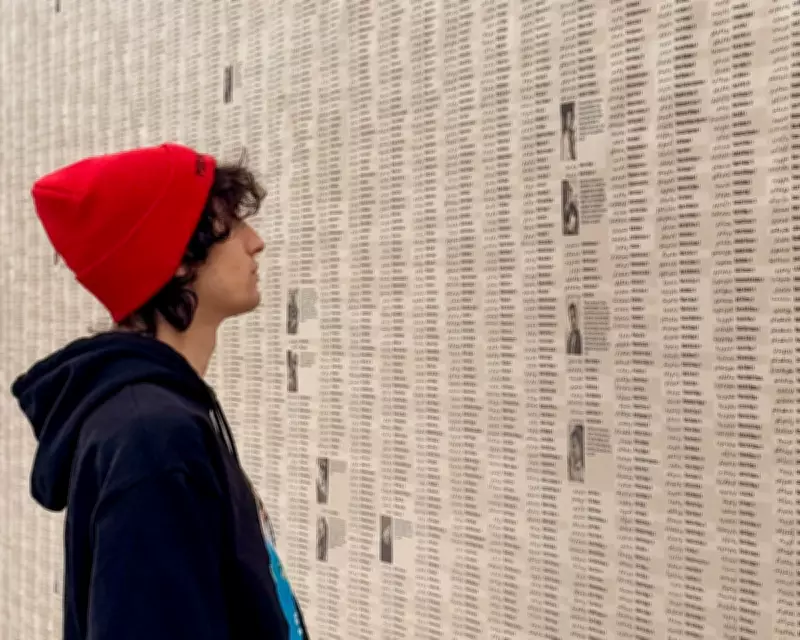
A striking new public art installation in Brooklyn has transformed a city street into a sombre memorial for the youngest victims of the ongoing conflict in Gaza. The Wall of Tears, a monumental 50-foot-long mural, meticulously lists the names of 18,457 children who lost their lives between October 2023 and July 2025, according to data from the Gaza health ministry.
An Artistic Response to Overwhelming Tragedy
Created by veteran artist Phil Buehler, the installation opened on Thursday at 12 Grattan Street in Brooklyn, adjacent to the Pine Box Rock Shop bar. The sand-coloured mural, printed on waterproof and UV-coated vinyl, stands 10 feet tall and presents the children's names in chronological order of their deaths. "If you approach from a distance, it looks like almost an abstract painting and that draws people in to see, what is that?" Buehler explained during a telephone interview. "Then you'll see they're names of the children killed in Gaza since 7 October and there are thousands of them stretching down the block."
The project represents one of Buehler's most emotionally challenging works to date. "This is probably one of the hardest ones I've worked on emotionally," the 69-year-old artist confessed. He referenced a chilling quote often attributed to Stalin: "A single death is a tragedy, a million deaths is a statistic." Buehler's intention with the Wall of Tears is to bridge that gap, allowing viewers to comprehend both the staggering scale of loss and the individual human stories behind each name.

Personal Stories Amidst Thousands of Names
The mural begins with the name of Wesam Iyad Mohammed Abu Fsaife, a 14-year-old boy, and concludes with Sabah Omar Saad al-Masri, an eight-year-old girl. Interspersed throughout the vast list are photographs and personal stories of individual children, sourced from reports by publications including the Guardian and the Washington Post. "That's the part that gets me when I look at it," Buehler reflected. "You see these faces full of joy and hope, snapshots from graduations and birthday parties and family gatherings and knowing that these kids' lives were just cut short."
Buehler hopes the installation will provoke deep personal reflection and action. "You can't not think about your own kids and your own families," he said. "I hope that might lead people to think about how they might help, even if it's just, take a photo of the mural and pass it along on their social media to their friends and family because hearing something from someone you know is important."
Timing and Context in a Divided City
The artist deliberately opened the installation on the second anniversary of a particularly harrowing incident: the death of Hind Rajab, a five-year-old Palestinian girl. According to the Forensic Architecture research group, Hind was left to bleed out among the bodies of six family members after their car was targeted by an Israeli tank. Audio recordings of her final, desperate calls for help, released by the Palestine Red Crescent Society, form the basis of an Oscar-nominated Tunisian film, The Voice of Hind Rajab. "She's five and she's pleading, come get me," Buehler said of the film. "This innocent five-year-old kid has become the image of the tragedy there."
The Wall of Tears arrives amidst a deeply polarised political climate in New York City, home to nearly one million Jews—the largest Jewish population outside Israel. Buehler addressed the sensitive nature of the work head-on, rejecting the conflation of opposition to the war with antisemitism. "Conflating those two things makes it more difficult to talk about," he argued. "You can't have that conversation at all. I worry a little bit about that with this piece."

He noted the fears within both communities: "Most of my Jewish friends are liberal Jews and their reaction was, it's a tragedy, their heart goes out for these kids and these families, but they are afraid bringing attention to it will bounce back as antisemitism. So Jews are afraid of bringing attention to it and Palestinians are afraid of bringing attention to it because it bounces back against them."
A Legacy of Provocative Public Art
Phil Buehler is no stranger to creating large-scale, data-driven art that confronts difficult political realities. His previous works include:
- Wall of Lies: Displaying over 20,000 false statements made by Donald Trump during his first presidential term.
- Wall of Liars and Deniers: Listing 381 Republican election deniers who ran in the 2022 midterm elections.
- Wall of Shame: Chronicling the actions of more than 1,500 individuals involved in the January 6th Capitol riot.
- Empty Beds: Highlighting the abduction of nearly 20,000 Ukrainian children by Russia.
For the Wall of Tears, Buehler collaborated with the non-profit organisation Radio Free Brooklyn. The artist acknowledges a tragic limitation of the project: it is necessarily incomplete. The mural only records deaths up to July 2025, the most recent update available from Gaza health authorities at the time of production. Hundreds more children have been killed since, even following a ceasefire in October.
"I hope with this piece, the Wall of Tears, you can both understand the scale of these 18,457 children's deaths by seeing their names stretching down the street 50 ft and empathise with their surviving families," Buehler concluded, offering a poignant hope for his powerful and painful public memorial.