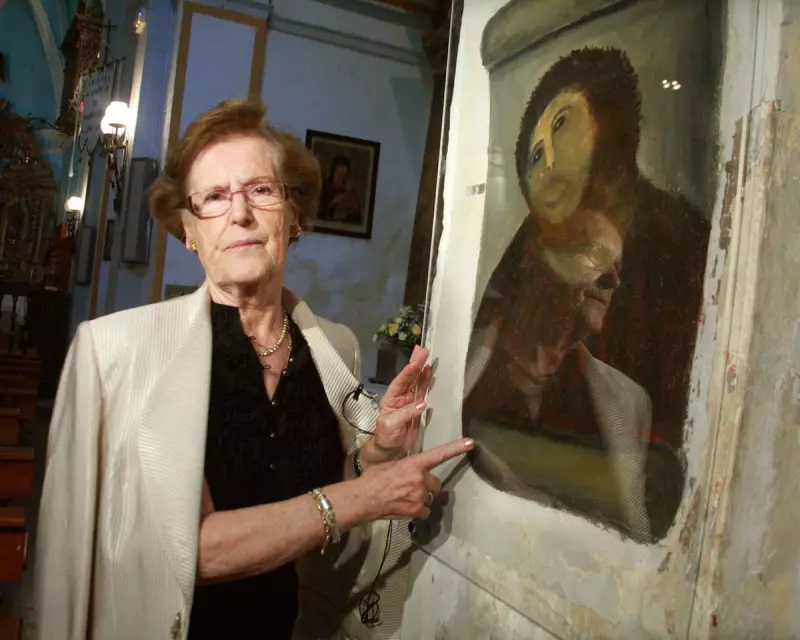
In the quiet Spanish town of Borja in 2012, an act of devotional restoration spiralled into one of the most infamous art stories of the 21st century. What began as a well-intentioned effort by an elderly parishioner to repair a fading fresco culminated in the viral sensation known worldwide as 'Monkey Christ' – and an unexpected journey of redemption.
The Fateful Restoration That Captured the World
Cecilia Giménez, then an 81-year-old amateur, took it upon herself to restore the deteriorating early 20th-century fresco 'Ecce Homo' (Behold the Man) by Elías García Martínez in the Sanctuary of Mercy church. The original work, a delicate depiction of Christ crowned with thorns, had suffered significant damage from moisture. Without formal authorisation from the church or local authorities, Giménez, who had previously done minor touch-ups, began her work.
The result was a drastic and unrecognisable transformation. The serene face of Christ was replaced with a crude, fuzzy visage that the internet swiftly compared to a monkey, a beaver, or a poorly drawn cartoon. Photographs of the botched restoration spread across the globe almost overnight, spawning endless memes, news headlines, and a mixture of outrage and bewildered hilarity.

Initial reactions were fiercely critical. Art historians lamented the loss of a work by a respected local artist. The Borja cultural foundation and García Martínez's descendants considered legal action. Giménez herself was initially devastated, retreating from public view as the storm of global ridicule erupted.
An Unexpected Economic and Cultural Revival
Yet, in a remarkable twist, the 'Ecce Homo' debacle triggered an unprecedented tourism boom for the small, previously overlooked town of Borja. Visitors flocked from across Spain and beyond, not to see a masterpiece, but to witness the curious phenomenon for themselves. What they dubbed 'Monkey Christ' became a cult attraction.
The local council, recognising the potential, made a pivotal decision. Instead of completely repainting the fresco, they preserved Giménez's version behind protective glass. A small entry fee was introduced, with proceeds directed partly to a charity for the disabled, a cause close to Giménez's heart due to her son's condition. The influx of tourists revitalised local businesses, from bars and restaurants to souvenir shops selling 'Monkey Christ' merchandise.
Over time, public sentiment towards Cecilia Giménez underwent a profound shift. From a figure of mockery, she was gradually reframed as a sympathetic, earnest individual whose actions, however misguided, were born of genuine love for the painting and her church. She became a local celebrity, even signing autographs for visitors.
Legacy: Redefining Art, Intent, and Value
The saga of the Borja restoration raises complex questions about art, authorship, and cultural value. It challenged the traditional gatekeepers of art restoration and sparked debates about who has the right to intervene in community heritage. The fresco, once a modest religious work, was transformed into a postmodern icon whose value derived not from artistic skill but from its extraordinary backstory and symbolic power.
For Cecilia Giménez, now in her 90s, the journey has been one of personal vindication. She has been honoured by the town, featured in documentaries, and has seen her name become permanently etched in popular culture. The story serves as a poignant reminder that the line between disaster and fortune can be astonishingly thin, and that public perception is capable of remarkable evolution.
The 'Monkey Christ' endures, not as a cautionary tale of ruin, but as a testament to an unlikely salvation. It saved a painting from obscurity, boosted a local economy, and ultimately redeemed a well-meaning restorer, proving that sometimes the greatest art stories are not about perfection, but about humanity's unpredictable touch.