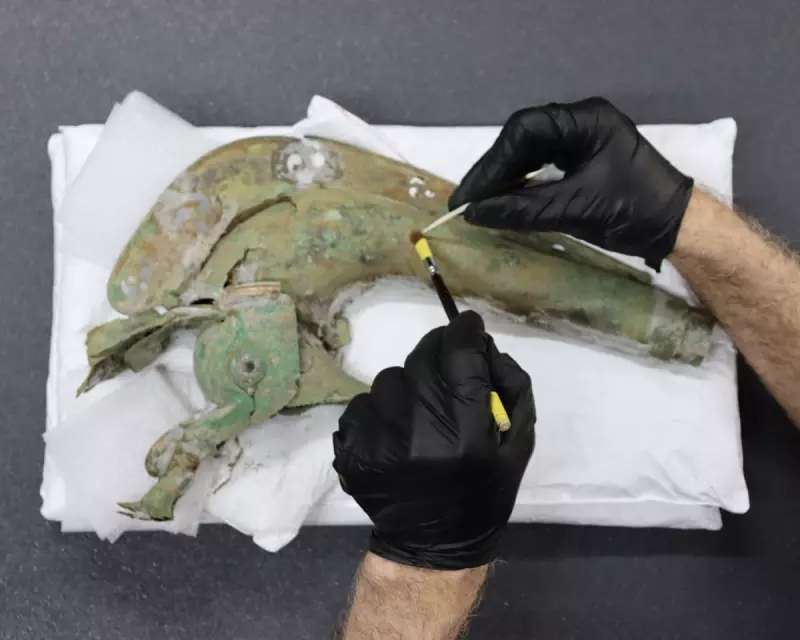
Archaeologists in Norfolk have made a stunning discovery: an ‘extraordinary’ Iron Age war trumpet, or carnyx, which may have connections to the Celtic tribe led by the legendary warrior queen Boudicca. The find, unearthed during excavations for a housing development, is being hailed as a once-in-a-lifetime discovery.
A Hoard of Military Treasures
The bronze instrument was found last summer in west Norfolk among a collection of significant Iron Age military artefacts. This remarkable hoard also included a unique bronze boar’s head battle standard—the only one of its kind ever found in Britain—and five shield bosses used to reinforce the centre of shields.
The carnyx is only the third ever discovered in Britain and is the most complete example found anywhere in the world. Fashioned into the shape of a snarling wild animal, it would have been mounted high on a pole above warriors. Its purpose was to produce a harsh, terrifying sound to intimidate enemies on the battlefield, a practice described by ancient historians.

A Potential Link to Boudicca's Iceni
The location of the find has sent ripples of excitement through the archaeological community. The hoard was buried within the territory of the Iceni, the British tribe that staged a famous rebellion against the Roman army in AD 60 under the leadership of Boudicca.
Mark Hinman, chief executive of Pre-Construct Archaeology, whose team made the discovery, stated it was a career-defining moment. “I’ve been doing archaeology for over 40 years and I’ve never seen anything like this,” he said. While a direct link to the queen herself cannot be proven, the timing is compelling. The artefacts were almost certainly buried in the first century AD, placing them squarely in the era of the Iceni revolt.
Hinman emphasised the objects' exceptional quality, suggesting they would have been known to important figures within the tribe. The carnyx itself shows signs of ancient repair, indicating it saw long and careful use before being ritually laid to rest, with the shield bosses placed carefully on top.
Reshaping Our Understanding of the Iron Age
The discovery promises to transform academic understanding of Iron Age Britain. Fraser Hunter, Iron Age and Roman curator at the National Museum of Scotland and a leading authority on carnyces, called the find “extraordinary.” He believes the full research and conservation of these fragile remains “will reshape our view of sound and music in the Iron Age.”
Unlike other fragments found across Europe, this carnyx is uniquely intact. “It’s the only one that’s ever been found where they haven’t taken the ears off. It’s got these great big flappy ears which are wonderful, and they’re still in place,” Hinman remarked, adding that looking at the object gives a powerful sense of connection to the past.
The fragile artefacts are currently undergoing meticulous conservation by the Norfolk Museums Service. Their legal status is under review by a coroner under the Treasure Act 1996, which will determine their final future home.
The discovery will be featured in the new series of Digging for Britain, broadcast on BBC Two on 14 January.