Baroque Splendour: Lully's Masterpiece Atys Returns to Versailles
The Palace of Versailles, a monument to artifice and spectacle, continues to reinvent itself for contemporary audiences while honouring its rich historical legacy. In our modern era of accessibility, this iconic Parisian landmark has arguably become more integrated into cultural life than at any point since the glorious reign of Louis XIV in the late seventeenth century. Today, it hosts an impressive array of events including elegant balls, garden parties, breathtaking firework displays, fountain shows, and a distinguished programme of concerts and opera performances. Remarkably, the palace now boasts its own orchestra, choir, and even a recording label, reaffirming its status as a living cultural institution.
The Theatre's Evolution and Historical Context
Walking through the palace gates in the evening and crossing the vast courtyard to reach the theatre entrance in the east wing remains an awe-inspiring, almost magical experience. The opera house within the Palace of Versailles is itself a masterpiece of artifice, much like Louis XIV's propaganda. Constructed shortly before the French Revolution, it was originally designed not for royalty to enjoy opera, but for the burgeoning middle classes to pay for the privilege of watching aristocrats dine on stage—a historical equivalent to today's celebrity food videos on social media platforms.
It was only decades later, as Versailles underwent gradual restoration under France's subsequent emperors, that this intimate theatre with its surprisingly large stage began to be used for its intended purpose. These days, it presents a carefully curated mixture of its own productions alongside visiting performances from across Europe that resonate with the historical setting, with a natural emphasis on Baroque opera and dance.

Lully's Atys: A Baroque Masterpiece Reimagined
On Saturday 24th January, the theatre was dedicated to Jean-Baptiste Lully's magnificent opera Atys, first performed in 1676 before Versailles was even completed. The original production was mounted in the enormous Ballet Hall of Louis's older palace across the River Seine in St Germain-en-Laye. When Lully first staged Atys, he commanded impressive forces: 50 singers, 40 dancers, and a substantial orchestra for that period. Today's production at Versailles operates with approximately half those numbers, yet the theatre's intimate scale means such reductions don't diminish the dramatic impact.
Atys represents Lully at his absolute finest—a continuous flow of wrenchingly beautiful music that carries the narrative forward without fragmenting into obvious arias and recitatives, as his Italian contemporaries might have structured it. Born Giovanni Lulli, the composer invented his own form of through-sung drama where dance was equally as important as singing, elegantly mirroring the emotional tribulations of the characters.
The storyline follows classic romantic entanglements: A loves B, B loves A, but C loves A and D loves B. When C is revealed as the goddess Cybèle and D as the King of Phrygia, it becomes tragically clear that the affair between Atys and Sangaride cannot possibly end happily.
A Modern Production with Historical Sensibilities
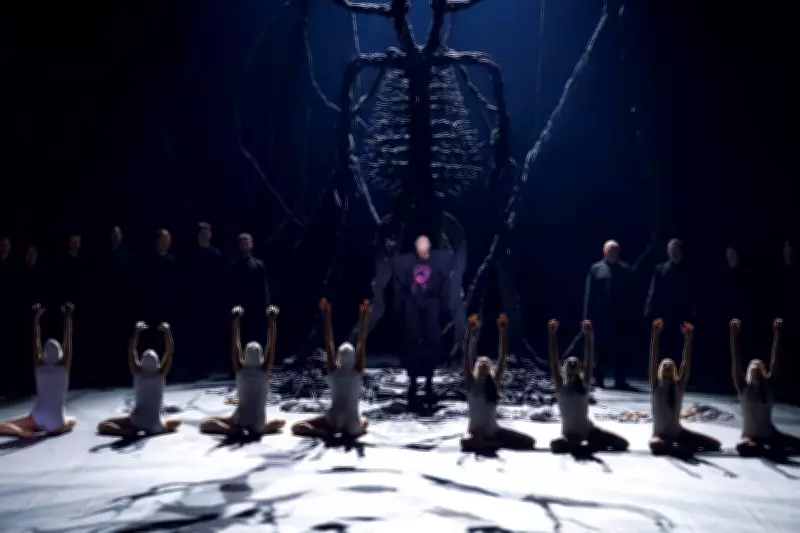
This particular production premiered in Geneva in 2022 under the direction and choreography of the immensely experienced and imaginative Angelin Preljocaj. For the Versailles revival, Preljocaj employs his own hand-picked troupe of fifteen dancers whose movement accompanies, comments upon, and frequently integrates with the singers, creating a seamless theatrical experience. The effect is consistently bold and surprising, yet never distracting from the musical narrative.
The scenery by Prune Nourry and costumes by Jeanne Vicérial cleverly reference Assyrian reliefs and black-figure Greek ceramics while incorporating contemporary dance attire—leotards and flowing dresses worn without regard to gender conventions. The principal quartet of singers delivers compelling performances: Matthew Newlin as Atys, Giuseppina Bridelli as Cybèle, Ana Quintans as Sangaride, and Andreas Wolff as the King of Phrygia. Musically, they strike the perfect balance between lyrical beauty and dramatic ornamentation.

Musical Excellence and Continuo Brilliance
The true joy of this production lies in the continuo group of the orchestra, Cappella Mediterranea, particularly the exceptional lutenists Monica Pustilnik and Quito Gato. They play nearly every bar of the three-hour score with endless subtlety and sensitivity. Similarly, Leonardo García Alarcón's conducting maintains the effortless flow of Lully's achingly beautiful music, allowing it to glide gracefully throughout the performance.
Complementary Lully Performance at La Villette
The following evening, Sunday 25th January, offered more Lully in the modern, sterile acoustics of the Philharmonie at La Villette. Christoph Rousset directed a concert performance of Lully's first attempt at his new form of lyric tragedy, Cadmus et Hermione, originally staged four years before Atys. For Rousset and his ensemble Les Talens Lyriques, this performance represented the culmination of their complete cycle of performances and recordings of all Lully's operas—an immense and rewarding project spanning years of dedicated research.
While the Philharmonie's acoustic idiosyncrasies made this concert slightly less rewarding than the previous night's experience at Versailles, it nonetheless felt significant to witness this gentle landmark in French musical history. Though Lully would write more compelling scores later in his career, Cadmus et Hermione contains one standout moment: the gorgeous Chaconne for three male voices in Act 1, which serves as a heartfelt hymn to sweet love.
Together, these two performances offered a comprehensive weekend immersion into the world of Jean-Baptiste Lully, demonstrating both the historical significance and enduring emotional power of Baroque opera when presented in appropriate settings with thoughtful, modern interpretations.