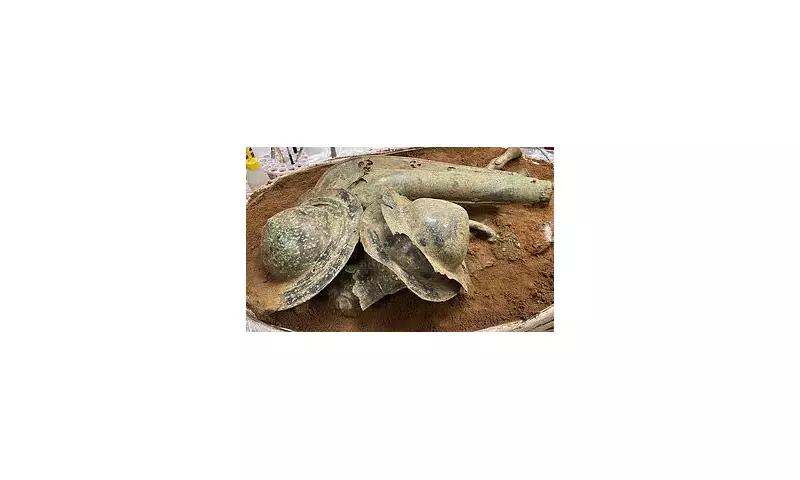
A routine archaeological dig in West Norfolk has yielded a discovery of international importance: a stunning collection of Iron Age metal artefacts, buried for two millennia. The hoard, described by experts as 'hugely significant', promises to transform our understanding of ancient British and Celtic culture.
A Symphony of War and Ritual
Among the fragile, earth-encrusted objects, one find stands out: a near-complete Iron Age battle trumpet, known as a carnyx. This extraordinary instrument, crafted from bronze and standing an estimated two metres tall, was used by Celtic tribes across Europe. Its piercing, harsh sound was designed to soar over the heads of warriors, inspiring them in battle against the expanding Roman Empire.
The carnyx's most distinctive feature is its bell, typically shaped like an open-mouthed animal's head. The Roman invaders were so fascinated by these instruments that they frequently depicted captured carnyces as war trophies in their art. Dr Fraser Hunter, Iron Age and Roman curator at National Museums Scotland and a leading authority, stated: 'The full research and conservation of these incredibly fragile remains will reshape our view of sound and music in the Iron Age.'

A Trove of Military Significance
The significance of the West Norfolk hoard extends far beyond the carnyx. The collection also includes a finely made sheet-bronze boar's head, which originally adorned a military standard. Such standards were held aloft during battle, serving as a vital rallying point and symbol of a unit's identity.
Further emphasising the martial nature of the deposit are five shield bosses – the convex metal domes that reinforced the centre of wooden shields. The objects were found carefully placed together, with stacks of shield bosses covering the head of the carnyx, suggesting a deliberate and possibly ritual deposition.
Delicate Discovery and Future Research
The excavation was carried out by Pre-Construct Archaeology on privately owned land as part of standard planning procedures. Upon discovery, the entire assemblage was lifted in a block of soil for later micro-excavation in the laboratory. Experts at the Norfolk Museums Service are now undertaking the painstaking task of stabilising the severely fragile objects.
Mark Hinman, Chief Executive at Pre-Construct Archaeology, praised his team: 'They discovered something completely unexpected, paused for breath, then followed best excavation practice to recover these rare and fragile objects.' As the find consists of multiple base metal prehistoric items, it has been reported to the coroner as potential Treasure under the Treasure Act 1996.
The long-term home for these nationally important artefacts is yet to be decided. The public will get its first glimpse of the discovery on BBC Two's Digging for Britain on 14 January at 9pm. For historians and archaeologists, the real work is just beginning, with years of conservation and research ahead to fully decipher the secrets of this remarkable West Norfolk hoard.