Emily Haworth-Booth's 'Mare': A Deep Dive into Love, Loss, and Equine Connection
Emily Haworth-Booth's remarkable debut adult novel, Mare, presents a poignant narrative centered on a woman grappling with three transformative crises. The protagonist faces an early menopause, rendering her unable to have children, alongside a creative drought as a once-successful children's book author. Surprisingly, it is her burgeoning passion for a horse that she does not own that becomes the focal point of her existence, challenging conventional notions of love and purpose.
Confronting Childlessness and Maternal Reflections
The novel opens with introspective musings on motherhood, quoting a mother who likens it to crossing out cherished activities one by one. Another mother is depicted as deeply embedded in a community of parents, while the narrator feels adrift, described as a "limp kite" dragged along. Her decision against having children stems not from personal sacrifice but from a profound fear of her potential child's future in a world marred by environmental decay—imagining "burning cities, flooded cities, desertified meadows." This fear leaves her emotionally unanchored, struggling to connect with friends who are mothers and avoiding her own mother's attempts to cheer her with a blog titled "Child-Free and Fabulous!"
Her interactions with neighbor's children, whom she affectionately calls "not-my-daughter" and "also-not-my-daughter," highlight her longing for connection, yet she feels a deep sense of loss when they return home. In winter, their absence amplifies her isolation, as she hears their joyful noises from her silent house. Concurrently, she battles writer's block while under contract for a children's book about plastics, finding it difficult to pen simplistic lines like, "Look around – how many plastic items can you count?"

The Unlikely Love Story with a Horse
The protagonist's journey with the mare begins in a fairytale-like setting, with the horse residing "at the very end of the train line and up on top of the hill." However, there is no magic in this ordinary, middle-aged mare, nor is the narrator a skilled equestrian. She remains a clumsy rider, dedicating as much time to mundane tasks like transporting hay and scooping manure as to riding. A friend's baffled comment—"So you pay to clean up someone else's horse's shit?"—underscores the perceived absurdity of her devotion.
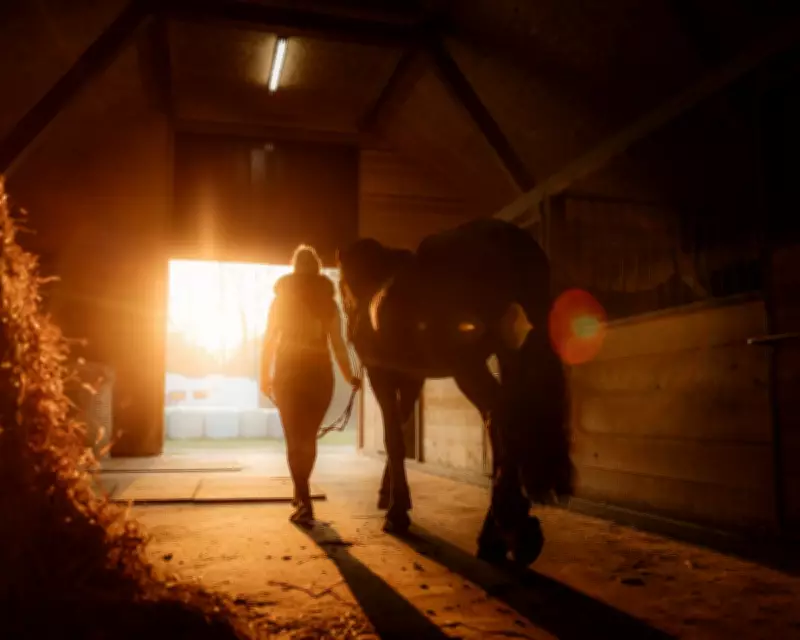
Yet, the stable transforms into a mythical realm, where women form a secretive community akin to a Freemasonry, engaged in rituals of care. The narrator observes, "There are almost fifty horses here, each attached to their own human female," describing scenes of women washing feed bowls, sweeping, and carrying haynets. This environment evokes a sense of ancient wisdom, where the horses are enigmatic beings—both powerful and dependent. The mare, like all horses there, is childless, leaving the narrator to ponder if this troubles them. She reflects, "The horse and I are both grown women but the relationship between our sizes is this: if I got on my hands and knees, I could be her foal," yet she remains unable to fathom the horse's inner thoughts.
Themes of Uncertainty and the Continuous Present
The narrator's notes aim for "a non-structured, non-linear, non-narrative, a collection of impressions belonging to the continuous present." While Mare evolves into a cohesive story, its strength lies in fleeting moments, thoughts, and vignettes that illuminate everyday life through intense, once-in-a-lifetime emotions. The novel balances grand themes with particular details, offering a modest yet profoundly impactful exploration. It may remind readers of animal memoirs like Raising Hare and H Is for Hawk, but it embraces a unique uncertainty inherent to fiction, questioning ownership, the mysteries of others' minds, and the future.
If there is a mystical wisdom among women, it is found in the arduous, unasked-for, and unrewarded acts of love, such as mucking out and soaking feed. These rituals shape reality, offering a glimpse into the profound connections that define human experience. Mare by Emily Haworth-Booth is published by Granta, priced at £16.99, and stands as a testament to the complexities of love, care, and existential searching.