Rebecca Perry's Debut Novel 'May We Feed the King' Presents a Dazzling Historical Puzzle
Poet Rebecca Perry's highly anticipated debut novel, May We Feed the King, published by Granta, offers readers a brilliantly intricate and deliberately confounding exploration of history, power, and perception. This puzzle-box of a book wrongfoots its audience at every turn, challenging conventional narrative expectations while richly rewarding those who approach it with curiosity and patience.
A Dual Narrative of Past and Present
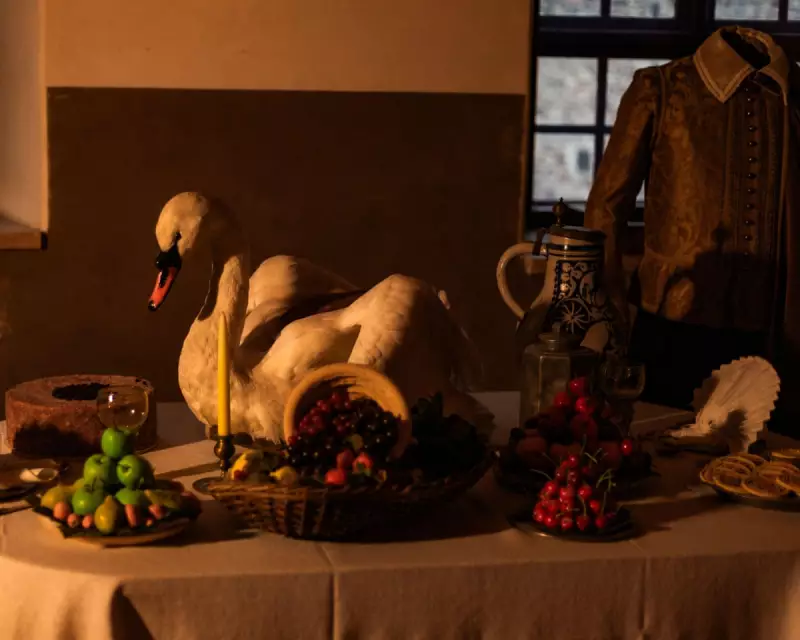
The novel unfolds through two interconnected narratives. In the present day, an unnamed curator of unspecified gender takes up a commission at a historic palace to dress rooms for public viewing following a personal tragedy. This character meticulously recreates royal banquets with historically accurate foodstuffs, even detailing the exact cost of individual pieces like oyster shells priced at £31.25 each.
Meanwhile, in the medieval past, we encounter an unnamed king who reluctantly assumes the throne after the deaths of both his brothers. Temperamentally unsuited to rule and raised as a subject rather than a ruler, he finds himself trapped by the very power he never sought. "The King sees an apple he would like to pick and someone is called to free it from the branch," Perry writes, illustrating the paradox of ultimate authority requiring total personal surrender.

The Architecture of Ambiguity
What makes May We Feed the King particularly striking is its deliberate construction of ambiguity. Perry provides exquisite, almost overwhelming detail about specific elements while withholding crucial information about larger narrative questions. Readers are told everything about the placement of pomegranates beside pies in recreated feast scenes, yet almost nothing definitive about the king's actual reign or the curator's personal history.
When the curator discovers historical records about the king's brief rule, their reaction speaks volumes: "It's important to say that I cried, I wept, when I saw it. What a reduction of a life." This moment encapsulates the novel's central tension between the fragmentary nature of historical evidence and our human desire for complete understanding.
A Literary Experience That Demands Active Participation
Perry, whose poetry has been shortlisted for the TS Eliot prize and who has written about her background in competitive trampolining, brings a distinctive perspective to narrative construction. The novel presents scenes from odd angles and perspectives, with confounding reflections and half-heard conversations. Readers become like ghosts peering into carefully dressed rooms, trying to interpret momentous events from scattered clues.
The narrative structure deliberately frustrates conventional storytelling expectations. As Perry writes through her curator character: "His great gift to us – or at least it has been a gift to me – is the very lack of an ending, that could drive a historian mad. What a great – pardon my language – 'fuck you' to everyone who tries to manhandle ambiguity into order, to knock out the air."
Themes of Power, Knowledge, and Historical Interpretation
At its core, May We Feed the King asks profound questions about how much we can truly know about history, or even about the lives of people with whom we live contemporaneously. The king's growing misery represents the plight of someone having objecthood forced upon them, while the curator's work demonstrates how we reconstruct the past through our own interpretive frameworks.
The novel forces readers to sit with frustration, denying them the certainty and clear resolution they might seek. Instead, it makes us watch our own minds "scrabble about, compulsively putting together the scattered pieces of the past," as Perry describes the reading experience.

A Challenging and Rewarding Literary Debut
While some readers may find the novel's deliberate ambiguity off-putting, those willing to engage with its unconventional structure will discover a richly textured work that challenges assumptions about historical fiction and narrative itself. The final instruction to "Listen for everything and, above all, pay attention" serves as both guidance for the palace visitors in the story and for readers navigating Perry's intricate creation.
May We Feed the King stands as a significant debut that establishes Rebecca Perry as a distinctive voice in contemporary fiction, one unafraid to demand active participation from her readers while exploring the fundamental limitations of historical knowledge and interpretation.