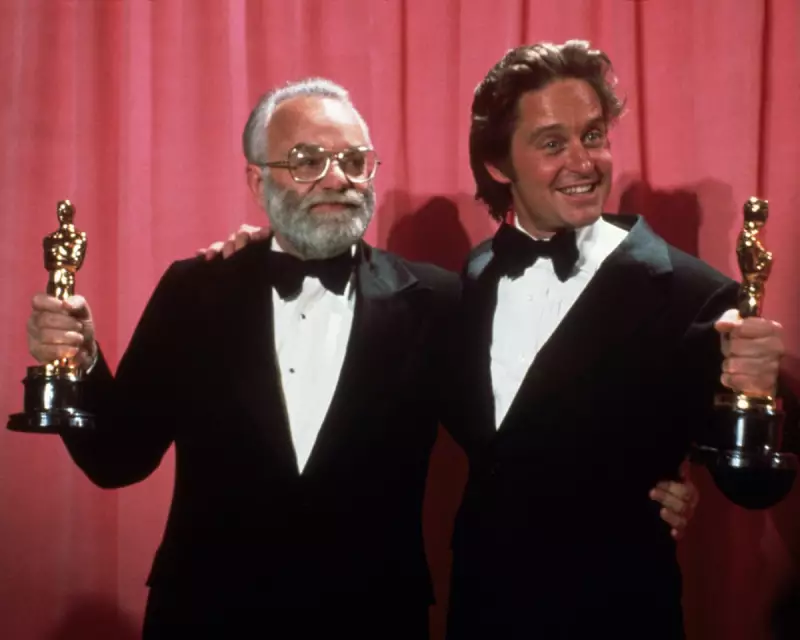
Fifty years after its seismic release, the Oscar-winning drama One Flew Over the Cuckoo's Nest continues to resonate as a powerful allegory of rebellion. Its producer, Michael Douglas, who was just 31 at the time, has revealed intimate details of the film's difficult birth and enduring legacy in a new interview.
A Timeless Tale of Rebellion
Speaking from Santa Barbara, the 81-year-old actor and producer reflected on how the film's themes feel strikingly relevant today. "It's about as classic a story as we'll ever have and it seems timeless now," Douglas said via Zoom. "With what's going on in our country politically, it's about man versus the machine and individuality versus the corporate world." When asked if he was referring to figures like Donald Trump, Douglas broadened the scope, noting a global trend towards autocracy during times of public insecurity.
The film, based on Ken Kesey's 1962 novel, pits the anarchic Randle McMurphy (Jack Nicholson) against the oppressive Nurse Ratched (Louise Fletcher) in an Oregon psychiatric hospital. Douglas first encountered the book in college. "Reading it, and being a hippie at the time, and the psychedelics that were involved... it was kind of a Bible for us," he recalled.

A Father's Legacy and a Son's First Foray
The journey to the screen was long and fraught. Douglas's father, screen legend Kirk Douglas, had acquired the rights after his success in Spartacus and starred in a 1963 Broadway adaptation. After years of failed attempts to launch a film, Kirk decided to sell the rights. "I never thought about producing," Michael Douglas admitted, "but I said let me run with it and he was generous enough and kind enough to let that happen."
His gamble paid off spectacularly, but it came with a personal gesture. Douglas revealed that he gave his entire half of the producing fee to his father, who ultimately made more money from that deal than from any other film in his career. While proud, Kirk was disappointed not to play McMurphy himself, a role that famously went to Jack Nicholson. "The only saving grace," Michael noted, "was when he finally saw the picture he loved it and he loved Jack's work." The success changed their relationship, with Kirk looking at his son "with a new eye."
Casting Serendipity and On-Set Realism
The casting process was filled with fortuitous moments. Danny DeVito, Douglas's oldest friend, was first to sign up. Finding Will Sampson to play the towering Chief Bromden was pure chance. After mentioning the project to a used-car dealer on a flight, Douglas received a call months later: "'The biggest sonofabitch Indian I ever seen walked in the door the other day.' That was Will Sampson." Upon meeting the over-seven-foot-tall Sampson at Portland airport, Nicholson reportedly shouted: "Oh, my God, it's the chief!"
Casting Nurse Ratched proved difficult in the era of Gloria Steinem, as four major actresses turned down the villainous role. Director Miloš Forman eventually discovered Louise Fletcher in a Bob Altman film. The production committed to authenticity, filming in an active Oregon state psychiatric hospital in January, when daylight faded by mid-afternoon. Patients, including some from the criminally insane ward, were hired as crew members. "In the art department we had an arsonist working there," Douglas recalled with bemusement.
This immersive approach extended to the actors. Brad Dourif, who played the stuttering Billy Bibbit, recalled Forman's direction to keep performances natural. Actors spent time in maximum security and attended real group therapy sessions. Dourif developed Bibbit's stutter by practising in stressful public settings like Grand Central Station, inspired by Forman's note that stutterers are "incredibly courageous" because "at the moment they are trying to talk, they are totally alone."
An Enduring Cinematic Triumph
Despite being rejected by every major studio, One Flew Over the Cuckoo's Nest made history by winning all five major Academy Awards: Best Picture, Director, Actor, Actress, and Adapted Screenplay. Steven Spielberg recently stated he would have voted for it over his own film, Jaws, for Best Picture that year.

Douglas credits the film's powerful ending—where Chief Bromden escapes after mercy-killing McMurphy—to a perfect alignment of elements: Jack Nitzsche's haunting bowed-saw score, Will Sampson's performance, and Christopher Lloyd's ecstatic reaction as another patient. "It was one of those pictures where we're firing on all cylinders," Douglas reflected. "My first movie as a producer, it lends me so much information for the rest of my career. I learned so much from that and I'm so proud to be sitting here talking to you about it 50 years later." The film was released on 4K Blu-ray last month to mark its golden anniversary.