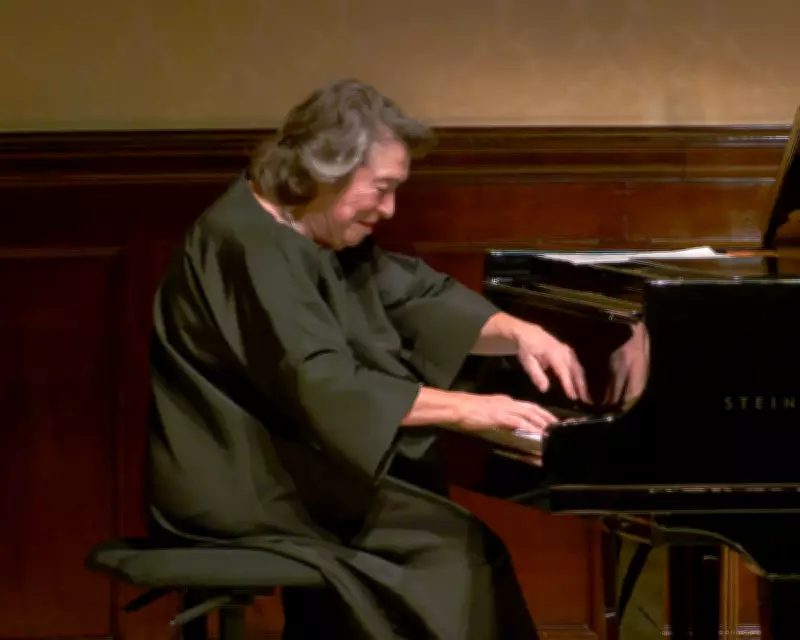
Elisabeth Leonskaja's Architectural Mastery Shines at Wigmore Hall
In a captivating performance at London's esteemed Wigmore Hall, the eighty-year-old piano legend Elisabeth Leonskaja demonstrated why her career spans decades with unwavering acclaim. Her recital programme, featuring a diverse selection from Beethoven, Schoenberg, Chopin, Webern, and Schubert, was not merely a collection of pieces but a thoughtfully curated journey through musical connections and kinships.
A Bold Opening with Beethoven's Op 77 Fantasia
Leonskaja began with a dramatic flourish, launching into Beethoven's Op 77 Fantasia in G minor with the two tumultuous descending chromatic scales executed in a single, seamless gesture. This opening set the tone for an evening where nothing was left to chance. The programme, which might appear as a Mittel-European lucky dip to some, was revealed through her playing to be a meticulously structured exploration of shared musical foundations.
While her expressive and emotional playing immediately captured the audience's attention, it was her unerring sense of underlying architecture that truly defined the performance. This architectural thread, a hallmark of her long career, allowed her to reveal secret connecting passages between the works, creating a cohesive narrative across the evening.

Navigating Fragments and Aphorisms
With works like Webern's Op 27 Variations from 1936 and Schoenberg's 6 Little Piano Pieces from 1911 in her repertoire, Leonskaja skillfully navigated the truncated utterances and half-thoughts that characterise these pieces. In Beethoven's Fantasia, she suggested that these fragments, rather than the later variations, formed the true heart of the composition. When the chromatic scales returned, it was a powerful moment, revealing the music's still-wild and unbroken spirit.
The transition from Schoenberg to Chopin was particularly insightful. Leonskaja subverted expectations by highlighting the lyricism and yearning in Schoenberg's pieces, with No 2 evoking a second Viennese "Raindrop" Prelude. This contrasted with the spiky flurries of Chopin's Scherzo No 1 in B minor, yet she maintained a clear intent throughout, even in passages where the execution was not always pristine.
Thunderous Force and Lyrical Closure
Her performance of Chopin's Polonaise-fantaisie in A flat closed with thunderous force, showcasing her dynamic range and emotional depth. This led into the finale of the programme: Schubert's substantial Piano Sonata in A minor D845, composed in 1825 on the brink of the composer's stardom.
In the slow movement's variations, Leonskaja cherished each note, with her left hand anchoring their lightness and reminding listeners of their kinship with the more robust sections of the scherzo and closing rondo. This sonata provided a sense of completeness in a programme otherwise filled with mosaic fragments, offering a full fresco to conclude the evening.
Insights and Legacy
Throughout the recital, Leonskaja's playing brought new insights to familiar works, emphasising the architectural connections between them. Her ability to reveal the shared foundations of pieces from different eras and styles underscored her status as a master interpreter. The audience at Wigmore Hall witnessed not just a performance, but a profound exploration of musical structure and emotion.
This recital reaffirmed Leonskaja's legacy as a pianist who combines technical prowess with deep musical understanding. Her programme, far from being a random assortment, was a testament to her curatorial vision and artistic integrity, leaving a lasting impression on all who attended.